


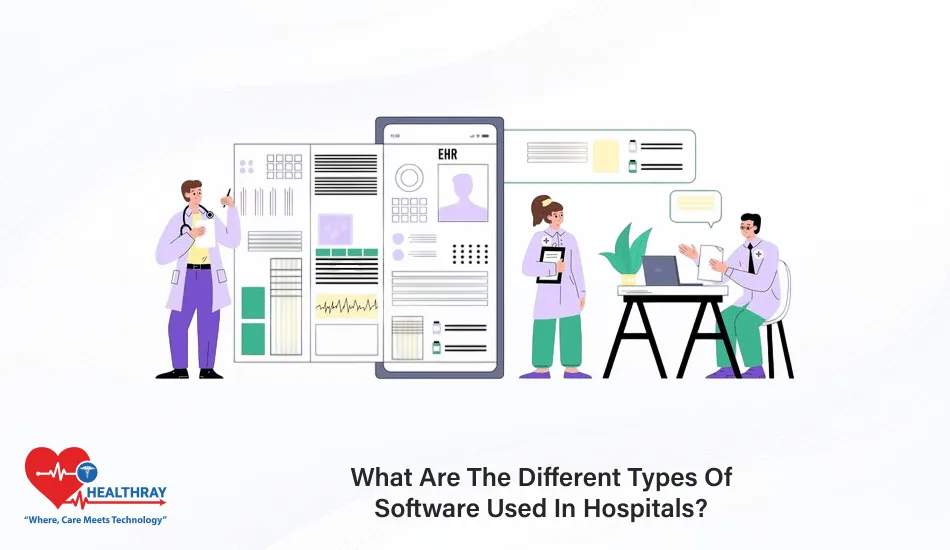

Quick Summary: Somewhere along the line, every hospital has some software applications: Electronic Health Record software (EHR), Picture Archiving and Communication System (PACS), Hospital Information System (HIS), Laboratory Information Management System (LIMS), and many others-all to make health care management more efficient. These tools enhance executive work efficiency, data storage, and patient care.
Introduction
The multibillion-dollar healthcare software development industry has been rising for some time now. And with this lethargy, it certainly does not seem to be on the slow lane. For your information, by 2030, the worldwide industry for IT healthcare providers is expected to pocket more than USD 870 billion!
Digital metamorphosis has affected several sectors, but none so ruthlessly in recent times than the health sector. Hospitals and the medical industry labor force are laboriously using specialized software. Health care operations grease the work of medical professionals, ease cases’ lives, and increase the effectiveness and affordability of the sector.
Pivotal concern of healthcare software relinquishment has arisen for medical associations, the labor force, and businesses. It enables them to facilitate request competitiveness and availability of healthcare services. Choose a good Hospital Information Management System for ensuring smooth integration with other software.
This paper will discuss the primary orders of medical software and their operations in hospitals and conventions. Different medical software solutions have diverse purposes. Select with the directed procedure and software must be based on your requirements.
Identifying the organization’s needs comes first and foremost, then creating a budget for software, elimination of the top-performing computer software found in hospitals, and selection of the right one from those shortlisted. More factors include, but are not limited to, appointment scheduling software, patient portals, patient management systems, revenue cycle management, inventory management, and customized platforms.
List of Most Famous Computer Software Used In Hospitals
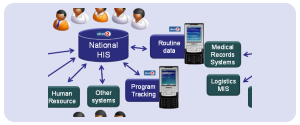
Hospital Management System
This multifarious software system aims to satisfy the need of various interested stoner groups: executive staff, medical professionals, and patients, while the main goal is to bring automation into the internal operation of the sanitarium. An HMS contains two interfaces: the one for clinic administration and work procedures for medical research software and the other for patient commerce.
Hospital operation software covers almost all pivotal clinic angles, starting with the original case contact, treatment plans, and posterior patient-doctor relations. The problem of the hospital and healthcare facilities is that they are complex with manual execution but not with the advanced healthcare management system.
Digital healthcare solutions accumulate client data, crafting visual reports, give excessive data security, boost patient education about healthcare, and join in the smooth flow of work in the routine. Then, a healthy communication bridge is being created for patients with their physicians.
It also helps in forecasting future demand, providing an effective resource to other medical instruments, installations, etc. This software can also drop some repetitive tasks, increase overall effectiveness, and enhance the quality of customer service across the Convention.
Follow-up implementation:
Registration, onboarding, and invoicing of cases
Dashboards and patient doors
Diagnostics operation and digital imaging
Modules for emergency care
Ward and bed management
Telemedicine Software
With no doubt, telemedicine has the fastest-growing divide of the IT healthcare sector. By 2027, the worldwide telehealth market is forecast to reach a value of $285.7 billion.
Online consultation was necessary even before the pandemic; now, it has become mandatory. During times of limited commerce or closure of hospitals, software in hospitals became a necessity for the majority and an excellent solution for people living in remote areas or having some sort of disability.
This is how telemedicine software enables doctors and patients to connect in a secure manner, receive answers to inquiries, schedule consultations, track treatment progress online, or do a quick check-up. Hence, patients save a lot of time and money by not having to visit hospital facilities. With all these advantages, it has become very lucrative for firms developing telemedicine apps.
Features:
Audio and video calls
HIPAA-compliant communication
Everlasting scheduling tasks
Analysis and management of patient records
ePrescription and payment gateway
Electronic Health Record (EHR) Software
The EHR software is analogous to CRM solutions for businesses. But it’s modified to meet the demands of the health sector. It is used by doctors and practices to gather patient data. This EHRs is arguably the most highly used software in medical science. Focus on HRM in Hospitals to maximize its advantages for record management.
The case file for electronic medical charting and electronic health record software encloses all personal patient information, including details about specifics taken at present or in the background, surgeries performed, and related medical history. Physicians can grant associates access to their case records; to alter the database, an appointed doctor is allowed.
Follow along:
Keeping track of cases’ conditions
Schedules that are automated
Document management
Smart conventions
Data analytics and reporting
Health Tracking & Monitoring Apps:
Such healthcare management software includes activities for tracking physical activities and movement, Nutrition and vital sign monitoring, and new internal health and wellness apps. This, undoubted, is the most diverse arena of healthcare software products. Even though these applications do not officially fall into the category of “healthcare software products,” they can still be viewed as a new source of case-generated health data.
Most popular health tracking apps for monitoring operations include those working with wearables such as Fitbit and Apple Watches tracking heart rates, movement, sleeping patterns, and other parameters.
Not only that, but companies are now also making rings, wristbands, and irons, that go above and beyond to help cases with diabetes, gravidity( by covering your body temperature or menstrual cycle), and other conditions.
Features:
User customization
Activity summary for a specified period
Metrics tracking and goal setting
Push notifications
Social and collaborative sharing
Medical Billing Software
This software is used to matter with respect to medical equipment, bills, invoices, insurance claims, and other payments. It is useful for tracking the complete range of financial operations of a medical establishment.
An electronic medical record incorporated with billing software is what a hospital administration system basically consists of. On the other hand, the market also offers specialized details catered to solving specifically this kind of work.
The medical executive staff can allow for tracking of the bills of patients, businesses, and other cash exertions. This is usually housed in larger hospital management systems, such as sanitarium operation systems or electronic health records( EHR).
Features included:
- Claims Processing
- Digital Super Bill
- Eligibility Verification
- Payment Monitors
- Electronic Funds Transfer
Electronic Prescription Software
The electronic prescription software is probably the most famed computer software for hospital use. It is a 3-in-1 software that acts on monitoring previous prescriptions, creating new prescriptions, and renewing or canceling it. Such applications can also give patients the option of ordering any necessary drugs from the specified pharmacy, which is very convenient.
Working with electronic prescriptions is fast and easy. Software of this type can be beneficial for both doctors and patients. The data in that software is kept online; thus, there is very little possibility for data loss.
The imposition of electronic prescriptions in many countries across the globe implies that doctors are now using prescription software. This software allows physicians to track, update, or cancel prescriptions for individual patients. It is also connected to the national medicines reference databases.
Features:
- E-prescribing Applications
- Substance Decision Support
- Calculating Generic Substitutions
- Real-time Drug Interaction
- Patient information and data
Remote Patient Monitoring Software
Remote Patient Monitoring suggests the digital covering of health data about a patient using medical information systems. RPM tools collect patient data and health data and shoot it to a medical guru so they can review it and take applicable action.
As referred to above, RPM allows health authorities to monitor patients in between visits or where face-to-face interaction is not feasible.
Being able to monitor patients almost in real-time, collecting required information, and acting appropriately to resolve new treatment challenges will make these custom software applications the next big thing for the healthcare industry. 24-hour monitoring is the best for all patients who need constant attention, like those with heart diseases, asthma, psychiatric illnesses, diabetes, and hypertension.
Another category of remote case monitoring tools that can be used to track a case’s health over time is wearable technology. These can include further consumer-concentrated bias similar to heart rate and blood pressure watchers, glucose and oxygen position trackers, smartwatches, ECG watchers, and so on.
Features include:
- Real-time health monitoring
- Reporting and data analytics
- IoT device configuration
- Internet-based communication channels
- Patient data security
Medical Diagnosis Software
One of the latest orders of software applied in the health service is medical diagnosis systems. It is an automated environment for rapid and precise clinical diagnosis. Sophisticated medical diagnosis software packages use AI/ML and automation to analyze large amounts of patient health data and arrive at correct decisions. One of these powers, AI, enhances patient care at the same time cuts costs for the parties concerned.
These instruments guarantee the lowest possible human error while assisting the clinician in decision-making. Clinical data analytics, which analyzes patient health records, test findings, and other data points to offer the medical staff necessary recommendations, is the foundation of every medical program. This way, medical professionals are able to identify people more predisposed to illnesses and initiate treatment earlier.
Well-known examples of such software development in the field include chatbots and symptom checker applications.
Features:
- Interoperability for Clinical Practice
- Alerts for Drug Interactions from Computerized Prescriber Order Entry (CPOE)
- Prior Electronic Authorization
- Pattern Matching and Data Correlation
Medical Image Analysis Software
Any instrument utilized to evaluate medical images and render a judgment, compare images of the same case on an interval basis to evaluate the progress of the complaint, and provide prognosis is deemed a medical image-analysis software.
Development efforts are directed toward medical image-processing software that could describe on an image-basis the clinical irregularities found in the clinical images, from CT scans to MRIs to echocardiograms, to thermograms, and much more, with the associated improvement in the logical capabilities of that software occurring along with imaging technology advancement.
Medical image analysis software employs Deep Learning algorithms to read and interpret images. It can sustain high workloads since it can contemporaneously sort through hundreds of prints. It can be trained to detect films with unanticipated results that fast-track radiologist workflow by allowing them to focus on the designated films which have been marked as opposed to sifting through every image.
Features:
- Segmentation and image registration.
- Image quality enhancement.
- Two-dimensional representation.
- 3D modeling.
- Qualitative Imaging.
Personal Health Record Software.
This application focuses primarily on organizing and storing health histories for each family member. Inputting all health records and information in a simple format serves various needs in cases. PHR software will perform optimization work that gives users easy access to their necessary data for monitoring. It is a key component in the entire ecosystem for custom healthcare apps and software development.
Push notifications and analytics will help notify cases of new jobs or changes in their health. A deeper utility could work as a health program to help cases with their conditions and live healthier while saving their data. Particular health record management software can handle it all, from cataloging all the related evidence to customizing health programs and alerting medical professionals to unforeseen emergencies.
Features:
- Implementation of soft version applications and mobile
- Sorting and combining data
- Depository for clinical and patient data
- Modules for summarization
- Individualized telehealth and telemedicine
One of the best healthcare software providers is Healthray!
Discover the best medical software with Healthray, one of the leading suppliers in the field of medical services. Healthray maximizes healthcare performance with state-of-the-art solutions, critical Hospital Information Systems (HIS), seamless commerce with Picture Archiving and Communication Systems (PACS), and innovative Electronic Health Records (EHR) systems. Improve patient care, smooth workflow, and great data operation.
Due to Healthray’s commitment to the skilled innovative work, interpreters can do what they do best-emphasize better case issues. Enhance the capabilities of your healthcare institution with Healthray, reputedly a front-runner guiding the roadmap for innovative software solutions for the contemporary medical terrain. The more you read on Hospital Policy Management Software, the more understanding you will get about these software.
Conclusion
Operations for production of healthcare software are essential for perfecting the processes of operation and delivery of treatment by medical associations. Information technology in the health field provides for several investigative ways whereby clinical wellness and health operations may be enhanced through application of machine literacy algorithms, analysis of data, and digital perceptivity. Giving consideration to all these salaries and opportunities, now is the rightful time to leverage medical information technologies for various health care operations.