


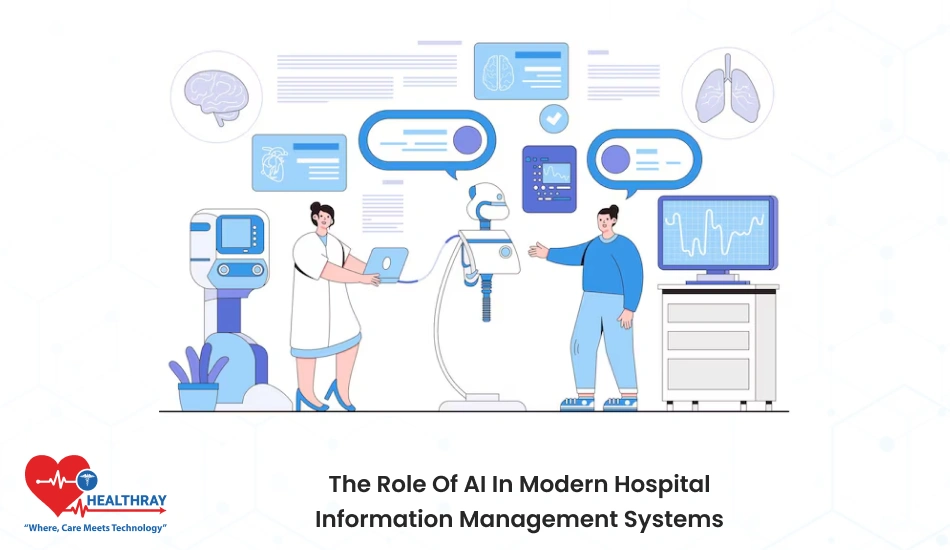

From hospital data management to streamlining operations to improving patient care-delivery-AI is here to stay. Healthcare administrators, IT managers, and policymakers must now fully embrace our latest partner called AI. In this post, we will open the lid to reveal how AI incor-porates into the Hospital information management system, the opportunities for the most efficient use of resources, and possible disadvantages to counteract its benefits. Beyond the accessories and jargon, we will explore some of the areas where AI is already being applied and possibilities of the future.
Benefits of AI Integration in Hospital Information Management Systems
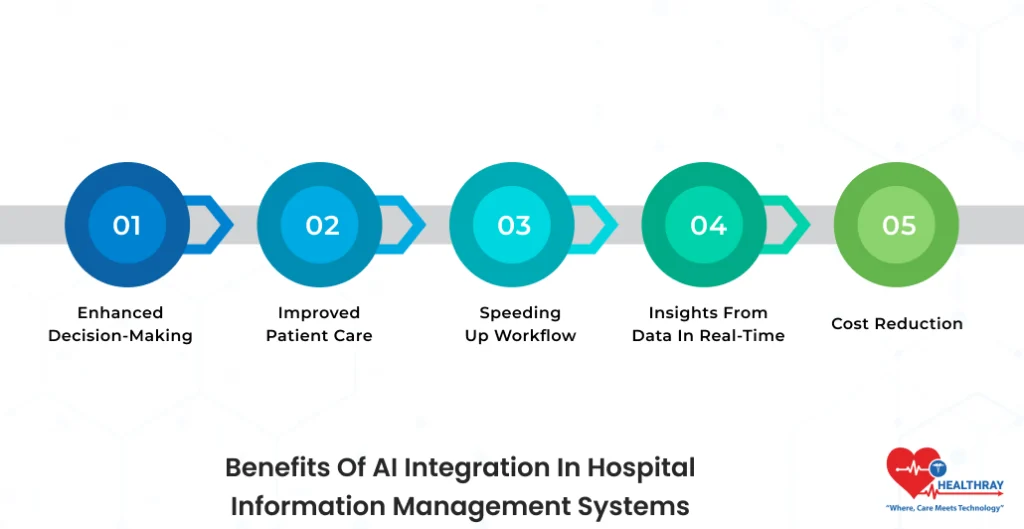
AI is a name that is generating loud footsteps within the hospital administration system; however, It is set to change operational workflows and patient care for the better along the way by making the systems enter into intelligent automation. The main benefits are:
Enhanced Decision-Making
Administrators and clinicians may, therefore, use AI to speed up and improve decision-making. Through predictive analytics, these could include forecasts of patient admission rates to enable better resource allocation for the hospitals. Machine learning models might retrieve existing medical histories related to the patient and recommend tailored treatment plans.
Improved Patient Care
AI systems analyze data on a large scale to individualize patient care. Through the use of chatbots and virtual assistants, patients can receive support 24/7 with answering questions or reminders for their medications, which, in turn, allows healthcare professionals to focus on other critical tasks.
Speeding Up Workflow
AI improves the speed of workflow by automating mundane processes such as appointment scheduling, inventory management, and billing. Reducing human errors ensures that more time is available to pursue care instead of getting lost in managing paperwork.
Insights from Data in Real-Time
Using AI, hospitals analyze real-time data from multiple sources. It can monitor patient vitals and send alerts about any anomalies requiring immediate action. This proactive intervention saves time and improves patient outcomes.
Cost Reduction
The net savings from lowered operational costs arise from the elimination of inefficiency. Administrative costs for manual interventions would be reduced and hence overall productivity increased with automatic systems.
Challenges and Considerations In AI Integration
AI integration will have gigantic possibilities for the hospital information systems; nevertheless, it is often not an easy venture to pull off. The various challenges pose an important consideration that the administrators, IT managers, and policymakers would need to take into account and address to execute a successful implementation.
Data Security and Patient Privacy
AI requires massive and often sensitive patient-data-heavy datasets. In violation of any laws, that would be a disaster. As if that isn’t enough, compliance with privacy laws like HIPAA makes it all the more daunting.
Integration with Existing Systems
Most hospitals already have some legacy Hospital Management Information Software in use. This makes AI integration with those systems often problematic. Compatibility or need for heavy upgrades could easily delay the integration and raise costs.
Initial Costs and ROI Concerns
Heavy initial investment is necessary for full adoption of any AI solution. Hospitals may look hesitant to adopt AI without clear demonstrations of long-term savings or benefits in outcomes.
Training Needs and Resistance
Training of medical and administrative members of staff becomes necessary in AI settings. Slowing down of the transition might arise as a result of resistance to change, which might heighten especially among those who are not used to advanced technology.
Ethical and Legal Considerations
Ethical dilemmas surface with respect to the AI system itself, as the rationale behind AI decision-making is obscure. For instance, the question of accountability arises when the AI proposes a treatment, which fails.
Case Studies: Successful AI Integration in Hospitals
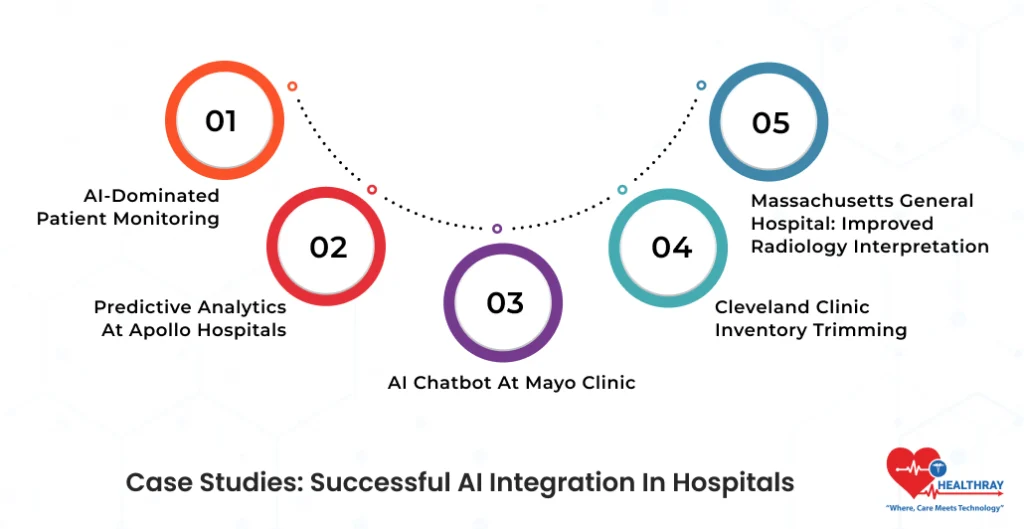
The essence of hospital information management systems is changing all over the world. The case studies highlight the unquestionable benefits and challenges of implementation.
AI-Dominated Patient Monitoring
AI system to track patient vitals and forecast declines in health. By receiving real-time data from monitors, the system is able to preempt issues that may turn serious. This proactive approach has helped augment patient outcomes and greatly reduced ICU admissions.
Predictive Analytics at Apollo Hospitals
Apollo Hospitals uses AI-based predictive analytics to forecast patient admissions. Using historical data, the system predicts patient flow, thus helping administrators better allocate resources. The result was enhanced operational efficiency and reduced waiting time.
AI Chatbot at Mayo Clinic
Mayo Clinic integrated chatbots powered by AI to respond to patient inquiries and appointment booking. Since the chatbots were available 24/7, the burdens on the administrative staff were greatly reduced. Patients were much happier with the administration of their appointments and the speed with which they received answers.
Cleveland Clinic Inventory Trimming
AI was used by Cleveland Clinic to streamline inventory management. The system tracks supply usage, predicts demand, and automates orders. The result is decreases in wastage and costs while always ensuring the availability of critical supplies.
Massachusetts General Hospital: Improved Radiology Interpretation
AI support in interpreting scans was introduced at Massachusetts General Hospital. AI systems highlighted potential abnormalities, thus fast-tracking diagnostic decisions and improving accuracy. The advantage of this technology is reducing the incidence of erroneous diagnosis greatly.
Future Trends in AI for Hospital Information Management Systems
AI is evolving rapidly, promising even more transformative applications into hospital information systems. Here is what is just lurking around the corner for healthcare administrators, IT managers, and policy-makers.
Artificial Intelligence Personalizes Medicine
AI is going to cause a revolution in personalized treatment plans. By taking genetic data and patient histories into account, it will allow for tailored therapies to maximize the chance of successful outcomes with minimal side effects.
Advanced Natural Language Processing (NLP)
As NLP technologies continue to evolve, they will bring in effortless communication with the hospital systems. By the use of advanced voice-recognition technologies, access to patient records system operation, and hands-free data entry are to be activated for physicians, resulting in improved workflow efficiency.
AI in Predictive Maintenance
AI will predict machine failures before they happen, reducing the downtime of a crucial hospital machine. Such predictive maintenance would be cheaper and would eliminate interruptions in patient therapy.
A Blockchain Coalition for Data Security
While AI is concerned mainly with creating actionable insights from data, blockchain will ensure maximum security for this data by creating immutable records, tackling challenges that exist in the realm of storing sensitive patient data.
AI Modelling in Policy Making
AI will be used by policymakers to mine data about trends and outcomes in care, facilitating evidence-based decision-making. AI models will simulate policy change and predict a policy’s impact, allowing for more effective healthcare regulations.
Autonomous Systems in Hospitals
AI-operated self-functioning entities would perform jobs such as disinfecting rooms, delivering supplies, and transporting patients, freeing human resources for more specialized roles.
Conclusion
AI in Hospital information management systems is no longer just a vision or an idea of the future. It is practically here, affecting how hospitals work, take care of patients, and manage resources. The contributions of AI made in modern healthcare define the very basis for decision-making and efficiency in hospital operations.
Nevertheless, several challenges come with implementing AI, namely concerns for data security, complexities for integration, and ethical dilemmas. These domains require an explicit foresight and collaboration involving healthcare administrators and policymakers. The future of AI in healthcare is bright with a trend toward more personalized medicine, pioneering automation, and secure data management. With these developments taken into consideration, hospitals could make strong evidence for the more efficient Hospital Information System, increased patient outcomes, and an improved healthcare design.