




Indeed, we are talking about how artificial intelligence is changing the way healthcare carries on its business by incorporating itself into Electronic Health Records, which is widely recognized as a breakthrough technology. For example, this helps lighten the burden of huge patient data management that is always time-consuming for healthcare professionals and doctors; however, manual inputs are still too numerous even in EHR systems and smart analyses are nonexistent, and AI fills in that gap by making EHR systems smart and efficient tools.
Beyond just automating the routine task, the intelligent system can, among other things, predict patient outcomes, identify people at risk, and streamline flows. This is not without its own challenges during implementation, just like any innovation. High installation costs, data privacy issues, and resistance to change are just some of the mentioned problems that need to be solved.
We will address this article with the various pros and cons associated with artificial intelligence and its introduction into EHR Software. Under our best practices, we will have World examples and actionable takeaways for healthcare professionals, developers, and doctors.
What is AI in EHR Integration?
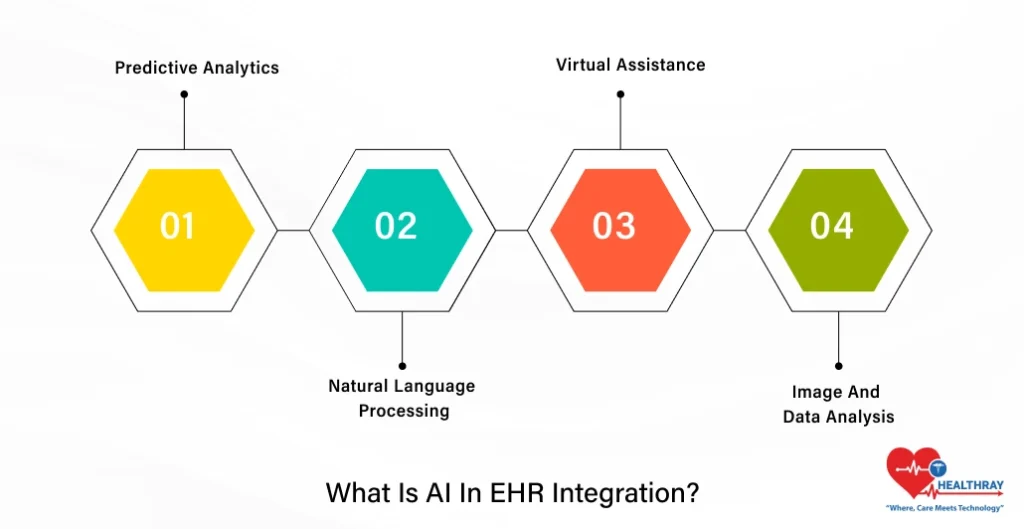
AI in Electronic Health Record integration, which includes advanced algorithms and machine learning models, enhances EHR features and functionality as well as being user-friendly and efficient. Former EHR platforms were mainly digital repositories for patient data, mostly requiring massive manual input and offering little analysis. AI shifts this paradigm making EHRs more intelligent and less user-hostile.
Top AI Instruments in EHR Systems
1.Predictive Analytics: These tools analyze patient history and trends to determine potential health outcomes or risks. For example, finding those patients who are more likely to develop chronic conditions.
2.Natural Language Processing: NLP tools turn disorganized data-like physician notes-into structured formats for easy and clearer analysis.
3.Virtual Assistance: For healthcare professionals, it automates the booking clinical schedules, reminders for patients on appointments, and even some initial diagnosis processes.
4.Image and Data Analysis: AI can process images from medical but also-large datasets to achieve faster and more accurate diagnoses.
Why This Is Important
By integrating AI into EHRs, healthcare practitioners spend less time on administrative dealings, saving more time for patient care. Moreover, doctors will benefit from better support for their decisions concerning the patient’s clinical picture, while developers will come up with even more innovative, connected systems.
Benefits of AI in EHR for Stakeholders
AI integration in EHR systems has massive advantages to healthcare professionals, doctors, and software developers regarding all-out streamlining operations while transforming patient outcomes and opening avenues for innovation.
For Healthcare Professionals
- Less Administrative Burden: Data entry, appointment scheduling, and documentation-the laborious aspects of healthcare-are entrusted to AI, thereby allowing healthcare professionals to devote their time to patient care rather than completing mundane administrative tasks.
- Streamlined Processes: Automated reminders and predictive scheduling add efficiency to processes, reduce time spent in carrying out repetitive tasks, and result in fewer errors.
For Doctors
- Enhanced Clinical Decision Support: AI tools analyze patient data and highlight trends that may raise flags for possible risks while proposing treatment pathways. For example, an alert could fire an indication to the doctor regarding early signals for sepsis based on vital signs and lab results.
- Improved Precision in Diagnoses: Data sets, such as medical images, are opened to machine learning models that allow such reference sources to assist doctors in diagnosing conditions more quickly and accurately.
- Tailored Care Plans: AI enables personalized treatment strategies by analyzing the individual patient history and outcome.
For EHR Software Developers
- Innovation Opportunities: Systems are smarter, more efficient, and predictive through integrating voice recognition and real-time data processing.
- Competitive Market Edge: By integrating AI into Electronic Health Record platforms, the organization improves the competitive edge since the demand for intelligent systems is growing.
- Scalable and Customizable: AI systems are crafted to fit any particular needs of any health facility-small clinics of mainly smaller reach, whereas hospitals are the hubs of their activity.
Real Impact
Beyond convenience to the users, all stakeholders have a potential to enjoy great benefits from AI tools integrated into the EHR system; they can save lives by alerting relevant stakeholders of serious issues much earlier and can relieve burnout due to mundane work and start making crazy advances with the achievement of health-care technology.
Problem of Integrating AI in the EHR Systems
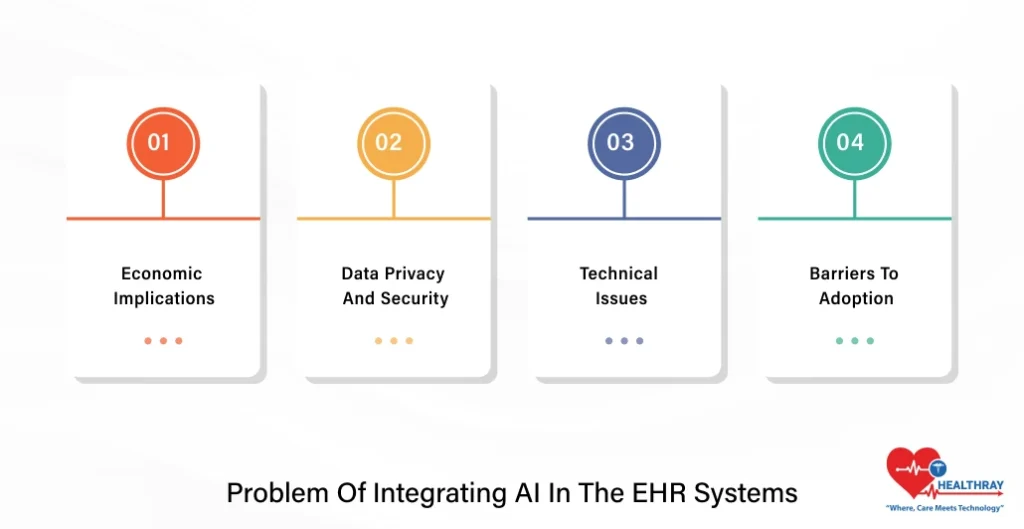
The potential benefits are obvious, but the challenges are profound. A host of issues, including cost, adoption resistance, technical and ethical hurdles, and barriers to the stakeholders’ surroundings, impede progress.
Economic implications
- Heavy Initial Investment-The AI installation in the EHR systems will incur heavy initial costs, from software development to hardware upgrading and training of the employees.
- Maintenance: AI systems require constant updates so as to be effective; all these maintenance activities constitute operational costs.
- Resource Contention: Such technology would fall far outside the already stretched budgets of smaller clinics or healthcare facilities.
Data Privacy and Security
- Sensitive Information: Due to the sensitive patient information stored in EHR systems, they become enticing targets of cyberattacks.
- Legal Framework: Possible legal compliance complexities under enactments such as HIPAA and GDPR surrounding AI integration.
- Trust Deficit: Patients and healthcare professionals’ concerns on sensitive data handling by AI systems shall impede future adoption.
Technical Issues
- Integration With Legacy Systems: Many players are still using old systems that poorly work with new AI integration solutions.
- Data Standardization: The absence of accepted clear formats for data hampers data processing and analysis for AI systems.
- Accuracy and Reliability: Model training requires a great amount of quality data; otherwise, any inconsistency in the datasets will paint an entirely different picture for predictive analysis.
Barriers to Adoption
- Resistance to Change: Some health professionals are not open to responding to AI systems, especially if they consider those systems to be too complicated or too intruding.
- Training Requirements: A deploying strategy for AI-powered EHR systems would require extensive training of the staff, which could disrupt workflow during the implementation phase.
- Usability Problems: Any poorly developed interface tends to frustrate and devalue related AI tools.
For AI’s adoption into EHR systems, concerted efforts among healthcare professionals, developers, and policymakers will be essential in curing these ailments.
Prototypic Examples for AI in the EHR
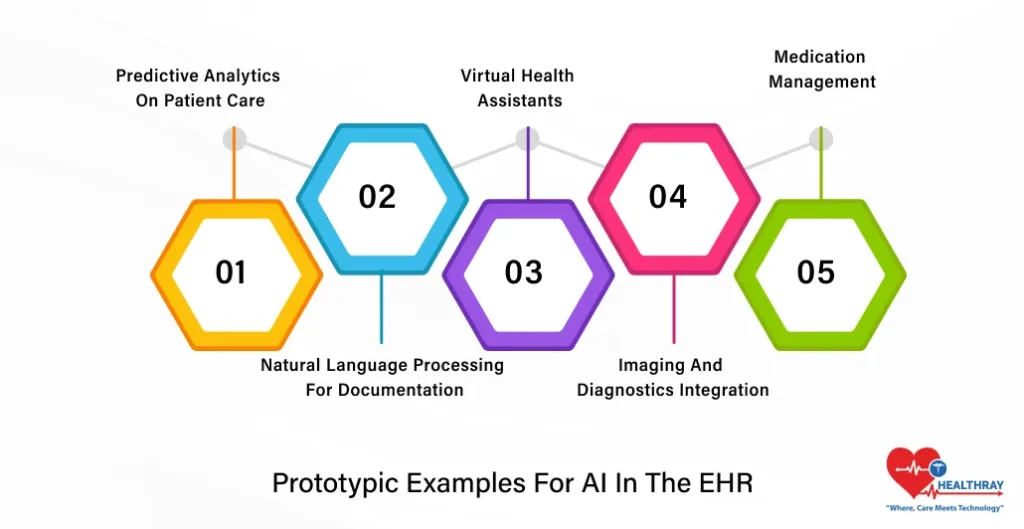
Actual cases testify how it can be actualized in EHR systems through the practical introduction of AI. Such cases testify to AI enhancing areas where stakeholder benefits in productivity are observable, especially patient care, and indirectly into the future of innovations.
Predictive Analytics on Patient Care
AI predictive analytic tools are increasingly being found in many hospitals across various use cases specifically targeting the identification of high-risk patients. Just to mention a few, examples of AI applications include the following:
- Prediction of sepsis: AI models would detect early signs of sepsis through sensor values, lab values, and historical data from the patient, improving the chances of very early interventions by health teams to reduce deaths due to sepsis.
Natural Language Processing for Documentation
The use of NLP tools to speed up clinical documentation by health providers includes some of the interesting pieces of information obtained from unstructured notes, for example:
- Converting conversations between a doctor and a patient into a structured entry in an EHR.
- Making lengthy medical histories much more reader-friendly.
Virtual Health Assistants
AI solutions interface with EHR platforms so that virtual help can perform mundane tasks, such as:
- Scheduling appointments and sending reminders for them to patients.
- Sending text messages to patients to follow up on their health.
- Responding to frequently asked questions to contribute to relieving some of the workload on facility administration staff.
Imaging and diagnostics integration
Supporting radiologists in AI implementation in EHR.
- Examination for indications of cancer through medical imaging, fracture, or any other condition.
- Real-time presentation of imaging reports integrated directly into the patient’s EHR so that it has a unified appearance to the pulmonologist.
Medication Management
Tools listed below are utilized by the facility and pharmacies in AI integrated EHR systems:
- Potential drug contraindications identified by prescriptions for patient.
- Smart pill dispensers within integrated EHR systems to monitor adherence to medications.
Conclusion
Integrating AI into EHR systems would revolutionize the way healthcare is delivered. AI stands to benefit all stakeholders-from doctors to developers- through automating monotonous and cumbersome tasks, improving clinical decision making, and offering individualized patient care. Challenges, however, are the price to be paid for advancement-high costs, security risks, and usability issues.
The best way for most health institutions to use AI in their Hospital Management Systems is to maintain a well-planned strategy. Making small beginnings, involving key stakeholders, and paying attention to the big issues of data security and user-friendly design are indications that smart thinking has gone into implementation. Real-life examples show that this is effort well spent, for AI tools save lives, cut administrative burdens, and make strong improvements in healthcare outcomes.
As the healthcare industry continues to advance, AI-enabled EHR systems will assume greater relevance in the industry. Careful consideration of each challenge alongside adopting best practices will enable these providers and developers to unveil the real potential of this groundbreaking technology.