


Quick Summary
Patient Registration is a determining factor of the whole care process. An efficient procedure will help in minimizing mistakes, delays and patient satisfaction. Using digital tools, automation, and planned out execution of work, healthcare providers can streamline operations, minimize claim denials, and provide quick and efficient care.
Introduction
THE FIRST IMPRESSION: Why is patient registration the most crucial first touchpoint of care?
First of all, registration determines the initial impression of any health facility. Patients come to an establishment with high expectations to get a quick and smooth experience. Nevertheless, the waiting time at the front desk can be very frustrating even prior to consultation.
Paperwork and manual verification still remain the initial contact in most hospitals. Consequently, this becomes a hindrance to operations, as well as affects satisfaction. That’s exactly where modern tools like Hospital Management Software come into play, helping providers simplify front-desk operations and reduce inefficiencies.
A paper based system is a characteristic of traditional systems whereby registration is done on paper thereby creating bottlenecks. The presence of long queues, repetition of data entry, and human error contribute to increased operations.
In fact, studies show that up to 35% of claim denials occur due to incorrect or incomplete registration data. Due to it, hospitals lose time as well as income.
In addition, employees spend additional time on fixing errors rather than attending to the patients. This has the effect of rendering the whole workflow inefficient.
So, what is patient registration process in modern healthcare?
In simple terms, it refers to a structured digital workflow where patient data gets captured, verified, and stored efficiently. It has several capabilities such as demographics, insurance, and medical history incorporated within a single system unlike traditional systems.
Today, a modern registration workflow connects seamlessly with clinical and administrative systems. Due to this, the hospitals attain greater coordination and quicker service delivery.
This guide focuses on practical strategies that help you optimize your hospital patient registration system. You will come to know how to minimize errors, increase speed, and improve patients’ experience using automation, workflow redesign.
Why Streamlining Patient Registration is Critical for Healthcare
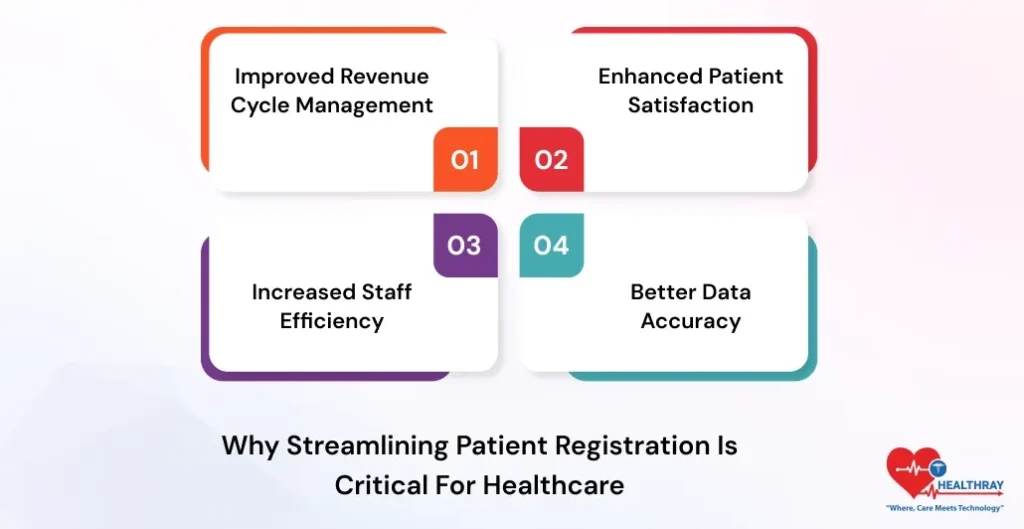
Improved Revenue Cycle Management
To begin with, the enhanced registration process directly increases revenue cycle management. Proper collection of data will make sure that there is proper billing and minimized rejections. When staff verify details upfront, hospitals avoid claim resubmissions. Consequently, the cash flow becomes better.
Enhanced Patient Satisfaction
On top of that, patient registration is convenient and fast through digital means. The patients do not have to fill out forms at the hospital. Rather, they fill in patient intake forms at home. This is a time saving as well as decongesting the waiting room.
 PRO TIP
Increased Staff Efficiency
The other major advantage is the productivity of the staff. A properly arranged registration process eliminates redundancy and lowers the levels of manual work. For instance, automated patient appointment scheduling allows staff to focus on patient interaction rather than administrative duties. Over time, this improves both efficiency and morale.
Better Data Accuracy
Healthcare operations are still based on accurate data. The hospital patient registration system is digital and reduces human mistakes. Moreover, integrated systems validate data instantly, ensuring accuracy across departments. This helps in making clinical decisions as well as administrative.
Key Components of an Efficient Patient Registration Workflow
Pre-Registration
To begin with, pre-registration plays a vital role in modern systems. Patients fill out patient intake forms before visiting the hospital.
This will help decrease front-desk work and accelerate the check-in process. Moreover, it enhances the quality of data as patients would key in their information.
Insurance Verification
Equally important, insurance verification ensures that coverage gets confirmed instantly. This helps to avoid billing problems in the future.
By automating this process, hospitals are able to decrease the rate of claims being denied and to improve their financial results. Hence real time validation becomes a necessity of efficiency.
EHR/PMS Integration
Integration stands at the core of digital transformation. A strong registration system connects with electronic health records and the practice management system.
Because of this integration, patient data flows seamlessly across departments. Doctors can access records instantly, which improves care quality.
Digital Consent & E-Signatures
Lastly, digital consent makes documentation easier. The patients fill in their forms by means of electronic signature, which eradicates the delays in paperwork.
Meanwhile, safe storage also implies adherence and convenient access. This measure enhances the efficiency of the operations and legal security.
6 Actionable Strategies to Optimize Patient Registration
1. Embrace Digital Patient Portals for Online Patient Registration
- As an example, using digital portals patients can register whenever they please. This flexibility lessens overcrowding of the hospitals.
- Also, these platforms will increase accessibility and lead to better patient satisfaction.
2. Implement Real-Time Insurance Verification to Reduce Registration Errors
- Next, automation helps in how to reduce patient registration errors. Active insurance checks resemble real-time and identify dormant policies.
- Consequently, hospitals can prevent billing complexities and enhance the precision of revenues.
3. Standardize Data Collection Protocols as Patient Registration Best Practices
- Consistency matters. Hospitals can guarantee standardized data collection by observing the best practices of patient registration.
- There is no duplication or confusion as is the case with standard templates. This leads to employees performing at a higher level.
4. Enable Mobile Registration Solutions for Better Registration Workflow
- The registration process is made easier with the use of mobile tools. Patients arrive at the hospital via smartphones, thus cutting on waiting time.
- Mobile entry also enhances the movement of patients during the high-traffic period.
5. Leverage Existing Information to Streamline Patient Intake Process
- Hospitals should use replication of previous records as opposed to re-entry of data. The methodology to this question is how to make the patient intake process efficient.
- Repeat patients just update the needed information and save the time of all involved.
6. Utilize AI-Powered Tools for Patient Registration Automation in Healthcare
- Lastly, AI has a disruptive role. Chatbots are used to take patients through automation in the healthcare industry and help in filling online forms.
 NOTE
NOTE
Overcoming Challenges in Patient Registration
Technology Adoption
- Implementation of new tools usually brings resistance to the staff. Most teams are content with the current systems that may not be efficient. Nevertheless, with modern registration programs, work is not complicated, as it should be.
- To resolve this, hospitals should emphasize training and lifelong encouragement. Besides, user-friendly interfaces have less steep learning curves. When employees have confidence, it becomes easier to adopt.
- Meanwhile, investing in HMS Software will facilitate the integration of operations and decrease the reliance on manual work.
Balancing Speed and Accuracy
- It is not that speed is not important but rather that accuracy is what counts. There is a tendency of having incomplete or erroneous data due to a rushed registration process.
- Due to this, hospitals are forced to make a compromise. Digital validation tools are used to provide accuracy and at the same time speed is preserved. As an example, automated checks minimize the omissions and inaccurate entries.
- Therefore, the improved data quality results in the reduction of billing errors and the enhancement of clinical outcomes.
Patient Technology Comfort Levels
- Not all the patients are comfortable with using digital tools. Although younger users are more inclined towards digital registration, other people might require some help.
- Hospitals are, therefore, supposed to provide various choices. As an illustration, assisted registration, kiosks and traditional methods can co-exist.
- This non-discriminatory practice will make sure that every group of patients gets equal care and assistance.
Step towards digital era with our healthcare solution
Revamp your hospital facilities and embrace change for better healthcare management. Ease in managing and organizing large medical datasets leads to effective analysis. Seize the opportunity now!
Measuring Success: Key Performance Indicators (KPIs) for Patient Registration Process
Monitoring performance aids in bettering the healthcare providers. In the absence of quantifiable data, optimization is hard.
1. Registration Error Rate
Error rates are used to show the efficiency of your registration system. A 1-2 percent error is the ideal target that should be pursued by a hospital.
Reduction in errors will also help to reduce claim denials during patient registration and enhance efficiency.
2. Average Registration Time
Patient satisfaction also depends on time. Faster registration process guarantees easy operations.
By cutting the registration time, the hospitals also enhance the patient flow and productivity of the staff.
3. Percentage of Pre-Registered Patients
The percentage of pre-registered patients is high, which is indicative of successful digital advances. Patient registration is done online to minimize the working load of the front desk.
In addition, it increases patient convenience and reduces waiting time.
4. Claim Acceptance Rate
Lastly, the rate of claim acceptance is one that describes financial performance. Clients will have their claims passed first time because the data collected is accurate.
Consequently, hospitals enhance their revenue cycle and minimize administrative overheads.
Transforming Your Workflow with Healthray’s Patient Registration Solution
The strategies offer direction but the implementation demands the appropriate tools. This is where Healthray assists the health practitioners with innovative solutions. Healthray’s system focuses on eliminating inefficiencies and improving front-desk operations.
1. Automated Patient Intake
Healthray eliminates the use of manual processes in favor of digital forms. Patients are able to fill their patient registration at the comfort of their homes via mobile phones. This would make the data clean and quick check-ins. It also makes the experience of staff and patients good.
2. Real-Time Eligibility at Your Fingertips
Healthray has incorporated real-time insurance verification to check insurance immediately. This eliminates mistakes and enhances accuracy of billing. Consequently, hospitals safeguard income and prevent unwelcome rejection of claims.
3. EHR Integration
The site is linked to electronic health records to remove the redundancy of data entry. Employees do not have to change between systems. Also, easy compatibility with Hospital Management System Software enhances the overall coordination.
4. Secure & Compliant
Security remains a top priority. Healthray ensures all patient data stays protected and compliant with industry standards. With this in mind, healthcare providers can focus on delivering quality care without worrying about data risks.
Conclusion
In conclusion, an efficient patient registration system enhances efficiency, precision, and patient satisfaction. Since it lowers mistakes to the betterment of work processes, each change leads to improved results.
In addition to that, embracing digital health could enable hospitals to remain competitive in a highly dynamic healthcare setting. Providers that invest in the appropriate tools open long-term operational gains.
It is time to review your existing registration procedure and find out weaknesses. The activities mentioned above will allow you to change your working process, contributing to the better care of patients and enhancing financial results.
Start free today with advanced booking software for patients and experience a smarter, faster, and more efficient system designed for modern healthcare.