
At 10 am on a Monday, a 100-bed multispeciality hospital receives an admission request. The medical ward has no suitable bed available. Yet the hospital’s monthly report shows an overall Bed Occupancy Rate of just 60%.
The medical superintendent checks the ward records. The surgical department has vacant beds. A few patients in another ward are waiting for final billing and insurance clearance. Some patients have already left, but staff are still preparing their beds.
The owner suggests adding more beds. The superintendent wants to investigate first. New beds mean more infrastructure, equipment, staff and running costs. But will they solve the actual problem?
The hospital needs to know why its existing capacity is not being used effectively. The cause may be patient demand, bed allocation or delays during admission and discharge.
This guide helps you identify the constraint, choose the right improvement and measure the result before investing in additional capacity.
How to Calculate Bed Occupancy Rate Correctly
To make any changes, you will first need to determine what your Bed Occupancy Rate (BOR) is for your hospital. The BOR demonstrates the percentage of available bed capacity that has been used during the specified time period.
Use this formula for monthly occupancy:
Bed Occupancy Rate (%) = (Total Occupied Bed-Days ÷ Total Available Bed-Days) × 100
Consider a situation of a hospital that has 90 functional beds for the duration of 30 days within a month.
| Calculation | Number |
| Functional beds | 90 |
| Days in the month | 30 |
| Available bed-days | 2,700 |
| Occupied bed-days | 1,620 |
| Bed Occupancy Rate | 60% |
Available bed-days = 90 × 30 = 2,700.
Bed Occupancy Rate = (1,620 ÷ 2,700) × 100 = 60%.
This means patients occupied 60% of the available bed capacity during the month.
Count functional beds, not just installed beds.
The hospital may have 100 beds in total, but only 90 beds might be usable for the purpose of admitting patients. The other beds may not be available due to reasons like maintenance issues, lack of equipment, or understaffing.
As per NITI Aayog, “Functional beds” are defined as beds which are maintained regularly, staffed and available immediately for admitted patients. NITI Aayog does not include floor beds, trolley beds, labour room table beds, operation theatre tables, and some observation beds.
For annual reporting, NITI Aayog uses this formula:
Annual BOR (%) = (Total Inpatient Bed-Days During the Year ÷ (Functional Beds × 365)) × 100
In this case, 365 stands for the total number of days in a year, while multiplying the outcome by 100 yields the percentage.
For instance, 100 beds at the hospital are capable of accommodating 36,500 bed-days per year; if the number of bed-days used is 18,250, then the occupancy rate is 50%.
The NITI Aayog district hospital assessment explains this annual calculation.
For monthly reporting, the Indian Public Health Standards (IPHS) guidelines for district hospitals use the number of calendar days in the month instead of 365:
Monthly BOR (%) = (Total Patient Bed-Days ÷ (Functional Beds × Calendar Days in the Month)) × 100
IPHS defines patient bed-days as the sum of the daily patient census for the whole month.
Account for changes in bed availability
Bed availability can change during a month. Suppose 100 beds are functional for the first 10 days, but 10 are taken out of service for the remaining 20 days.
To track the number of bed-days available internally, the following calculations shall be made based on the actual number of beds available for each particular day:
- For the first 10 days: 100 × 10 = 1,000 bed-days
- For the next 20 days: 90 × 20 = 1,800 bed-days
- Total number of available bed-days: 2,800
Occupancy rate when occupied bed-days amount to 1,680:
(1,680 ÷ 2,800) × 100 = 60%.
Using 3,000 bed-days will result in 56%, since it includes the unavailable beds as well.
For official returns, follow the applicable reporting format and bed-counting requirements.
 NOTE
Do not rely only on the hospital-wide average
An overall occupancy figure can hide significant differences between departments.
A study conducted at District General Hospital Matale, Sri Lanka, in 2026 looked into monthly occupancy within 12 inpatient wards for 24 months (July 2024 to June 2026). It found considerable variation between specialities, highlighting why hospital-wide averages may not reflect the actual utilisation of individual wards.
Here is an example of a hospital that can accommodate 100 patients. The calculations will consider a 30-day month without changes to functional bed capacity during this period.
| Ward | Functional beds | Available bed-days | Occupied bed-days | Occupancy |
| Medicine | 30 | 900 | 810 | 90% |
| Gynaecology | 10 | 300 | 270 | 90% |
| Surgery | 25 | 750 | 420 | 56% |
| Orthopaedics | 20 | 600 | 210 | 35% |
| Paediatrics | 15 | 450 | 90 | 20% |
| Overall | 100 | 3,000 | 1,800 | 60% |
For example, Medicine has 30 functional beds, of which an average of 27 are occupied daily.
- Available bed-days = 30 × 30 = 900.
- Occupied bed-days = 27 × 30 = 810.
- Occupancy = (810 ÷ 900) × 100 = 90%.
The overall occupancy is calculated using all five wards:
(1,800 ÷ 3,000) × 100 = 60%.
The difference is important. While the hospital reports 60% overall occupancy, medicine and gynaecology have 90% occupancy, compared with 20% in paediatrics.
This does not automatically mean the higher-occupancy wards are turning patients away. Check admission requests, waiting times and refused admissions to establish whether they are facing capacity pressure.
Calculate occupancy separately for medicine, surgery, paediatrics, maternity, ICU and other relevant units. Compare each figure with admission demand and the type of care each department can provide.
Once you identify where occupancy is low and where departments face pressure, you can investigate the reasons behind these differences.
Why Patients Wait for Beds When Occupancy Looks Fine
The hospital reports low or moderate bed occupancy but still struggles to accept patients who require admission. First, determine the source of the problem whether there is lack of enough inpatient referrals or the availability of appropriate beds.
When most wards have spare beds and no patient requires admission to the hospital, then the problem could be a lack of enough inpatient referrals, and you should look at referrals, OPD activities, and inpatients referred for admission who didn’t go ahead. Determine why they were not admitted and check if they are seeking medical assistance from other facilities.
However, when patients are still awaiting admission and despite the fact that there are available beds, find answers to these operational constraints.
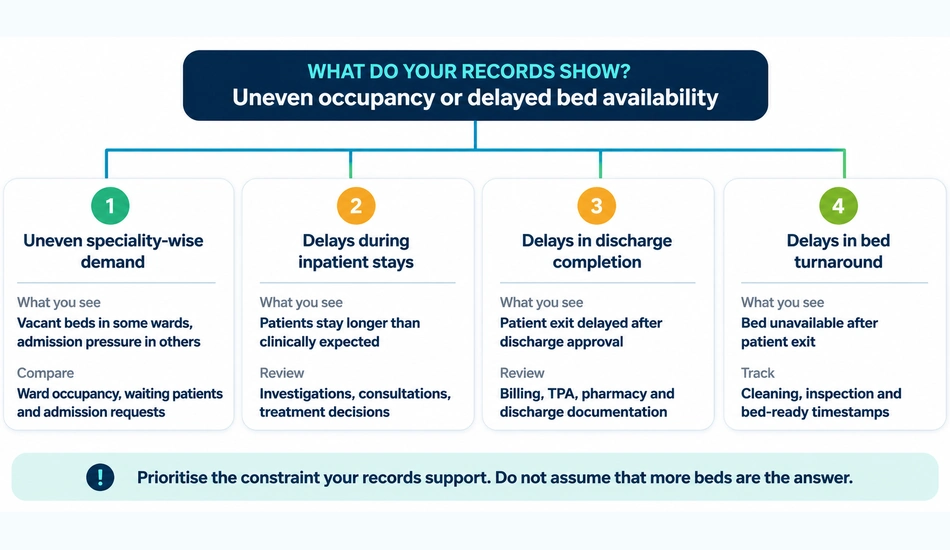
1. Uneven speciality-wise demand: Some departments have vacant beds while others face admission pressure. Compare ward-wise occupancy, waiting patients and admission requests to identify whether bed distribution matches patient demand.
2. Delays during inpatient stays: Pending investigations, specialist consultations, treatment decisions or internal coordination may extend a patient’s stay. Review cases that exceed the expected duration for their clinical condition to identify avoidable delays.
3. Delays in discharge completion: Billing, TPA approvals, pharmacy clearance and discharge documentation may delay patient exit, even after the treating doctor approves discharge. This keeps beds occupied and delays admissions for incoming patients.
4. Delays in bed turnaround: After a patient leaves, cleaning, inspection, or maintenance can delay the bed’s availability for the next admission. Track the time between patient exit and the bed being marked ready.
Use this table to decide what to investigate first:
| What you observe | Records to review | Area to investigate |
| Most wards have vacant beds and few admission requests | OPD, referral and admission records | Inpatient demand |
| Vacant beds in some specialities, pressure in others | Ward-wise occupancy and admission requests | Bed distribution |
| Patients staying longer than expected | Investigation and consultation timelines | Inpatient delays |
| Patients leave late after discharge approval | Billing, TPA and pharmacy records | Discharge completion |
| Beds remain unavailable after patient exit | Cleaning and readiness timestamps | Bed turnaround |
Prioritise the constraint supported by your records. The following strategies address each of these operational issues.
6 Ways to Improve Bed Occupancy Rate Without Expanding Capacity
Each fix below targets a different part of hospital bed management. Pick the one that matches your problem.
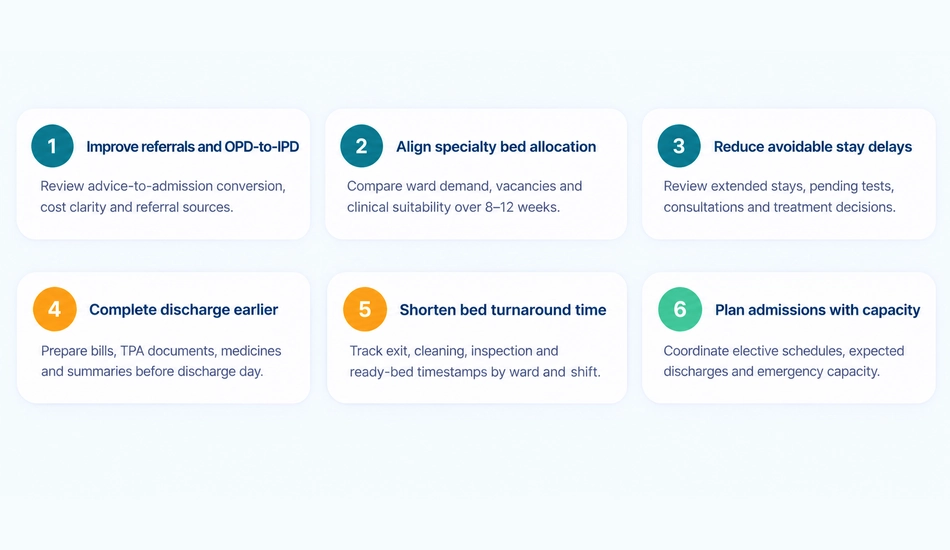
1. Match Inpatient Admissions with Available Bed Capacity
Compare planned and actual admissions with respect to bed availability on a speciality basis. Identify whether suitable beds remain vacant in one ward while patients are waiting for admission in another.
See if the bed distribution is according to the actual need of the patients. In case of a mismatch, see if the available beds can be reallocated taking into account the needs of the patient and staff availability.
Consider the cases of deferred admission as well, and whether they were deferred due to shortage of beds, wrong specialisation, or inadequate coordination between departments.
The idea is to make better use of the available bed capacity while making sure that the patients are admitted to the right ward at the proper time.
2. Align Bed Allocation with Speciality-wise Demand
Analyse occupancy of speciality, available beds, waiting patients and new admission requests. This should be done over a period of eight to twelve weeks, not just in one bad week.
In case the general medicine service seems to be always stretched despite the excess capacity of other specialities, think about redistribution and even sharing of beds across the specialities.
Here there are two ways forward. Either transfer beds permanently to the over-demanding speciality, or establish a shared bed pool that can serve suitable patients from different specialities.
To have the shared bed pool, determine who can use the beds, which nurses will look after them and which consultant will be accountable.
In this way, you take advantage of available beds in one speciality to cater for demand in another, especially when the peak admission times are different.
3. Identify and Reduce Delays During Inpatient Stays
Delays may be caused if the reports are not reviewed immediately, if consultations are not done at the right time, or if patients are not transferred due to lack of coordination.
Start with patients whose stays run longer than expected. Ask the treating team what is holding them up. It could be a pending investigation, a delayed specialist opinion or an uncoordinated transfer.
A short daily review helps. The doctor confirms what is needed. Nursing and support teams follow up on their tasks.
If a patient waits for a diagnostic report, check when it was ordered and when it arrived. Then ask if the delay was avoidable.
The goal is to remove unnecessary waiting. It is not to discharge patients before they are clinically ready.
4. Reduce Delays in Discharge Completion
The doctor may approve discharge. The patient can still wait for the final bill, TPA approval or medicines. Check where time is lost:
- Billing: Are all department charges posted before the final bill is made?
- TPA: Are documents sent and approvals followed up on time?
- Pharmacy: Are discharge medicines ready without waiting?
- Documentation: Is the discharge summary ready for the doctor’s review?
- Communication: Does the family know which payments and formalities remain?
You don’t need to wait for the end of orders before starting any work. Maintain a list in the evening of patients who may get discharged the following morning. Present the list and assign it to each department.
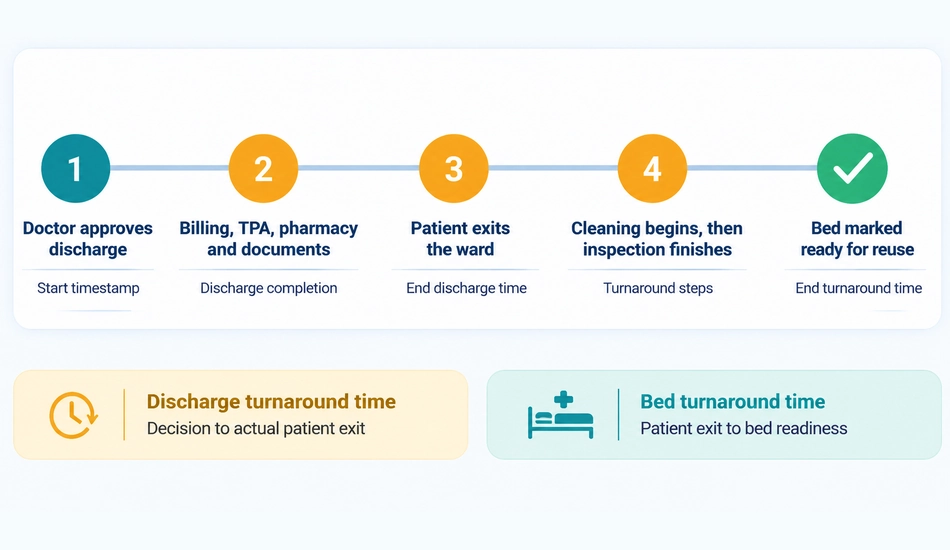
Track the time from discharge decision to actual exit. This stage ends when the patient leaves.
5. Reduce Bed Turnaround Time After Patient Exit
Bed turnaround starts after a patient exits and ends when the bed is ready for reuse. Record four timestamps:
- Patient exit.
- Cleaning begins.
- Cleaning and inspection finish.
- Bed marked ready.
These timestamps help identify delays. Housekeeping may receive the notification late, or inspection may be held up while waiting for a supervisor. Review the cycle for each ward and shift, and assign responsibility for each step.
The ward team should update the bed status as soon as inspection is complete. The admission desk must check this status before allocating the bed. Also, track the time from the admission decision to the patient reaching the assigned bed. This helps identify delays between bed readiness and actual allocation.
Better turnaround contributes to improved bed utilisation. However, do not shorten cleaning or disinfection time to improve the ratio. Infection prevention comes first.
 PRO TIP
6. Coordination of Admission with Bed Availabilities
Prior to scheduling the patient’s elective admission, determine if a bed is available and the availability of other wards for the patient’s discharge, etc. Where there are several surgical cases on the same day, make sure post-operative beds are available in advance.
Use past admission and discharge patterns to plan. Share the schedule with the treating team, admission desk and wards.
An expected discharge does not guarantee a bed at a set time. Also keep room for emergencies. Scheduling every available bed is poor hospital capacity management.
Struggling to Track Available Beds Across Wards?
Get live ward-wise occupancy visibility and manage admissions, transfers and discharge planning with Healthray HIMS.
Which Metrics Should Hospitals Track to Measure Bed Occupancy Improvements?
Comparison of results after a change should be done against the period before the change. The relevant metrics for solving the problem should be monitored, but interpreted as a whole to see the overall impact.
| Metric | What it reveals |
|---|---|
| Bed occupancy rate | Share of available bed capacity occupied |
| Average length of stay | Average duration of inpatient stays |
| Bed turnover rate | Discharges served by each functional bed |
| Discharge turnaround time | Time from discharge decision to patient exit |
| Bed turnaround time | Time from patient exit to bed readiness |
| Admission-to-bed allocation time | Time from admission decision to bed assignment |
Occasional growth could result from an increase in the number of patients admitted. Occasional growth could also occur due to increased lengths of stay. However, the latter should be viewed as a signal rather than a victory.
This principle is applicable to turnover as well because leaving prematurely does not serve as evidence of improved efficiency. Improved efficiency in bed preparation will not increase occupancy if inpatients are scarce.
Comparison should be made between identical units during the same period. Waiting times for emergency cases and cancellations of admissions should also be taken into account.
PRO TIP
What Is a Good Bed Occupancy Rate for a Hospital? Why 100% Is Not the Goal
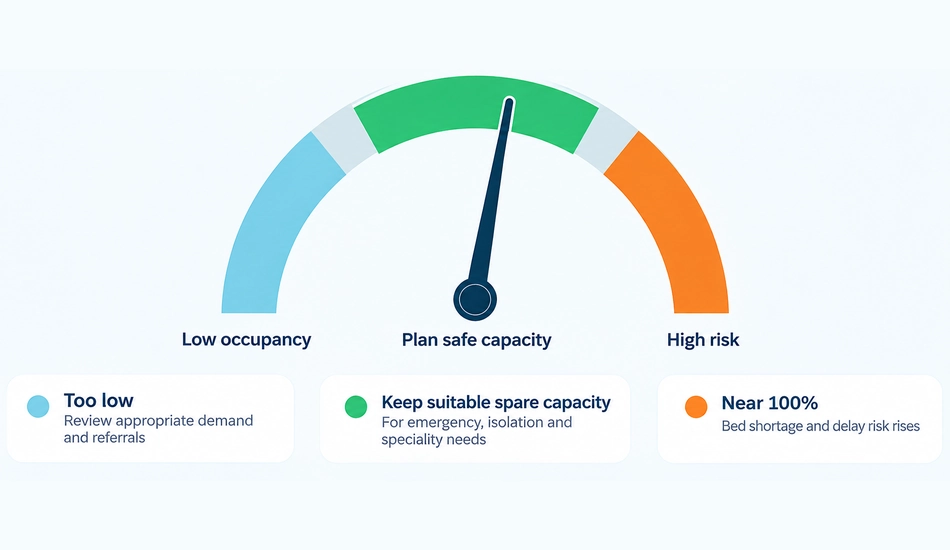
No single percentage suits every hospital. The right level depends on speciality, demand, emergency needs, staffing and resources. Three reference points are often quoted. Each has a different context.
- IPHS norm for district hospitals: IPHS norm for district hospitals: The norm for district hospitals under the IPHS is that of 80% occupancy. It is a benchmark in the public sector and not one for private or multispecialty hospitals. A CAG audit of public healthcare in Chhattisgarh found five of seven test-checked district hospitals below this norm in 2021-22. Two others averaged 137% and 185%, which pointed to too few beds there. So both extremes can be a problem.
- NABH entry-level certification: It requires minimum occupancy of 20%, 25% and 30% at final assessment, first renewal and second renewal. These are eligibility floors, not operating targets.
- OECD: Its 2025 report notes there is no agreed optimal occupancy rate. Around 85% is often seen as a ceiling to lower the risk of bed shortages. This is an international context, not an Indian target.
Why avoid 100% occupancy?
When every functional bed is full, an unexpected admission has nowhere to go. Emergency patients may wait longer. Planned admissions may slip. Staff feel the strain.
Some beds must stay available for emergencies, isolation and speciality needs. Filling every bed is not the same as managing capacity well.
When should you consider expansion?
Think about it when suitable demand repeatedly exceeds your safe, staffed and functional capacity.
First, check three things. Does bed allocation match speciality demand? Have you fixed avoidable delays in stays, discharge and bed preparation? If patients still wait or get turned away because suitable beds are consistently unavailable, more beds may be needed.
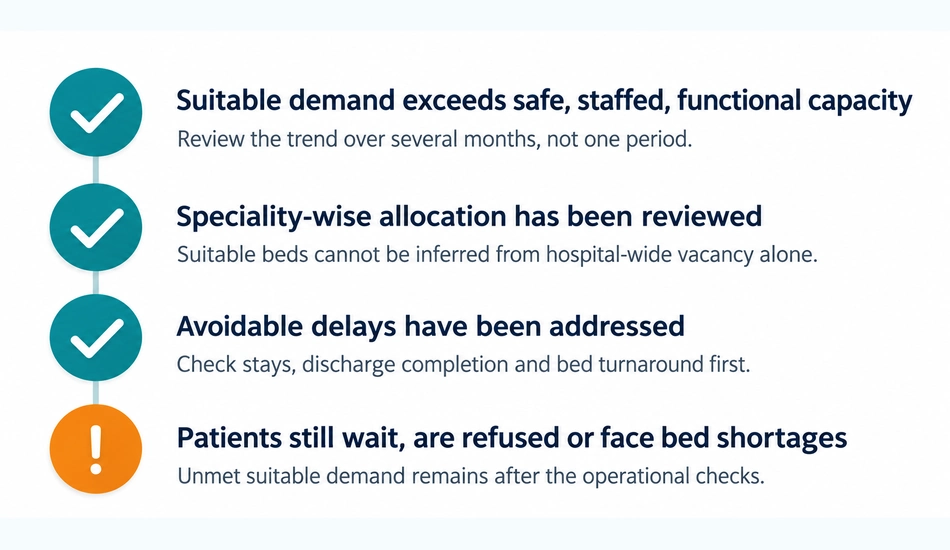
Base that decision on sustained demand and operational records. One month’s figure is not enough.
How Hospital Management Software Helps Monitor Bed Utilisation
Improving bed occupancy is important, but hospitals also need to monitor bed utilisation regularly to sustain that improvement.
Hospital management software brings admissions, transfers, discharges and bed management into a shared view. Administrators can see which beds are occupied, vacant, being prepared or unavailable. Bed management and IPD functions are part of the wider range of hospital management system modules that help coordinate hospital operations.
Ward-wise reports help compare occupancy across departments, while discharge and bed-readiness updates show where delays are occurring.
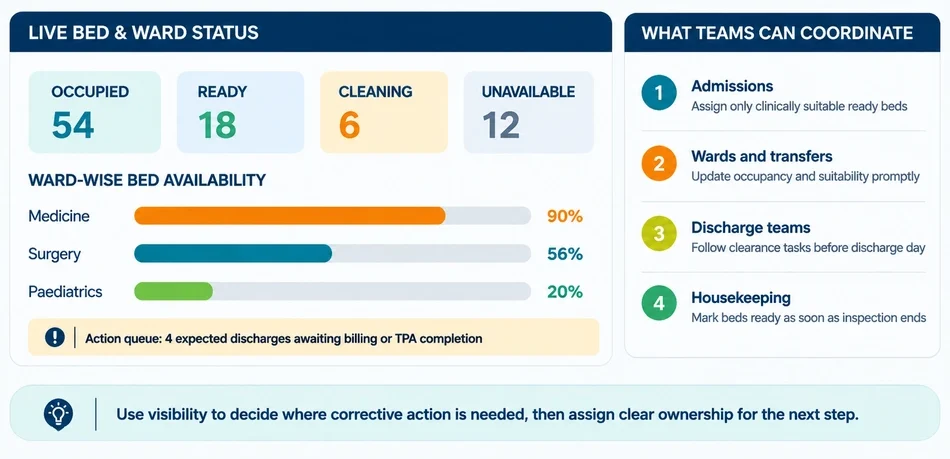
Healthray HIMS supports these workflows through bed and ward management, IPD workflows and MIS dashboards that provide occupancy and average length of stay reports.
Lotus Hospital, a 200-bed multispeciality hospital in Valsad, reported 30% faster bed allocation after implementing Healthray’s Bed & Ward Management workflow. Read the Lotus Hospital case study to see how better bed-status visibility supported coordination during admissions and transfers.
However, software improves visibility and coordination; it does not automatically increase bed occupancy. It cannot create patient demand, provide missing staff or make clinical decisions.
Administrators should use these reports to decide where corrective action is needed. For example, recurring bed-readiness delays may require clearer housekeeping responsibilities, while uneven ward occupancy may call for a review of speciality-wise bed allocation.
Conclusion
A low Bed Occupancy Rate does not automatically mean your hospital needs more beds. It means you need to identify why your existing bed capacity is not being used effectively.
Start by checking whether your occupancy calculation reflects the functional beds available. Then identify the main constraint: insufficient inpatient demand, uneven speciality-wise allocation, delays during patient stays, slow discharge or delayed bed preparation. Address the biggest constraint first and track the results through occupancy, Average Length of Stay, Bed Turnover Rate and patient-flow metrics.
If suitable inpatient demand continues to exceed your safe, staffed and functional capacity even after these improvements, expansion may be justified. Base that decision on sustained demand, ward-wise records and patient waiting patterns rather than one occupancy figure.