


Summary
Are you still relying on conventional approaches to run the lab operations? The time to update your software has come. In 2026, manual systems will not give you productive results. Sample tracking software is now a must; without it, managing client information and their inquiries and offering prompt assistance becomes extremely difficult. As sample volume increases, clinics face challenges with tracking errors, delays, or misplacement risk. Through this software, clinicians can efficiently track sample collecting, different department viewpoints, testing and reporting the final results to patients. They no longer need to assemble reports through emails and manually prepare the final reports. In this blog I will discuss the importance of sample tracking software and how it helps lab technicians minimize errors, improve operational efficacy and provide real-time visibility in lab practices. Keep reading!!!
Introduction
Modern laboratories nowadays are facing unprecedented pressure due to rising test volumes, strict regulatory requirements, and increasing expectations for more precise results. Furthermore, laboratories require complete visibility and real-time control. Every sample is not just a specimen; it represents a complete patient’s critical medical story. If a sample is misplaced, delayed, or handled incorrectly, it has a direct impact on patient medical diagnosis and treatment options. That is why Importance of sample tracking software has become critical in laboratory operations. Traditional manual tracking approaches such as handwritten registers or basic spreadsheets are incapable of handling the modern laboratory operations. As sample volume increases, tracking complexity also evolves in an exponential manner.
Without a structured system, there is a high possibility of a coordination gap that can become the major reason for operational ineffectiveness and turnaround time complications. Laboratory information management systems provide an intelligent solution to circumvent these complex challenges by integrating automation, accessibility, and transparency in the lab practices. Overall, implementing sample tracking software empowers specialists to build a smooth culture and deliver accurate and timely reports to patients.
Beyond Barcodes: Multi-Modal Tracking Evolution
Hybrid tracking technologies
Hybrid tracking technologies are highly powerful and take the sample identification of laboratories’ operations to the next level. Further, LIMS combines barcode, RFID, NFC, or AI-based vision systems to make the operational practices more impactful.
Power of Barcode, RFID and NFC
Barcode provides base identification. RFID immediately recognizes bulk samples without individual scanning. Additionally, NFS is helpful for short-range verification and ensuring highly secure practices in the lab departments. Beyond that, AI vision automatically reads labels without the need to give any manual input.
How does a multi-layered system help labs?
- It eliminates errors
- Enhance tracking speed
- Accurately monitors the sample.
 PRO TIP
Importance Of Sample Tracking Software
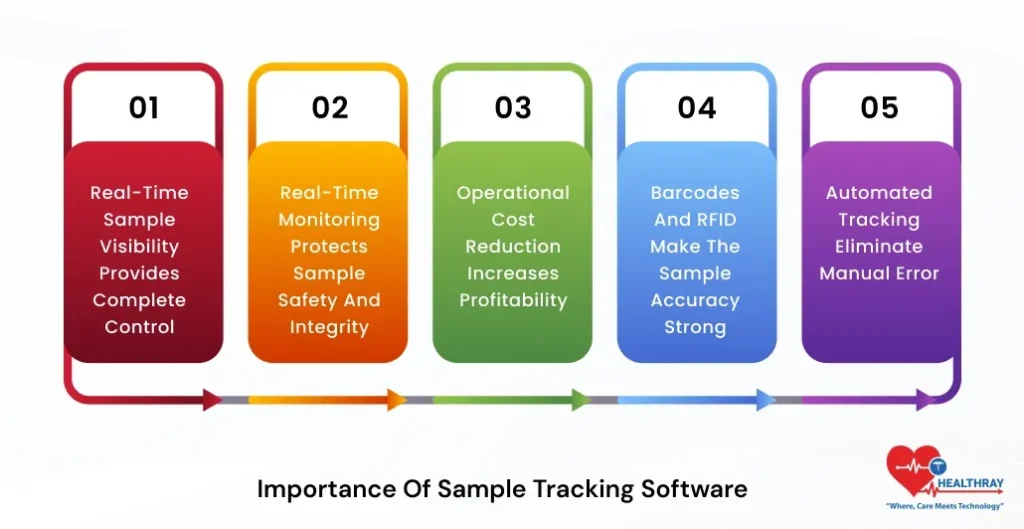
Real-Time Sample Visibility Provides Complete Control
Real-time sample visibility makes the laboratory function completely transparent and accountable. Further, LIMS automatically updates the parameters such as location, processing stage, and current status updates instantly in the portal. It minises the hectic work pressure of staff to manually check the records and enter each piece of information. In traditional software, it takes several weeks to complete the sample tracking procedure; however, LIMS streamlines all the steps. now it takes a few minutes to finalize the reports. Additionally, administrative staff can quickly determine which samples are ready for delivery, in the processing stage, or pending. This visibility prevents delays and improves workflow coordination.
Real-Time Monitoring Protects Sample Safety and Integrity
Real-time monitoring ensures samples remain in safe and stable conditions in every phase. Manual reading often creates confusion and delays the process. The LIMS system constantly measures environmental conditions such as temperature, storage spot, and handling status. Further, the system automatically sends alerts to the team if any abnormal pattern is observed. This allows staff to take immediate action and resolve the issues. Moreover, LIMS drastically minimizes sample spoilage, contamination, and mishandling possibilities. This continuous monitoring provides confidence and empowers laboratories to maintain integrity at every step. Also, support clinics ensure proper test outcomes and accurate patient diagnosis.
Operational Cost Reduction Increases Profitability
Operational cost reduction directly improves the laboratory profitability. Furthermore, it helps lab departments minimize unnecessary labor and inefficiencies in the system. When sample tracking accurately tracks all the samples, it naturally reduces sample misplacement, repeat testing, and wastage. It allows lab divisions to accurately utilize consumables, manpower time, and operational resources. Moreover, staff no longer need to spend time on manual correction or rework. As a result, laboratories achieve faster workflows and keep the operational expenses under control. This organically boosts the overall workforce efficiency and revenue growth.
Barcodes and RFID make the Sample Accuracy Strong
Barcode and RFID technology makes the sample verification highly efficient and dependable. As the lab professional collects the sample, the LIMS system automatically assigns it a unique digital code. Furthermore, digital code represents the complete identity of the samples. It eradicates manual labeling errors and sample overlapping. Moreover, lab professionals can easily scan the sample details and access them. It helps lab professionals ensure they perform the right test for the specific samples. In traditional software, lab specialists make huge mistakes and delay the final approvals. Overall, LIMS improves patient safety and strengthens laboratory credibility.
Automated Tracking Eliminate Manual Error
Automated tracking makes the laboratory procedure smart and flawless by helping clinics continuously monitor the samples. As the sample moves to the next phase, the LIMS system automatically updates all the details. It reduces the work pressure of manual entries, which was previously a stressful procedure. Further, sample tracking software significantly reduces human errors, missed entries, and tracking gaps. Additionally, staff get relief from repetitiveness that drains their energies; now they can focus on analytics that require the highest diligence. Overall, LIMS automation strengthens operational reliability and prevents delays. And ensure that the sample process is successful and risk-free.
Step towards digital era with our healthcare solution
Revamp your hospital facilities and embrace change for better healthcare management. Ease in managing and organizing large medical datasets leads to effective analysis. Seize the opportunity now!
How AI-Powered Label Recognition Eliminates Manual Scanning Dependency?
Computer vision technology makes the sample tracking fully automated and simple to perform. Furthermore, AI-powered cameras or imaging systems automatically detect sample labels and read the sample once the technicians collect the sample. Lims evaded the need to manually scan the sample with a barcode.
They no longer require entering each and every sample detail manually in the system. Moreover, lim software improves tracking speed and minimizes error in the system. System instantly captures correct sample information. Overall, it ensures accurate recognition, seamless workflow collaboration, and accurate monitoring throughout the complete laboratory testing phase. Also read our blog, Role of LIMS in healthcare, to get deeper knowledge.
Intelligent Workflow Orchestration
Machine Learning allows Smart Sample Routing
Machine learning makes the laboratory workflow intelligent and adaptive. Furthermore, ML algorithms embedded in LIMS route the sample to the most appropriate lab specialist. Further, the LIMS system continuously evaluates analyzer accessibility, task load, and sample priority. By analyzing these essential parameters, LIMS makes decisions based on that. Moreover, it helps clinics to rapidly proceed with the sample test procedure. Staff no longer need to wait for other updates and depend on other departments for final approval. Thai smart workflow improves efficacy and reduces turnaround time. Additionally, it ensures laboratory operations run smoothly without creating unnecessary interruptions in the middle of procedures.
Allows Priority-Based Processing
Priority-based processing allows the team to put high focus on urgent and critical samples. In traditional software samples, focusing on critical cases was practically impossible. The disorganized system takes several weeks to finalize the reports. Further, when doctors assign high priority to any test order in the EHR system, the system automatically moves that sample to a fast-track workflow. This evades the need for manual approval; previously, it took several weeks to approve the sample. Furthermore, technicians can immediately identify which sample is urgent and requires urgent attention. Additionally, this approach ensures faster diagnosis and care during emergency cases.
Geo-fencing Makes the Simple Movement Secure
Geofencing strengthens the security of laboratories by establishing clear boundaries for every approach. In traditional systems, sample movements were monitored manually. This enhances the risk of unauthorized transmission or misplacement. Sometimes staff unknowingly move the samples to unauthorized areas; this creates tracking gaps and compliance risks. Further, geofencing-enabled systems automatically define authorized zones and continuously monitor the sample location. Additionally, laboratory system software automatically sends alerts to the team if a sample crosses threshold boundaries. Overall, geofencing enhances the safety of samples, improves movement control and provides complete tracking transparency and regulatory compliance to lab departments.
 NOTE
NOTE
How Does Automated Exception Handling Maintain Sample Safety and Compliance?
Automated exception handling instantly identifies unexpected situations in the laboratory operations. It plays a critical role in controlling it. In traditional systems, unapproved sample movement or tracking gaps are often disregarded. Thus, it enhances the risks of sample loss, mishandling, and compliance violations. Dependency on manual monitoring makes it highly difficult for teams to take timely action.
Further, Advanced sample tracking system automatically detects unusual activities such as unauthorized location modifications, delayed handling, and workflow deviation. As the system identifies an exception, it immediately generates an alert and moves the sample to auto-quarantine status. Additionally, automated exception handling provides:
- Helps in protecting the sample integrity
- Maintain compliance standards.
- Ensure security in every approach
- Provide a fully controlled operational environment.
Learn more: All-in-one Software for Lab Management
Conclusion
Sample tracking software eliminates manual errors and ensures correct sample determination and reporting. Laboratories can instantly monitor every sample location and processing status. It reduces workloads on staff and helps labs utilize the resources effectively. Advanced tracking systems help laboratories to build cutting-edge, adaptable, and future-oriented operations.