



Summary
Modern laboratories are now operating under the pressure of growing sample volumes, increasing patient expectations, and strict reporting timelines. It is crucial for clinics to accurately process the samples and timely deliver the report. But manual paperwork, unstructured procedures, and disconnected systems create errors and more delays. Over time, these inefficiencies reduce workflow visibility and impact the overall lab productivity. In this situation, a laboratory information system provides a centralized and automated platform that streamlines sample tracking, data management, and reporting. This system allows the laboratories to be functional in a faster, more reliable, and more controlled environment. In this blog, I will discuss the top benefits of LIS system and how it helps you achieve 100% success outcomes in a few months. Keep reading!!!
Introduction
Modern laboratories are now operating in a highly demanding environment where speed, accuracy and coordination have become an essential pillar for survival. All samples reaching labs are not just a routine process but are attached to clinical decisions. Doctors depend on timely reports to avoid treatment delays.
Patients expect quick and reliable results and management maintains smooth operation through financial stability. But in ground reality, many laboratories are still encountering challenges with operational disruption, such as report postponements, manual documentation mistakes, misplaced material, and an unbalanced workload. Gradually, these small efficiencies convert into a serious operational breakdown that impacts both productivity and patient trust. As the diagnostic demand grows, these operational gaps become more serious. Technicians spend more time on data browsing rather than productive work.
It becomes difficult for supervisors to monitor workload distribution and administrative staff face constant pressure of reporting accuracy. Over time these inefficiencies create negative consequences on operational viability, service standards, and financial effectiveness. To combat such a situation, clinics should adopt a laboratory information management system. Laboratory Information System provides a standardized, automated, or centralized solution that helps healthcare organizations manage lab workflows digitally. Through this structured environment, laboratories can manage the operations through confidence, efficiency, and consistency.
Best 5 Benefits Of LIS System
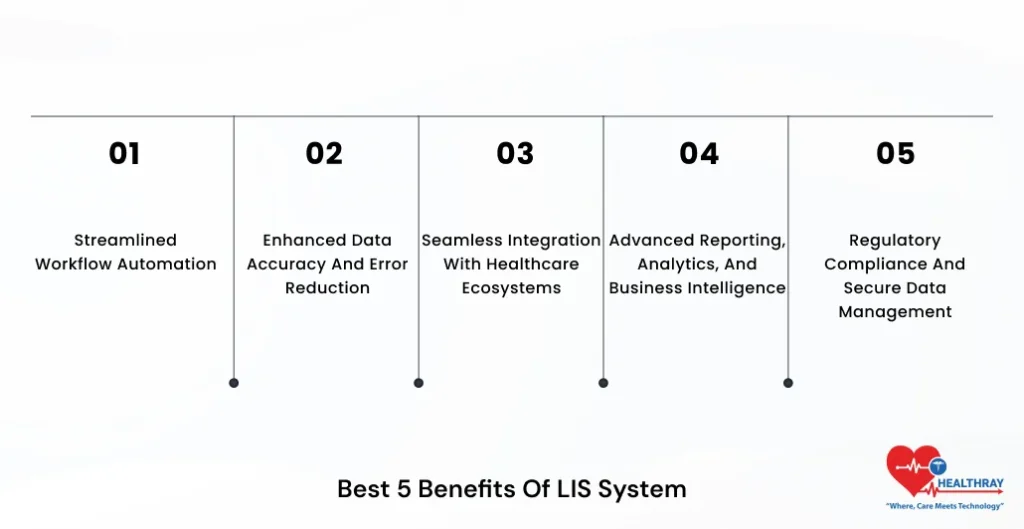
1. Streamlined Workflow Automation
Modern laboratories handle more than a hundred and a thousand samples, such as blood tests, biopsies, cultures, and advanced diagnostics. In traditional systems, lab technicians manage every detail in standardized-format reports. Further, it takes considerable time and naturally delays the process.
1.1 Instant Sample Registration and Real-Time Tracking
When clinics receive the samples, mobile LIMS apps automatically assign them a barcode and register them into a system. Further, it simplifies the complex efforts of sample tracking and also keeps it in a password-protected portal. Moreover, through this structured tracking, technicians can easily determine sample stages, which prevents unnecessary postponements.
Key advantages:
- Through LIMS , samples get instantly visible in the system.
- Lab specialists get real-time alerts.
- It eliminates confusion
- It prevents sample misplacement.
- Staff no longer need to search samples manually.
1.2 Direct Integration with Laboratory Analyzers
In the traditional system, machines generate the results; however, staff still need to add sample details manually in the system. Further, this step is completely slow and highly prone to errors. It helps lab technicians to focus efforts on productive concerns where human touch is still needed.
Through LIS analyzer integration:
- Results automatically get transferred to the system.
- Eliminate labor’s work pressure of manual workloads.
- Results are 100% accurate.
- Reporting process becomes significantly faster.
2. Enhanced Data Accuracy and Error Reduction
In the laboratory system, accuracy is the most fundamental factor. Further, a small mistake can create serious clinical consequences. A misplaced decimal point and inaccurate value entry can lead to a wrong diagnosis. Moreover, in a conventional system, a data entry procedure, report confirmation, and result handling are dependent on human intervention. This makes the error incidence rates naturally high. Over time, this error rate significantly impacts lab credibility, patient safety, and compliance standards. Furthermore, a Laboratory Information System (LIS) through multiple validation layers, automated checks, and confidential audit procedures significantly improves system accuracy. Let’s check other benefits of LIS system:
2.1 Built-in Quality Control Monitoring
It is highly crucial to evaluate the laboratory analyzers’ effectiveness. Further, this will help clinics detect incorrect readings. In manual evaluations, clinics frequently fail to recognize inconsistencies. Moreover, this proactive monitoring helps clinics detect gaps before releasing reports to patients.
LIS quality control features provide:
- Instantly flag out-of-hand consequences.
- Automatically dismiss improper examinations.
- Effectively detect abnormal values
- Thoroughly check inconsistent values
- Constantly evaluate the performance of the system’s capabilities.
2.2 Digital Report Approval by Authorized Pathologists
Manual signature process makes the process slow and secure. Therefore, it is highly imperative to adopt laboratory management solutions to curb such hectic work pressure. Further, the system provides a digital signature where pathologists approve the reports electronically.
Digital approval benefits include:
- Prevent unauthorized report acceptance.
- Allow only authorized people to check the reports.
- Maintain complete accountability in the system.
- Approval process becomes highly fast and completely secure.
 PRO TIP
3. Seamless Integration with Healthcare Ecosystems
In the modern healthcare system, laboratories do not operate in an isolated environment. Furthermore, every lab needs continuous coordination with hospitals, doctors, pharmacies, or digital health platforms. When systems are disconnected, then patient data remain scattered, communication becomes slow and treatment decisions get delayed as well. Moreover, manual coordination leads to an information gap and detrimentally affects both patient welfare and operational profitability.
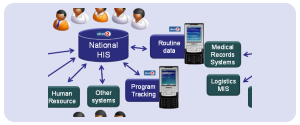
3.1 Direct Integration with Hospital Information Systems (HIS)
Hospitals and labs continuously exchange patient data. Without integration, staff struggle to enter patient details manually. Further, this increases workload and error possibility in the system.
LIS-HIS integration ensures:
- Patient details automatically get reflected in the lab system.
- It eliminates manual data entries.
- Test orders directly reach the labs.
- Enhances the possibilities of lab coordination between hospitals and labs.
- Seamless connection makes the workflow faster and more accurate.
3.2 Unified Patient Records through EHR Connectivity
Through electronic health records integration, complete patient histories are available in a centralized location. Further, doctors can easily review the past records and trends.
Key advantages include the following:
- Instant access to complete patient histories.
- Avoid duplicate testing.
- Doctors can make faster and tangible decisions.
- Continuously improve patient care.
Learn more: LIMS vs Excel: Why Labs Are Losing Money
4. Advanced Reporting, Analytics, and Business Intelligence
Modern laboratories are not just sample processing centers. Further, it has become a knowledge-based operational unit. Every day, the lab generates thousands of data points such as test volumes, turnaround times, analyzer performance, rejection rates, and revenue metrics. Moreover, if clinics fail to utilize this data efficiently, they may lose highly valuable insights. Traditional tools such as spreadsheets provide limited visibility and encourage real-time managerial decisions. Let’s check other benefits of LIS system:
4.1 Centralized Dashboards for Complete Operational Visibility
LIS dashboards display the complete operational picture on a single screen. Further, management no longer needs to check multiple reports from different departments manually.
Dashboards help labs to:
- Track daily sample volume.
- Review test completion statuses.
- Able to identify pending and delayed reports.
- Evaluate the complete operation’s effectiveness.
- Provide real-time visibility to make tangible decisions.
4.2 Custom Reports for Better Performance Analysis
Every laboratory’s operational priorities are different. Furthermore, LIS digital lab software provides customizable software that addresses specific business needs.
It provides insights about:
- Which test results are performed frequently?
- Check lab specialist productivity and performance.
- Which department faces a high workload?
- Sample rejection rates
- Which areas still need enhancement?
 NOTE
NOTE
5. Regulatory Compliance and Secure Data Management
Healthcare laboratories handle sensitive patient data where data security or regulatory adherence is not just an option; it’s a mandatory requirement. Further, regulatory bodies such as data security and regulatory compliance enforce strict guidelines. Moreover, this helps lab specialists ensure patient confidentiality, data integrity, and operational transparency in the practices. Read our blog to know more about lab cost reduction strategies.
5.1 Role-Based Access for Complete Data Control
Manual systems have high risks of unauthorized data access. Hackers can easily steal the data from the server if protection is insufficient. Further, sensitive patient reports and lab data get exposed if access is not properly controlled. Therefore, you need a proper platform laboratory information system to handle such data leakage risks.
LIS role-based access ensures:
- Allow only designated individuals to retrieve the information.
- Pathologists, technicians, or admins have different levels of access.
- It prevents unauthorized inspection and modification.
- It maintains patient data confidentially.
- Significantly reduce data incorrect usage and accidental inefficiencies.
5.2 Strong Data Encryption and Secure Storage
Patient health information is extremely sensitive and cyber threats are continuously increasing. Furthermore, unsecured systems are vulnerable to hacking and data vandalism.
LIS advanced security provides:
- Data gets transferred after getting encrypted. It eliminates the risk of unauthorized access.
- Automatically creates cloud backup so that critical data remain safe and recoverable.
- Prevent data loss from system failure and human error.
- Advanced security layers prevent cyber violations and hacking attempts.
Conclusion
India’s diagnostic sector is rapidly growing, where patient volume is increasing and regulatory compliance is becoming strict. It becomes highly crucial for clinics to maintain faster, more accurate, and more organized operations of laboratories. The laboratory information system is not just software; it has become a complete operational backbone. LIS helps labs to efficiently scale and gain a competitive edge.