

Summary
Role-based access, one of the simplest and the best security measures that spikes up operational efficiency and reduces data breaches. Moreover, 94.7% of businesses follow the zero-trust model and it is considered as the robust authentication system. Let’s understand role-based access in PMS.
Introduction
Do you also want to implement a role-based access system? But in a dilemma, how to do it. And, still troubling how to administer a wide workforce and eye on their activities, which might be crucial nowadays.
And, there is a constant pressure regarding the security implementation. Now, we break the silence and provide an excellent solution, the pharmacy management system that will take over all your data security burdens and reduce most of your stress.
The role-based access in PMS, easy to implement and render the best care practice. Also, it is hard to maintain and replace. Whenever the employee requires any documentation, they would go to the pharmacy management system and ask for permission.
Therefore, the pharmacy management system mitigates operational level complexity and easily tracks permissions continuously.
Critical Elements of The Role-based Access Control
The role-based access is the modern approach to maintain data security and accomplish compliance. Moreover, you should use pharmacy management systems that will help you to render necessary permission and improve complete security. The vital components encompasses :
Resources
You can also say an object rather than resources, these are the electronic files and documents for which the employee required permission. Moreover, the RBAS in PMS maintains such information along with the employee name and time.
Also, it mentions the duration of the document accessibility and other levels of employees except senior level has no permission to any files.
Users
The term is mainly used for employees and agents, who actually want permission to see and edit the document for the specific time period. Moreover, it simplifies the interaction and maintains high-end security.
Based on their job function, automatically grant permission to them. It mitigates security risks and errors.
Session Management
It speaks how much of your time is engaged to a document, seamlessly monitors each and every detail during the session. Moreover, it tells what was edited, how much it is done, and also says about the exact location.
This is perfectly administered for the auditing purpose and also showcases the steps, what was done and how much work is left.
Permissions
The pharmacy management system allows users to leverage the document and file for a specific amount of time period and has the authority to withdraw the permission at any time, if it suspects any unauthorized activity.
Therefore, it assists to know which individual opens the particular document and application. Helps to scrutinize the user activity and several systems are so smart they can detect any fraudulent transactions.
Roles
In the pharmaceutical industry, each and every individual has diverse responsibilities, requiring a diverse range of accessibility. Moreover, there is a hierarchy in the organization that everyone needs to follow. A low-hierarchy employee requires the basic level of permission like viewing documents but who are at the high-level hierarchy requires full-fledged permissions.
Most of the pharmacies have the pre-built roles as per the desired job position and can be assigned several permissions to one individual.
Why Does Security Matters The Most To Pharmaceutical Industries?
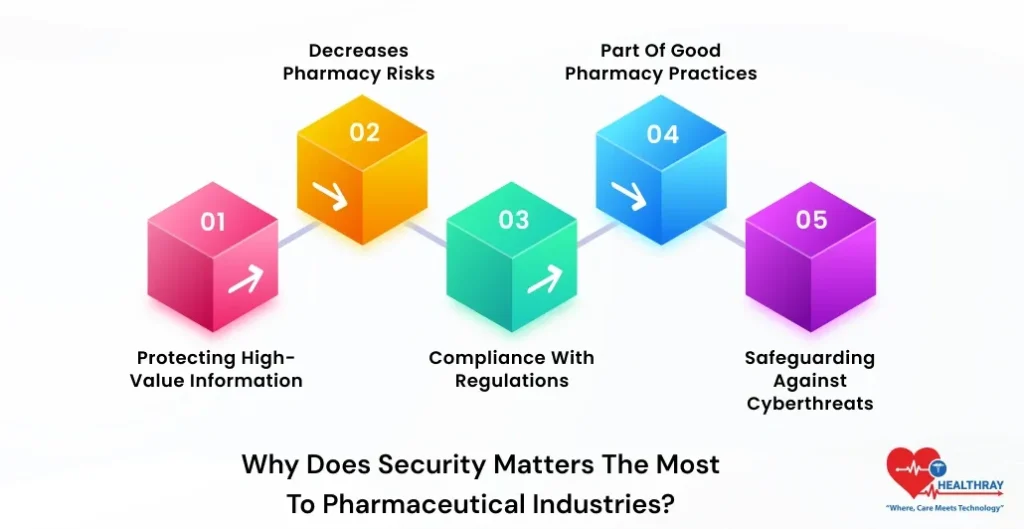
Like other industries, the pharmaceutical industry has undergone several stages of transformation from the past few years and there are lots of security challenges, which may arise in the pharmacies, they suffer a lot in terms of expenses and risks. Let’s check how is it done :
Protecting High-Value Information
The role-based access in PMS or other security measures extensively utilized for safeguarding pharma information and minimizes costs. Moreover, the information encompasses prescription details, stock details, employee details, employee bank details, financial information, and can be managed invoices.
Additionally, it monitors the inventory details, improves patient engagement through PMS, easily traces the expiry date of medicines, and avoids frauds.
Decreases Pharmacy Risks
Accumulates stacks of pharma files such as patient information, inventory details, and bundle of prescriptions, creates high-end risks and decreases efficiency level. Moreover, the pharmacy management system mitigates dispensing errors and hand-written mistakes.
Helps to meticulously monitor the current details and minimizes wastages. Additionally, the PMS avoids data breaches, reduces frauds, and monitors employee duties.
 PRO TIP
Compliance With Regulations
The security measures supported in maintaining information along with pharmacy regulations, reduces the risks level and mitigates pharma standards. Moreover, it prevents patient high-end details and seamlessly controls data accessibility.
Generates a detailed document, which decreases the operational burden and improves documentation accuracy. Therefore, it is better for supply chain management and aids to meet the regulation standards.
Part of Good Pharmacy Practices
When you secure information in a structured manner, it is considered as a good pharmaceutical practice. Administer the inventory and pharmaceutical operations to enhance patient safety standards, improves prescription accuracy, and decreases risks.
Streamlining to monitor the stock levels, ease to do patient counselling, and improves the stock quality.
Safeguarding Against Cyberthreats
Your time and efforts on data security in pharmacies would not go waste, preventing cyber crimes and data breaches. Moreover, the pharmacy workflow automation improves stock safety, increases patient care, and enhances safety standards.
The role-based accessibility and other data measures helps to reduce cyber threats, improves the instrument standards, and minimizes loss.
Step towards digital era with our healthcare solution
Revamp your hospital facilities and embrace change for better healthcare management. Ease in managing and organizing large medical datasets leads to effective analysis. Seize the opportunity now!
How Role-based Access Works Within Pharmacy Management Systems?
In the recent pharmacy world, there is a high-end security of patient information and administering accessibility. That’s where the role-based access comes in. Your subordinates and seniors do any kind of work, they require accessibility with data restriction. Moreover, the whole system of Role-based access in PMS depends upon the following pointers :
Assigned Roles
In the pharmacies, there are various employees and have varied job positions such as pharmacy managers, patient counselling members, cashiers, pharmacy technicians, and more. Furthermore, they require a different level of document accessibility and that power given by the role-based accessibility.
Before that, the pharmacy owner scrutinized their experience and assigned them job profiles. They have different responsibilities and require a diverse level of permissions.
Providing Required Access
Each of the pharmacies have different job profiles and require a varied level of permissions. The admin wants the comprehensive accessibility of modules from prescription, inventory, to finances.
Not only require role-based accessibility but also need two-factor authentication, increases data security and can administer stock management.
 NOTE
NOTE
Immediately Block Unauthorized Person
When any person somehow edited and created pharmacy data, the admin has the power to block unauthorized users and can eradicate the session access. Mainly it occurs when the employee is about to leave the pharmacy, they take the immediate revocation action and restricts all accessibility.
If the threat is suspected, they immediately cancel all employee credentials from log in and passwords. When employee status modifies from inaction to terminated, the superior or HR gets those rights automatically.
Monitoring Each Activity
After assigning permission to employees, the pharmacy management system helps managers to trace each pharmaceutical activity from the single dashboard. Moreover, there is persistent monitoring every 3 months and identifies the suspicious activities.
Additionally, the pharmacy management system helps to review each employees’ activities and what they have done till now.
Discover How Role-Based Access Considered The Best Practices
Pharmacy security is always on top, you can’t avoid it. There are several security measures but role-based access is the most powerful one. Let’s comprehend why it is considered the supreme practices :
- Safeguarding information from internal & external team
- Enhances operational efficiency and scalability
- Streamlined compliance and increases data quality
- Minimizes risks and enhances document accuracy
- Ease to manage permissions
Therefore, the role-based access in PMS mitigates frauds, support in persistent audits, and scales service.
Conclusion
The role-based access in PMS requires high-end data security, improves pharmacy performance, and decreases risks. Moreover, the vital components include resources, users, permissions, roles, and session management. The role-based access protects high-end information, minimizes pharmacy risks, improves good pharmacy practices, and safeguarding against cyber threats. There are several gradual steps such as assigning roles, providing required access, immediately blocking unauthorized individuals, and tracking each duties. It safeguards details, improves operational efficiency, simplifies compliance, reduces risks, and can manage permissions.