



Key takeaways
- AI gets you an edge in finding electrical problems, before they become down-outages or tickets.
- Real-time monitoring enables safe environments for patients, staff, and equipment.
- Tying in AI on your existing systems makes for audits and reports much easier.
- Local electrical experts have the potential to counteract the disconnect between code requirements and AI tools in the field.
What Is Artificial Intelligence (AI) Enabled Electrical Compliance Monitoring?
When you get rid of the buzzwords, AI-enabled electrical compliance monitoring just means this: You use data and software to watch your electrical system all the time instead of checking it once in a while.
In healthcare electrical compliance typically resides on a mountain of standards. NFPA 70 and NEC for wiring and protection. NFPA 99 for Essential Electrical Systems In Patient Care Areas. Then by Committee of Joint Association, CMS, state health department and local inspector.
Traditionally, to meet those requirements, you would have scheduled inspections, manual logs and periodic testing. Someone walks around with a clipboard or a tablet checking panels, testing generators, signing off emergency lighting, etc. It works, but leaves a lot of blind spots in between the inspections.
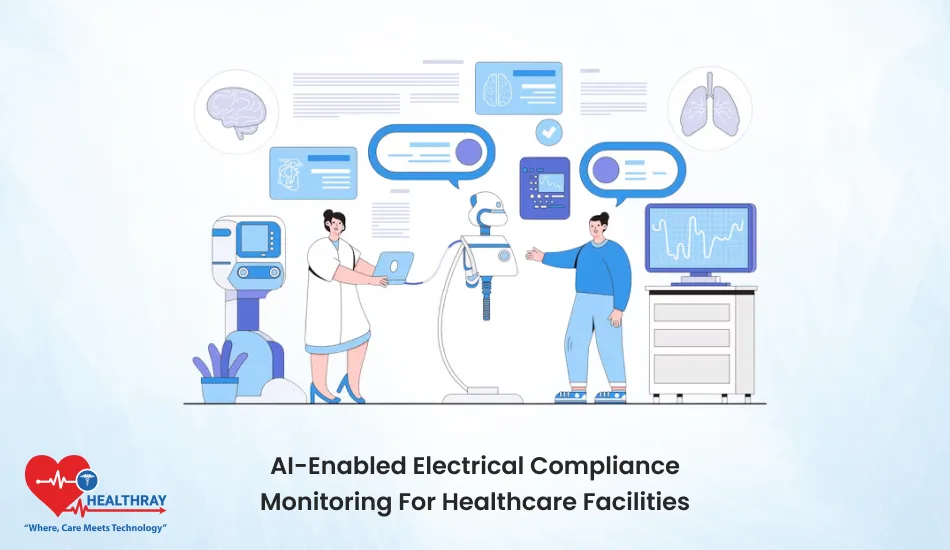
AI changes that rhythm. You install meters and sensors that monitor current, voltage, temperature and breaker status. An AI system takes that data, searches for patterns and flags anything that doesn’t look right. It can alert you in real-time, generate reports, and help you in proving the compliance, without digging through binders.
I remember at one hospital where they used to record (by hand) the monthly panel checks. A critical panel feeding imaging kept running hot but nobody noticed the trend. They only responded when one of the breakers went off during a busy morning. With constant monitoring that pattern would have been noticed weeks ago.
Why Biomedical Electrical Compliance is So Important
If you work in a hospital or a clinic you already feel this. When power blips in an office building, it is annoying. When it blips in an OR or ICU, it is a serious event.
Essentially, electrical systems keep life-support equipment, ventilators, monitors and imaging suites functioning. NFPA 99, and related codes, expel them to separate normal power from emergency power, protect critical branches, and achieve redundancy. When those systems fail, even for a few seconds, staff performance falls, alarms go off and patients are cared for in a haphazard manner.
There is the financial side as well. Studies from companies such as Ponemon and Uptime Institute have put the cost of unplanned data center outages at thousands of dollars a minute.
Healthcare facilities experience similar consequences for slippages in their surgical schedules, Imaging backlogs increase, or pharmacy operations delay. One regional health system I was involved with completed the math which for one major hospital said a single two hour outage, cost them to upgrade monitoring for a full year.
Then you have the regulators and insurers. Joint Commission surveyors pay special attention to your testing records, your generator performance and documentation. State agencies could postpone certifications when they notice recurring electrical problems Insurers may be able to increase premiums following serious incidents.
Life Safety Code and HCFC regulations require facilities to demonstrate ongoing compliance with electrical and emergency power performance during certification surveys, reinforcing the need for accurate monitoring and record-keeping.
On top of that, there is the community trust. When local news reports on an ED diversion when there’s an issue with the power, people remember. The staff remember too. Repeated outages silently prod good clinicians to seek out working more stable places.
How AI Can Help in the Achievement of Electrical Compliance in Medical Facilities
AI is what helps you go from “we checked it last month” to “we know what is happening right now.” That change is important to the compliance issue, because most standards will care more about performance over time than can be seen by a clean report on inspection day. In this context, AI automation where systems autonomously analyze sensor data and trigger alerts or workflows enhances responsiveness and reduces manual oversight, as discussed in insights on AI automation workflows.
You can implement thresholds within the AI model that represent code requirements and design limits. For instance, you can monitor feeder loading in comparison to NEC requirements, or temperature increase in panels that supply critical care areas. When the AI tools identify patterns indicative of overloads, loose connections or repeated nuisance trips they adhere to alerts before they occur or become violations or outages.
Predictive maintenance is a big chunk. Instead of waiting until a breaker goes down or a transformer overheats, the system examines historical data and trends. Maybe taking a generator more time to get stable during testing? Maybe UPS batteries have declining performance. The use of AI in this case is simple, but powerful: It’s a nudge to get you to act early.
I witnessed this play out in a midsized hospital which added monitoring to the emergency power system. Within six months, the number of emergency electrical calls was reduced by 30 percent or so as a result of reviewing their electrical installations to replace the weak components at the appropriate time rather than at 2 a.m.
AI is also beneficial for documentation. Every alarm, test and maintenance action is automatically logged. When a surveyor requests evidence of monthly practices for exercising a generator or transfer switch, you can take a nice, tidy report as proof, rather than rag-together any notes.
Official healthcare facility standards mandate regular electrical inspections, emergency power testing, and documentation as part of Life Safety Code and Health Care Facilities Code compliance, providing a regulatory framework for electrical safety and performance.
The most important use cases of AI in Healthcare Electrical Compliance
You need not cover all the circuits on day one. The best projects begin with a couple of power use cases with high impact.
Emergency power is often the first power. Generators, automatic transfer switches and emergency panels are the backbone of patient safety. With evidence provided by AI-enabled monitoring, you monitor such things as runtimes, load levels, start times and fuel status.
Growing up or working with an experienced electrician, you make observations as to which generators don’t hold up well under load, and which transfer switches are hesitant. Some health system case studies demonstrate that constant monitoring enables halving failure rates of generators compared to facilities that only rely on periodic tests.
Federal guidance highlights that healthcare facility resilience to power outages depends on robust emergency and standby power systems, underlining the role of compliant electrical infrastructure in maintaining critical services.
Another good use case is to support the NFPA 99 and NEC requirements in critical care areas. You can see loads on critical and life safety branches, you can see loads particularly in ORs, ICUs and procedure rooms. If you have certain circuits that keep running close to their limit, the system catches it, and you have a chance to redesign or equilibrate before you run into any kind of real problem.
Power quality is an issue of increasing concern. Sensitive imaging equipment, lab analyzers and pharmacy automation do not like voltage sag, harmonics or transients. AI can be used to correlate faults in devices with power quality events.
I did a job where one particular medical device was constantly breaking. The monitoring data revealed a trend of the dips in voltage occurring at a similar time of day every day related to a large motor starting in a central plant.
You can also get life safety systems into the picture. Fire alarm circuits, emergency lighting and nurse call power can be logged to know they behave as they ought to during drills, rather than just during a drill.
Benefits for Facility Managers, Clinical Teams & Leadership
From the seat of the facility manager, AI is like another pair of eyes in a position that never tires. You get fewer surprises of failures, better visibility across the campus, which not only improves data for capital planning but also reduces the instances of failure. Instead of having to guess which panels or feeders need to be upgraded, you have actual loading and event history.
Engineering teams often tell me that they sleep better when they know there is around-the-clock monitoring on the most important systems. They are still walking the building of course, but there is no flying blind from round to round.
Less obvious ways that clinical staff feel it More stable power in ORs and ICUs means fewer reboots, fewer delays and less frustration. I recall one of my nurse managers explaining to me, half in jest, that our “mystery glitches” on her unit had decreased after the ” hospital had started to monitor the quality of the power.” She was not interested in the artificial intelligence model behind it. She cared that her monitors not go off.
For the executives and compliance officers is the value in risk and proof. You can demonstrate that you are not being reactive when it comes to controlling electrical risk; you are being proactive. When you make an investment case to a supplier for a new generator or a panel upgrade you can show the data instead of the anecdotes.
Surveys from organizations such as ASHE tend to indicate that reliability, safety and regulatory risk are at the top of leadership priorities in the healthcare industry. AI-enabled monitoring gives you a concrete way of making those metrics move in the right direction.
How AI Systems Work with Current Healthcare Infrastructure
One concern that I hear a lot is, “Are we adding another siloed system? It is a fair question. The good news about all of this is that modern artificial intelligence tools will typically integrate with what you already have.
Most hospitals have some level of a combination of BMS, SCADA and CMMS. You can take electrical data and feed it into the BMS to have central visibility, while the AI layer has analytics and alerts. When the system detects a trending overload or abnormal temperature, it can place a work order directly into your CMMS, such that the order appears in the normal workflow of technicians.
On the IT and OT side, there are networks and cybersecurity. Electrical monitoring equipment often exists in a VLAN by itself, providing firewalls and strict access control. You want encrypted connections, role-based access, and get understandable rules about who gets to see what. Recent news on cyber events in healthcare indicate that this is a growing favorite among hackers on the healthcare and cybersecurity front, and you can’t leave this as an afterthought.
Data governance matters too. It is up to you how long you want to retain logs, trends and records of incidents. Some facilities maintain back years of data to support root cause analysis and long term planning. Others cut it down to control storage costs. The key is to be intentional, and document your approach so that it will stand up to audits.
Step towards digital era with our healthcare solution
Revamp your hospital facilities and embrace change for better healthcare management. Ease in managing and organizing large medical datasets leads to effective analysis. Seize the opportunity now!
Roadmap for Implementation of Artificial Intelligence in Electrical Compliance
If you try to do everything at one time, the project will stall. A simple roadmap helps.
The first step when determining your sustainability roadmap is to be able to evaluate your current baseline. Inventory critical electrical assets, review recent incidents, look at where you currently struggle with compliance or documentation. Sometimes only mapping out your key electrical system will come up with surprises.
Second, there are goals and scope. Maybe you start with some ORs and emergency power. Maybe you only concentrate on one building. Set a couple of measurable goals, such as unplanned outage decrease or response time improvement.
Third is to choose technology and partners. Look for platforms that have experience dealing with healthcare, good reporting and security. This is where a local expert can help you to sort through options and match them to your infrastructure. I have seen small establishments begin with a few meters and a cloud dashboard and large and acute-care hospitals build more complex setups on the premises.
Fourth, to design and install Monitoring infrastructure. Layout meter locations, communication paths and panel coverage. Coordinate shutdowns with clinical leaders so that you do not disrupt patient care. Commissioning plays an important role here. You want to test on the electrical and on the data side.
Fifth, train your teams. Show facilities staff how to read dashboards, respond to alerts and tune thresholds In those first few months, it is likely that you will adjust a lot. That is normal.
Finally, scale. Once you have results in one area, you can expand monitoring to satellite clinics, specialty centers and other buildings. Some of the multi-site projects that I have witnessed take two to three years with standard dashboards for the entire health system.
Challenges and How to Overcome them
There are a few bumps every AI project encounters that are predictable.
The budget is usually first. Hardware and software as well as installation costs money. The way around this is by comparing those costs to a realistic outage scenario. When you slap numbers on an unsuccessful surgical day or a failed generator test which is delaying accreditation, the math usually changes.
Change management is another challenge. Some technicians are anxious that AI will take their judgment away from them. I try to be clear, the point of it is to support their expertise, not put it to the side. So long as you get them involved in setting alert thresholds and looking at early results they usually become great advocates.
Data overload can creep in. If you set all of your alerts the first day, people will begin ignoring it. A phased approach is more effective. Focus on high risk circuits and events first. Review alert logs periodically and adjust the rules.
Legacy systems create complexity. Older buildings may not have room in panels for new meters or may be lacking modern communication wiring. I was involved with one older wing where we were forced to get creative in the use of external CTs and wireless gateways since there was no space in the existing gear. Not perfect, it was a big step up from having no data at all.
And, if you anticipate these challenges and openly discuss them, they become manageable rather than project killers.
How an Electrical Contractor in Indianapolis Can Support AI-Driven Compliance
At some point, you need someone who knows both code and real life construction. That is when a local partner comes in.
A qualified electrical contractor in Indianapolis, for example, understands Indiana amendments to the NEC, local utility rules, and how the local AHJ tends to interpret gray areas. That local knowledge is important when you design your metering layouts, select metering equipment and arrange your inspections.
On the practical side, they help you to fit your gear with the appropriate meters, sensors, and communication hardware. They know how to work in areas of active patient care with minimal disruption, which panels can be shut down during the day, and which require work during the hours.
Commissioning is another area for which local knowledge assists. You want someone who will be able to test circuits under load, test readings and make sure that the AI platform receives accurate data. I have been in rooms where the facilities team, IT and the contractor are all watching the first trends live in. You almost can feel the relief when it all lines up.
Over the course of time, that same partner can be a support for periodic reviews. Maybe once a year you sit up at the end of the table for a day, and look at the trends happening, repeating alarms, getting old equipment, and adjusting the capital. The technology is important but the relationship and local context is also important.
Future Trends of AI in Electrical Compliance in Healthcare
Looking forward, I think we will see data tied more strongly to clinical and operational data of AI. Imagine correlating the power events to the schedule of surgeries or throughput of imaging. You may find that there are blocks on a procedure that use certain feeders, or that there are some staffing patterns that affect equipment use.
We will likely see granular monitoring at the device level for high value equipment. Instead of just watching some panel, you watch individual circuits feeding MRI, CT or special lab analyzers. That provides you with more information about which devices or locations are places of introduced harmonics or instability.
Standardization is here to come as well. And as more facilities get moving to continuous monitoring, industry groups will begin to create benchmarks for reliability and compliance. Insurers may provide incentives for facilities which meet certain thresholds. Regulators may not mandate artificial intelligence per se, but they may expect the level of visibility that it may offer.
There is an interesting crossover with AI in healthcare in general too. While the majority of discussion is done with patient data, electronic health record systems and ways to better the outcomes of patients, the same data driven operations mindset is sneaking into the physical side of hospitals. It is all part of a more connected, more measurable environment.
I do not believe every facility needs to be chasing every trend. But keeping an eye on where the market is headed helps you make decisions today that will not work you into a box tomorrow.
Practical Steps You Can Take This Year
If you are looking to transition on this and don’t want to get overwhelmed, start small.
pick one building or one building set of systems, such as emergency power and ORs. Look at your recent incidents and near misses. Where did issues of power hurt patient care or staff workflow the most?
Get facilities, IT and a couple of clinical leaders in the same room. Ask them where they feel the most risk or frustration. You will hear stories that are never seen in official reports.
From there, Sketch a Phased Plan. Phase one could potentially be basic metering and Ai monitoring on a few key panels. Phase two could continue on to the power quality or life safety circuits. Keep the scope loose enough that you can actually be able to make it.
Talk with a cross one that you know is to be trusted and know about both construction and AI-enabled monitoring. Get an approximate budget and schedule. Then, construct a simple business case which compares that-cost to one or two realistic outage scenarios.
If you can do that this year, you will be in a much better position during the next time the surveyor walks in, or the next time your leadership team asks you how you are managing electrical risk.