





Summary
Modern pharmacies face growing pressure to deliver medications faster while maintaining zero tolerance for errors. The manual operations are not able to cope with the growth in the number of prescriptions, the problem of shortages of staff, and the demands of patients. Pharmacy workflow automation directly addresses these challenges by introducing structured, technology-driven processes that improve speed, accuracy, and reliability. The blog describes the role of automation in transforming the pharmacy business and how this technology lessens risk, enables pharmacies to create safer and more efficient workflows, and still retain the human touch.
Introduction
The pharmacies are currently working in an intense environment. The prescription volumes are increasing steadily, patient demands are becoming more acute, and the regulatory control is expanding in such regions as INDIA and USA. Meanwhile, the number of staff is only enough to ensure that pharmacists can handle a particular amount of work regardless of the day. In such circumstances, conventional work processes are unable to produce the same results.
Manual operations often depend on repetitive human effort. Pills counting, prescription writing and inventory checks are a waste of time. As a result, burnout increases and accuracy declines. Even experienced teams feel stretched when demand spikes.These pressures over time reveal loopholes that affect the safety and quality of services delivered to patients.
Pharmacy workflow automation offers a practical solution. It employs intelligent systems, machines, and software to control dispensing, inventory and communication functions. Automation does not supplant pharmacists instead of assisting them. Many pharmacies begin this transition by modernizing their pharmacy management system which provides a stable base on which daily activities are automated.
Notably, automation preconditions the acceleration of operations and their enhanced precision. It is also useful in ensuring that pharmacies divert their attention to patient care, rather than the repetitive processes. With the growth in competition in INDIA and USA, automation is becoming less discretionary and less tactical.
Core Areas of Pharmacy Workflow Automation
Prescription Processing & Dispensing
The workflow automation in the pharmacy revolves around prescription. Automated dispensing systems automatically sort, count and label drugs. Robotic filling systems eliminate relying on technology to manually count and repeat counting. As a result, pharmacies shorten processing time and reduce variability.
Barcode check is a further safety measure. Every drug undergoes scanning prior to dispensing, something that guarantees to match the prescription. This strategy will help in reducing prescription errors with automation and be consistent during the peak hours.
Inventory & Stock Management
Mishandling inventory makes it wasteful, inadequate and exasperating. Automation out of this problem will help by means of real-time inventory tracking. Systems update stock levels automatically after every transaction. Therefore, pharmacists do not need to use manual counts or slow reports.
Automation also supports predictive restocking. Systems predict demand using previous trends when used with AI in pharmacy. The INDIA and USA pharmacies enjoy reduced stockout and expired inventory. Inventory accuracy enhances stability of the operations as time goes by.
Billing & Insurance Claims
Billing mistakes decelerate the revenue cycles and augment workload among the administration. Automated verification checks insurance eligibility and claim details instantly. This minimizes reimbursement and claim denials.
Integration with pharmacy management software ensures accurate pricing, tax handling, and reporting. Consequently, the teams take less time rectifying mistakes and more time attending to patients.
Patient Communication & Engagement
Engagement between patients tends to fall apart in busy times. Automation fills this gap with timely communication. Automated messaging will alert patients when their prescription is ready, refills, and delays.
Digital alerts and chatbots will mitigate the number of calls and keep patients informed. This will enhance satisfaction without the overworking of employees. In the long run, consistent communication strengthens trust and loyalty.
How Pharmacy Workflow Automation Increases Speed and Accuracy
Automation enhances the performance of pharmacy by eliminating conjecture. Barcode scanning verifies medications at every stage. Automated checks ensure the right drug, dose, and patient match before dispensing. The accuracy is much enhanced with this systematized approach.
Parallel processing is a way of increasing speed. As a robot dispenses prescriptions, the pharmacists engage in counseling or verifications. Turnaround times shrink because tasks no longer depend on sequential manual steps.
Automation also enables extended operations. Machines do not tire, which allows pharmacies to maintain consistency during long shifts. In the meantime, employees concentrate on value-added processes and not on routine.
 PRO TIP
Key Benefits of Implementing Pharmacy Workflow Automation
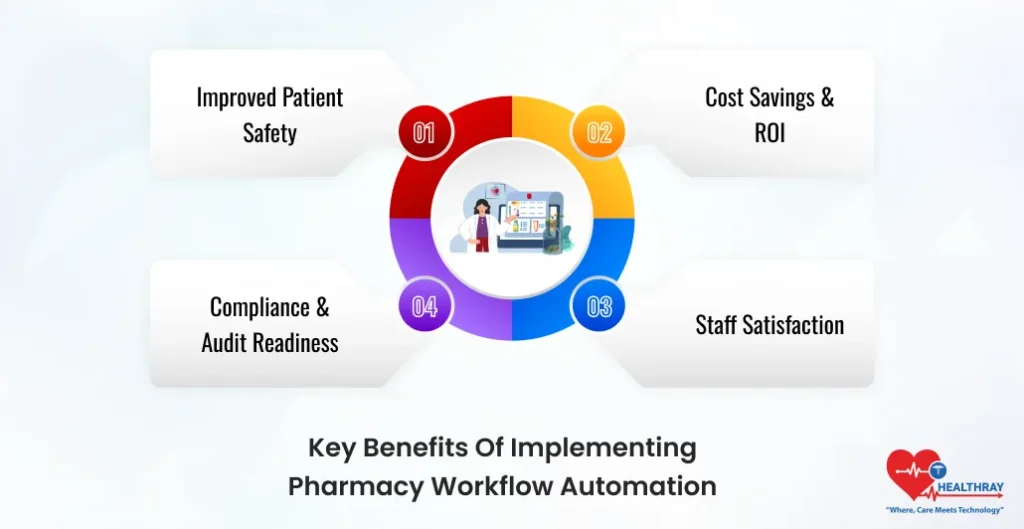
Improved Patient Safety
The most convincing argument of automation is safety. Systematic processes minimize the use of memory and manual controls. Automated alerts flag discrepancies before they reach patients. This method helps in safer dispensing in all sizes of the pharmacies.
Cost Savings & ROI
Automation minimizes wastage, overtime and rework. Effective inventory control restricts out of date inventory. The improved speed leads to pharmacies obtaining more clients without necessarily increasing staff. Over time, these gains improve margins and support pharmacy profit improvement.
Staff Satisfaction
Monotonous labor is a contributor to fatigue. Automation eliminates menial activities in day-to-day life. Pharmacists get back time to do counseling and clinical services. Morale improves as work becomes more meaningful.
Compliance & Audit Readiness
Regulatory compliance demands accurate records. Automated logs track dispensing actions, lot numbers, and expiration dates. This openness makes the audits easier and enhances responsibility.
Best Practices for Implementing Pharmacy Workflow Automation
Implementing pharmacy workflow automation works best when pharmacies follow a structured and realistic approach. Rushing automation often creates resistance instead of results. The best practices assist in the process of achieving a smooth adoption and long-term value.
Step – 1: Start Small with High-Impact Tasks
An effective automation process often starts off with a single routine. At the pharmacies, counting of pills, checking barcodes, and receiving e-prescriptions are often the starting points. These activities take up time on a daily basis and are prone to errors. Automation of these gives fast payoffs and instills confidence in the team.
Step – 2: Evaluate the Existing Workflow Thoroughly
End to end workflow mapping prior to choosing any pharmacy technology should be done by the teams. This exercise brings into the fore bottlenecks, delays and duplication. Once gaps become visible, automation aligns better with real needs rather than assumptions.
Step – 3: Invest in Structured Staff Training
Employee satisfaction is a direct influence on the success of automation. Pharmacists and technicians have a duty to know how to use tools, but why they are important. Practical training shortens the hesitation time and also avoids early productivity slumps in the adoption phase.
Step – 4: Choose Scalable and Flexible Solutions
The pharmacies ought to choose pharmacy automation software that is conducive to the expansion. Cloud-based tools with multi-location support allow automation to expand without system replacement. As a result, this flexibility cushions long term investment and operations stability.
 NOTE
NOTE
The Future of Pharmacy Automation
Due to the presence of technology, it is possible that pharmacy automation will grow. The second step aims at intelligence, accessibility and a more pronounced integration between pharmacy activities in INDIA and USA.
- AI and Machine Learning for Predictive Insights
The systems powered by AIs examine prescription patterns, seasonal demand, and patient behavior. The insights aid pharmacies to predict better stock requirements and manpower, while auto post systems can automatically share inventory updates and health alerts with patients. In the long run, this eases the shortages and over-stocking and aids better planning.
- Advanced Robotics for Community Pharmacies
Robotics has ceased to be the asset of big hospitals. Small pharmacies work with new short and cheap robotic dispensing, packaging, and sorting systems. All in all, the tools enhance speed without the necessity of significant space or other infrastructure.
- Telepharmacy Integration for Expanded Access
Telepharmacy reaches out to rural and underserved regions. Remote verification, counseling, and prescription processing is facilitated by automation. This model enhances access and does not compromise the safety and compliance standards.
With increased rates of acceleration in innovation, automation enhances the pharmacy technology ecosystem in INDIA and USA. It is evident that in the future, pharmacies that combine intelligent systems and human competence are successful.
Step towards digital era with our healthcare solution
Revamp your hospital facilities and embrace change for better healthcare management. Ease in managing and organizing large medical datasets leads to effective analysis. Seize the opportunity now!
How Healthray Does Pharmacy Workflow Automation
There is one belief that Healthray has towards pharmacy workflow automation. Automation is not supposed to make the work more complicated. Rather than trying to transform the pharmacies into a different form of operation, Healthray concentrates on step by step, practical improvements that can be implemented in the real world of operation in INDIA and USA.
Healthray centrally develops automation based on the daily pharmacy realities. The prescription intake, dispensing, billing, and inventory work collaborate within one system. This integrated solution eliminates data silos and decreases paperwork. This makes the teams work quicker without the loss of control.
Visibility is also highlighted by Healthray. Pharmacists are able to see prescription status, inventory levels and alerts in real time. This can be attributed to the fact that this makes teams quick to respond during peak hours. In addition, intelligence is built in to encourage smarter decisions without straining employees.
Automation blends with the existing working processes. Pharmacies do not have to make a total replacement. Rather, through Healthray, automation can be scaled due to increasing confidence. This point of flexibility encourages the stability of the long term and not a short term disturbance.
Notably, Healthray is a technology-driven care company. Automation works with repetitive duties, but pharmacists remain concerned with interacting with patients. Such a balance enhances trust and increases the outcomes in community and hospital pharmacies.
Conclusion
Pharmacies are no longer operating in a predictable environment. The increasing amount of prescriptions, stricter rules, and increasing expectations of patients transform everyday operations. In such circumstances, pharmacy workflow automation will be a necessity and not a luxury.
The automation helps in improving accuracy because it eliminates manual guesswork. It enhances faster speed because it simplifies repetitive procedures. It also facilitates safer dispensing through checks arranged in every step. Together, these benefits help pharmacies reduce medication errors while improving service consistency.
Meanwhile, automation helps the staff to feel good. Pharmacists are able to reclaim time in counseling and clinical activities. Groups are not under stress at their best times. In the long run, this equilibrium enhances retention and performance.
The moral of the story is not that complex. Technology is effective when it serves human beings. Pharmacies investing in structured automation today are planning sustainable growth in the future.
Request a free demo and understand how Healthray analyzes your existing workflow and pinpoint one area that can be automated. Even a short-term gain can be achieved because of a small step today.