


Summary
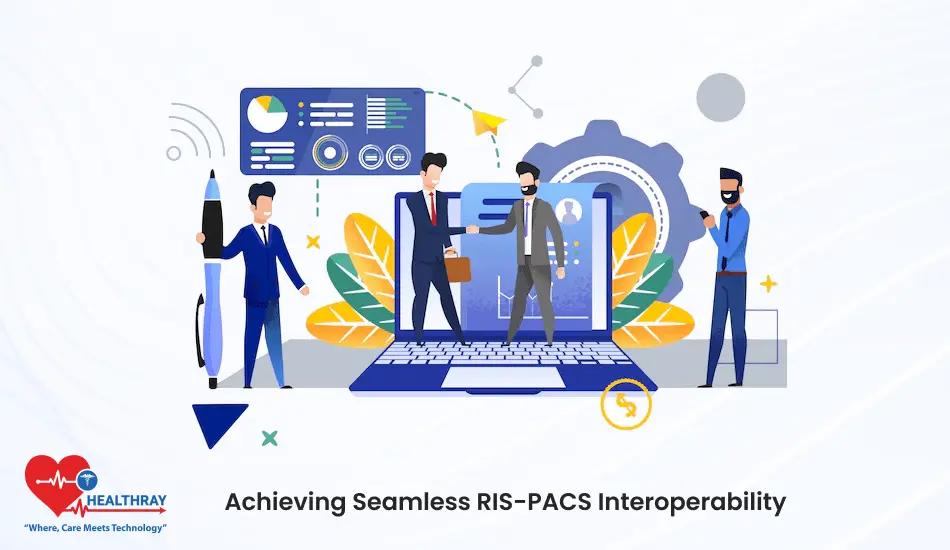
In the fast-paced field of medical infrastructure, the PACS and RIS are the big game-changer in the radiology workflows.They play a critical role in collecting and analyzing patient medical images, administering operational work, and making diagnostic decisions. The RIS-PACS interoperability makes it possible for you.
Introduction
Radiology is an inevitable part of the medical eco-system, you can’t ignore this department and continuous improvement is the utmost necessity. Might you be acquainted with the PACS? It is connected with the diverse modalities, receives the radiology images and then the print out in the hardcopy.
With the evolution of radiology technology, the PACS server integrates with the radiology information system (RIS). Therefore, they eliminate the manual human process for creating radiology reports like CT-scan, MRI’s and mammography. They both work with each other meticulously and augment the rate of diagnostic efficiency.
The radiology information system (RIS) directly receives the radiology images from the PACS server, reducing the labour costs and saves time. The PACS is responsible for handling and scrutinizing radiology images effectively. On the other hand, the radiology information system (RIS) centralizes the patient’s demographic and medical images.
Let’s discuss more about the seamless incorporation with the RIS/PACS system, how they work with each other and enhancing radiology workflows.
Understanding The RIS and PACS System
PACS: E-Heart of Radiology Images
- A smart e-imaging technology, replaces the traditional physical-film based approach for creating radiology reports, seamlessly collecting and sharing medical images.
- Built for the purpose of administering healthcare images from distinct modalities like MRI’s, CT-Scan, and X-ray.
- Allows radiologists and doctors to instantly retrieve imaging records from anywhere, decreases manual labour work and increases speed.
RIS System: An Unified System For Radiology Excellence
- An exceptional radiology platform – seamlessly executes the radiology workflows from patient appointment, registration process to insurance claim management.
- Consolidating the entire radiology centre information in one place, making it smoother to retrieve and analyze medical images.
- Generating the business intelligence reports, depicting information into the bar-chart, line, and pie-chart format.
RIS-PACS System: What Happens When They Combine?
Streamlining to record medical images and analyze it properly, improving the intricacies of radiology and support diagnostic excellence. Moreover, RIS and PACS are the vital ones, which are the leading heroes in the back of scenes.
RIS server for managing the department whereas the PACS system related to record and tracing information of healthcare images and helps in radiology data back up strategy. Their combination of RIS and PACS increases workflow efficiency and renders sleek coordination.
Therefore, it improves the patient care standards, optimizes diagnosis procedure, saves operating expenses, and enhances the outcomes results.
Potential Advantages of RIS-PACS System
The RIS-PACS System creates an unified platform, where it is easy to exchange information and they don’t need to work in disparate systems, which reduces labour work and maximizes efficiency. Moreover, the potential encompasses :
Instant Data Accessibility
A new discovery that simplifies medical record administration from precisely archiving to tracing effectively. Moreover, it aids to access information quickly and generates marvelous reports for making effective decisions, quickly inspection of emergency findings. Also, it helps in :
- Advancing the diagnostic procedure
- Mitigates the duplicate efforts
- Increases workflow efficiency
- Augments the data security
Therefore, it speeds the update procedure, and reduces operational costs.
Augment The Productivity Rate
In-depth integration of PACS (Picture Archiving And Communication System) and RIS (Radiology Information System) simplifies the operational duties for the radiology department, it concludes as advanced tools, which improves the turnaround times by 30% and enhances radiology practices.
- Unified radiology and imaging workflows
- Automates the patient care systems
- Decreases the working load
- Anytime record accessibility
- Mitigates the reporting time
Consequently, it reduces the labour work, increases operational efficiency without compromising care standards, and mitigates bottlenecks. Also, it improves RIS training and user adoption.
 PRO TIP
Budget-friendly In Nature
The traditional process of creating X-rays and CT-scans is highly labour-intensive and incurred a hefty amount of costs, deploying the PACS and radiology information system (RIS) is replaceable. Here are the ways to make it more budget-friendly and efficient mechanisms :
- Reduces radiology film costs
- Decreases the storage need
- Eliminates no-shows rates
- Minimize labour work
- Enhances invoices accuracy
Minimizes Errors
The PACS and RIS, the base of modern radiology, automates the procedure from creating patient documents, administering medical images, invoicing systems, to claim management. It structures information along with regulations. The radiology information system helps in eliminating errors because of :
- Eliminate duplicate efforts
- Minimize turnaround time
- Improve reporting precision
- Provide instant notification
- Optimizes diagnostic process.
Enhancing Collaboration
The combination of PACS and RIS advances the administrative and imaging capabilities, augments the operational efficiency rate and reduces mistakes. Moreover, it unifies information, provides remote capabilities, generates advanced reports, and assists to make definitive decisions.
Additionally, it creates secure access for the radiology documents, provides instant image delivery and is connected with any physicians remotely. Utilizing the collaborative approach to generate treatment plans and effectively monitor it.
PACS and RIS : How They Integrate and Work With Each Other
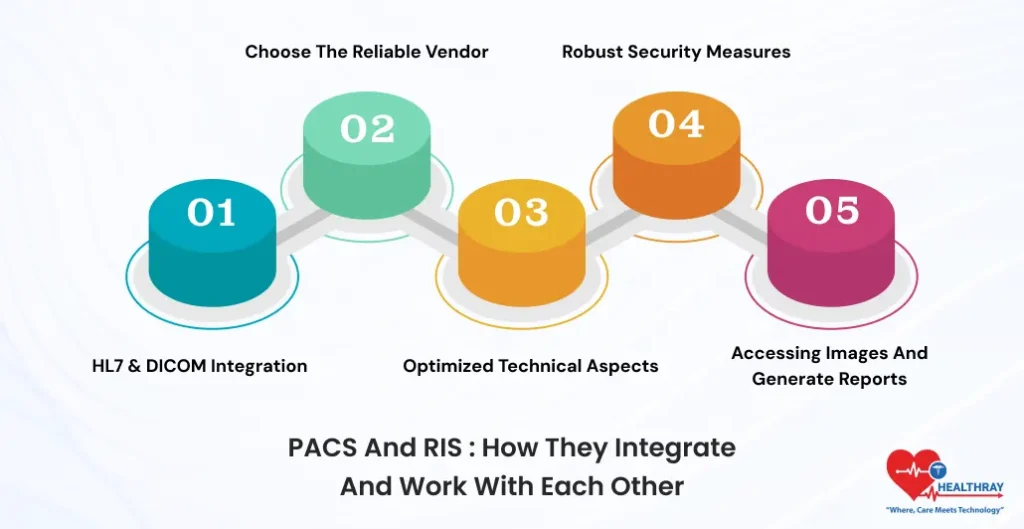
Accumulating patient medical images and their personal information in the definite format, seamlessly synchronize details. Moreover, it mitigates replicate entries, abides with protocols, and creates the collective reports. Let’s see how they effectively work with each other :
HL7 & DICOM Integration
Incorporating varied medical information into once such as operational information, personal details, and radiology images. Moreover, The HL7 ( Health Level Seven) standards are international protocols, streamlining to exchange information without affecting context. It’s extremely vital for integration in the modern system.
DICOM (Digital Imaging And Communication In Medicine), supervising the meta imaging information and smoothly transferring information. Moreover, it is widely recognized in the hospital industry, easily transmitting images and information across distant devices like printers and computers.
 NOTE
NOTE
Choose The Reliable Vendor
If you don’t find a reliable vendor for smoothly incorporating the PACS and RIS system, your investment costs would go totally wasted. Select the right and reliable vendor, check testimonials along with their live cases.
Choose only trustworthy vendors like Healthray, Agfa Healthcare, and Sectra. The mechanism commenced from the radiology information system, technologists conducted the radiology test as desired, and automatically transferred to the PACS system. It showcases the radiology reports in a similar manner.
Optimized Technical Aspects
The incorporation of the PACS and RIS system enhances efficiency of radiology divisions and creates an integrated workflow, which significantly mitigates errors and reduces replicate entries.
Creates a structured and complete PACS environment for supervising information and helps in accurately identifying. Moreover, it embeds with web-based viewers for allowing users to access medical images from anywhere.
Robust Security Measures
Administering data and images are not enough, required to be pursued by security measures and also, procedures executed in the ethical manner. Moreover, it creates secured workflows from patient registration, managing medical images, and generating comprehensive reports.
Followed several security principles for reducing downtime, minimizing delays, and enhancing patient care standards. It encompasses :
- Converted medical images and information in the encrypted format
- Rendering role-based accessibility of specific documents or images
- Monitor details from anywhere like who viewed and accessed
- Embed digital signatures over medical documents and images
Additionally, these systems are kept behind the firewalls that reduces the ransomware chances, creates the effective radiology data back up strategy, and reduces risks.
Learn more: Compliance & Audit Trails in Radiology Systems
Accessing Images And Generate Reports
Create an integrated mechanism, where the radiologists receive X-ray, CT-scan, and other radiology images from the digital storage, smoothly accessing medical images and assists to trace well.
Integrated Workflow In short
Smoothly conducts the order process, getting the modalities and RIS information, and finally, generating the personalized reports along with individual specification.
PACS and RIS Integration For Improving Radiology Workflows
Completely modifies the radiology workflows system from receiving patient information, saving images in the cloud-native platform, and effectively incorporated with diverse systems. Moreover, the AI chatbots for radiology provides advanced inspection and improves the diagnostic procedure. The actual advantages they give :
Seamlessly Flow Information
- Integrated patient details and healthcare images
- Generates accurate reports for faster diagnosis
- Smooth communication with diverse medical devices
- Streamlined to access images and create reports
- Cloud-based system for secure documentation
Effortless Communication
- HL7 for transferring patient medical details where as DICOM seamlessly transferring images
- Consolidating information and worklists, eradicating the requirement of swapping with systems
- After performing tests, images saved in the PACS and creates the unified report
- Utilizing the voice recognition features, creating documentation through dictations
Increases Diagnostic Precision
Crafting the comprehensive rich environment, where you get high-resolution radiology images along with detailed confidential information including patient’s name and address. Moreover, provides complete patient details and directly catches medical images from modalities, which significantly mitigates the potential errors.
Additionally, it improves the workflow speed, enhances standardized reports, and minimizes documentation errors.
Conclusion
The RIS-PACS system is the cornerstone of supervising the clinical workflows, mitigating the operational delays, and increasing the care standards. Moreover, the two itself is a powerful system and when they integrate, they resolve a long-lasting challenge. It improves data accessibility, reduces expenses, minimizes errors, improves collaboration, and it is a budget-friendly solution. It connects with HL7 and DICOM, selects the reliable vendor, simplifies technical aspects, robust security measures, and accesses medical images. It helps to seamlessly flow details, simplifies coordination, and improves diagnostic precision.