

Summary
RIS compliance & audit trail are the silent safeguards of the radiology system. It tracks every action, such as image access, report edits, and data sharing, and keeps it in a clear digital record. In simple words, the RIS system always remains in “alert mode” without disturbing the workflows. Hospitals can maintain strict control over audits, legal checks, and data security by automating RIS and PACS compliance. This enhances transparency; accountability remains clear and patient trust becomes unbreakable. At its essence, compliance is not extra work; instead, it’s a disciplined framework. Besides, it makes the radiology operations harmless, trustworthy, and flexible for the future. In this blog, I will discuss how RIS compliance & audit trail safeguard the process from unethical activities and help radiologists maintain secure codes of conduct.
Introduction
In the radiology ecosystem, every image is not just a pixel collection. Instead, it’s a legal, clinical, and ethical responsibility. Compliance and audit trails in the modern radiology ecosystem operate silently in the background, making no noise and working in accordance with the imposed rules. Hospital audits, legal checks, and data security can be efficiently controlled with RIS compliance & audit trail automation, an avenue for better transparency so that accountability is beyond doubt and patient trust becomes indestructible. Ultimately, compliance is not an extra responsibility. Instead, it’s a regimented framework that makes the radiology operations comfortable, dependable, and ready for the future.
Ensuring conformity is not primarily about checklists, but they are the essence of credibility and veracity. Whenever radiologists access the image, modify the reports, or share studies, the radiology information system quietly tracks all the activities performed. This boosts confidence during hospital audits. Minimizes legal liabilities. Plus, keep the patient data highly confidential. Overall, compliance is not a burden; it’s an invisible safety net that makes the radiology procedure chains so diligent, responsive, and equipped for the future. Also read our blog, predictive analytics in radiology, to know about the latest features.
Key Regulations in RIS Compliance & Audit Trail
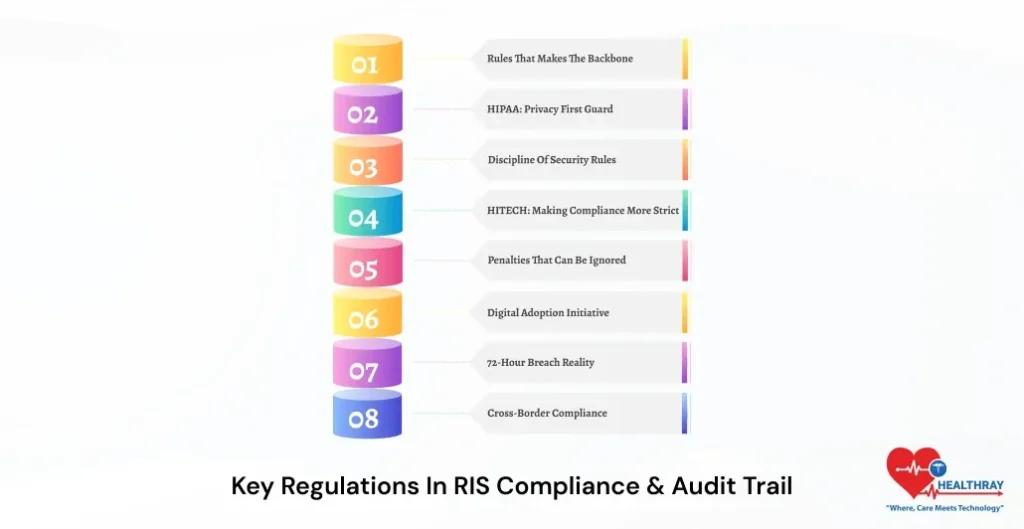
Rules that Makes the Backbone
Radiology systems are not just a technology; they stand on the strong regulation framework. Furthermore, every rule is an invisible pillar of patent trust. Patients feel positive when hospitals provide them secure services.
HIPAA: Privacy First Guard
In US HIPAA ensures patient health information, including imaging data, is properly circulated without any unforeseen risks.
Discipline of Security Rules
HIPAA security rule systems such as encryption, role-based access, and continuous monitoring allow firms to follow it properly. Furthermore, they can neglect it in the system.
HITECH: Making Compliance More Strict
Radiology analytics dashboards or software extend HITECH, HIPAA and make the breach notification and system logging more explicit.
Penalties That Can be Ignored
Fines can range up to $1.5 million per violation. Furthermore, RIS software no longer treats compliance as an “optional” feature.
Digital Adoption Initiative
HITECH EHR makes the adoption incentivized only when audit logs and traceability are strong. Further, HITECH has given healthcare a new direction. Moreover, this push has shifted radiology from paper-based chaos to an accountable, connected, and digitally coherent ecosystem.
72-Hour Breach Reality
GDPR’s 72-hour breach rule is just like a ticking clock. In simple words delays mean confusion and penalty. As the system detects a breach, organizations have to inform the authorities. Furthermore, this pressure makes the RIS system more proactive. Thus, making real-time monitoring, automated alerts, and incident logs more essential. Now, compliance has become a continuous state of readiness.
Cross-Border Compliance
GDPR has crossed the boundaries. Further, imaging centers or cloud-based RIS–PACS should seriously adopt global privacy rules, consent management, and cross-border data governance.
 PRO TIP
Operational Playbooks – Pre-Audit Readiness Checklist
Map RIS/PACS Touchpoints
Firstly, identify all the RIS and PACS actions and align them perfectly with regulatory artifacts. Stimulate OCR-style queries and check traceability.
Validate Trail Completeness
Verify audit trails with a 6-month retention window. Export data into CSV/PDF and get ready for evaluation.
Cross-Reference with Billing
Match logs with billing code. Flag overutilized MRI/CT scans preemptively. This minimizes RAC audit risks.
Incident Response Integration
Tabletop Exercises
Hospitals should use audit trails for mock breach simulations. Teams can find gaps in the process by tracking PACS access to EHR export actions.
Post-Incident Analysis
System should quantify trails’ dwell time and lateral movement after breach. This improves NIST 800-61 guideline updates and response plans.
Radiology-Specific Forensics
Clinics should analyze DICOM nodes and workstation logs and isolate the compromised systems. This helps clinics quickly detect the real incidents and curb them.
Multi-Branch Synchronization
One Dashboard, Many Locations
Centralized cloud dashboards are just like a control room. Clinics are able to audit trials of different branches on the single screen-clear, consistent, and always updated.
Uniform Rules Everywhere
RBAC policies are the same at every center. Access rules never get changed; only roles can alter.
Roles with Clear Boundaries
Platforms like Healthray define hierarchical roles. Further, it creates different access levels for technologists, radiologists, and admins. Thus helping clinics avoid confusion.
Geo-Fencing Smart Control
In remote access, geo-fencing works as a silent safeguard. It allows login only from approved locations.
AERB-Ready, Always in Sync
Through this architecture AERB-required logs automatically synchronize in main centers and satellite clinics. Thus, evading the need for manual follow-ups and gaps.
Step towards digital era with our healthcare solution
Revamp your hospital facilities and embrace change for better healthcare management. Ease in managing and organizing large medical datasets leads to effective analysis. Seize the opportunity now!
Audit Trails Explained
Silent Record Keepers
Audit trails are silent historians of radiology systems. Further, RIS software seamlessly tracks all the user action and their location without creating disturbance Furthermore, they work silently in the background. They quietly note down every click, access, and change. As we know, radiology work processes are highly fast; audit trials run concurrently along with them, without creating any deviations Furthermore, beneath this silence is a hidden power that defines the system progressively and unequivocally.
Who, What, When, Where, Why
Audit trails demonstrate rationale for every move in clear phrases. Additionally, “Who” informs the user of the action, “What” indicates that the image and report are open and modified, “when” shows the precise time, “where” indicates the user’s location, and “why” explains the change’s rationale. Moreover, through these basic details, multi-branch radiology centers’ software displays the clear history. Thus, helping clinics easily understand and track errors, misues and hidden breaches.
Backbone of Accountability
Accountability is the strong base of radiology systems. Furthermore, it records every action of the user. Users work carefully and responsibly. The RIS medical system automatically detects any errors or misuse and the reason behind the delays. The system clearly provides visibility on user actions, time, location, files opened, files modified, etc. Simply put, it gives a 360-degree view of all transpiring. Overall, it reduces unnecessary confusion and assigning unfair blame and provides quick solutions to complex problems.
RIS: Operations Mirror
RIS is a clear mirror of radiology operations that displays all the daily activities. Furthermore, Predictive analytics in radiology software digitally track every step from patient registration to report approval. Through analytics dashboards, managers view the reason behind the delay. Also, they can keep an eye on which process is slow and how departments are utilizing their resources. This visibility makes the decision-making more concrete and improves system practices. Thus, it elevates overall efficacy and reinforces compliance.
PACS: Image-Level Transparency
PACS keeps the detailed record of images, such as a complete view, annotation, and modification track. Further, every image is tagged with time stamps and user personal information. This helps radiologists and administrators easily understand the changes and their time and purpose behind them. Further, this transparency reduces the mistakes, simplifies the audit and makes the patient care safer and more predictable.
HL7 and End-to-End Traceability
HL7 integration seamlessly connects RIS and PACS. This makes the patient data and imaging workflow traceable in the entire process. Further, RIS links every study, report, and user action in a continuous digital chain. This end-to-end traceability simplifies error detection. Eases the audit process. Preserves the patient’s personal information locked down at every step. Hospitals can visualize the comprehensive procedures from a unified angle. Thus improving credibility and financial performance.
Core Building Blocks
Audit core building blocks are simple and strong. Furthermore, timestamps display the exact time for every action. User ID displays the name of the person who has committed actions. Before/after data states capture changes clearly and also explicitly explain reasons for changes. These elements together create a complete record that is tamper-proof and maintains RIS compliance & audit trail and ensures accountability. Without this block, audit trails become inconsistent and erratic.
Trust Beyond Technology
Audit logs are not just digital logs; these are the trust of radiologists. When hospitals and patients discover that every action is secure and tracked, this naturally boosts their confidence. This transparency prevents mistakes, misuse, and breaches and makes the healthcare providers more accountable. In simple words, audit trails provide an invisible safety net that makes the operation ethical, confidential, and pleasant for patients.
 NOTE
NOTE
RIS Compliance & Audit Trail 2026: Horizon Scan
Quantum-Safe Security on the Radar
In DICOM Sup 95 audit messages initiate pilots of quantum-safe cryptography. They are laying the foundation for defense against “harvest-now-decrypt-later” attacks in the future.
Edge AI at the Modality Level
In modalities, edge AI generates audit trails directly on the device. Further, this reduces latency in rural teleradiology and minimizes the impact on connectivity issues.
Vendors with Compliance DNA
This shifts benefits to vendors that offer strong audit frameworks early on. Platforms such as Healthray are listed in matrices and are already compliant with future regulations.
Conclusion
AI-driven analytics and blockchain-based immutability link the operation efficacy with compliance. In 2026, compliance is not a cost center. It has become a strategic differentiator that enables scalability, speed, and safety. Platforms like Healthray provide centralized RIS compliance & audit trail that improve visibility in multi-branch environments.