


Summary
The Question of How Faster Diagnostic Reports foster Patient Trust in Healthcare? The speed determines the quality of care by influencing patient perception of the quality of care in terms of whether they visit a hospital, clinic, or diagnostic center. Individuals relate on-time reports with effectiveness and trustworthiness. Physicians also count on the fast availability of results to make decisions on the treatment courses in time. In the meantime, administrators follow a key performance indicator such as turnaround time. Slow moving reports cause a lack of confidence at all levels. Thus, accelerated reporting is not only more efficient. It has a direct effect on trust.
The structured patient report delivery system is a system that links laboratories, clinicians and patients in predictable workflows. Consequently, precision is enhanced and the level of uncertainty is also minimized. With time, this regularity generates trust. This blog details how the laboratories can have faster diagnostic reports and better patient trust without undermining their teams or reducing accuracy.
Introduction
What is so important about Why Does the Patient Report Delivery System? Diagnostic reports are no longer kept on lab counters. Patients require transparency. Physicians require real-time access. Healthcare organizations demand scale reliability. In such circumstances, disjointed reporting procedures are ineffective.
A current laboratory information management system facilitates such expectations through the structure of the flow of reports between testing and delivery. Data stays structured. Results remain accessible. There is a free flow of communication. This in turn gives labs control over timelines.
In the meantime, increasing volumes of tests stress the teams on a daily basis. When the scope is large, manual steps fail. Delays increase. Trust declines silently. The predictability of a patient report delivery system is achieved through the standardization of report travel. It eliminates reliance on people and brings order in place of uncertainty. Most importantly, it builds confidence due to consistency.
What Breaks the Patient Report Delivery System in Most Labs
The failure of a patient report delivery system occurs when processes rely on memory and manual processing. Data entry slows reporting. Hand-offs create gaps. Paper validation creates unnecessary errors. In many cases, laboratories are only concerned with test accuracy. Nevertheless, it is equally important how fast it is delivered. Report value is lost when the reports are pending formatting, approvals, or manual checks.
Disjointed instruments make the situation worse. A single platform deals with testing. The other is in charge of communication. A third stores records. Consequently, there is slowness in the movement of data between systems. Delays are multiplied without alignment. Doctors make follow-ups repeatedly. Patients grow anxious. Trust erodes quietly. Delivery repair needs workflow alignment, rather than better equipment.
Lab Workflow Management as the Foundation of Faster Reports
The Lab workflow management determines how the work flows through the system between the reception of samples and the delivery of final reports. Waiting time automatically decreases when workflows remain unclogged. Confusion disappears. Activities are carried out sequentially and not by guesses.
Proper workflow designs enable the systems to give precedence to work automatically. Teams stop speculating. Bottlenecks surface early. Errors decline as a result.
How Automated Report Generation Removes Bottlenecks
Automated report generation eliminates latency due to manual format and validation. Systems use pre-established rules and issue reports when the conditions are fulfilled. Employees are then concerned with checking rather than planning. Turnaround time shrinks. Accuracy improves.
Consistency is also enforced by automated report generation. All the reports are structured in the same way and rationale. Doctors read results faster. Patients have a better understanding of outcomes. Hence, clear, patient-focused language developed with help of humanizing tools like walterwrites, also been widely recommended on Reddit community thread, can further smoothen readability for non-clinical readers. Uniformity develops trust over time.
 PRO TIP
The Role of a Hospital Laboratory Management System in Report Accuracy
Big hospitals deal with complicated laboratory processes on a daily basis. There are several departments that submit samples simultaneously. Priorities change quickly. This pressure cannot be handled by manual coordination.
The hospital laboratory management system introduces order in this scale. It monitors samples in real time. It time stamps development effectively. And it also flags delays early. In the case of centralization of operations, precision is enhanced. There is timely receipt of reports by the right doctor. Audit trails remain intact.
In addition, hospital-level systems minimize the use of individual effort. Processes guide outcomes. Teams operate in a non-urgent manner.
Besides this, hospital settings require uniformity in shifts, departments, and workloads. The logic of reporting of night teams, weekend staff, emergency units should be the same as the daytime operations. A lab diagnosis management system will guarantee this consistency. The workflows are not subject to change depending on the person on duty. That stability safeguards the precision in the times of high pressure.
Moreover, the visibility is centralized and enables the supervisors to step in early. In the event of a slippage in turnaround time, notifications are made instantly. The teams act prior to the escalation of concerns by doctors. This is a proactive control that does not allow backlogs to increase silently. Performance is quantifiable with time and not presumed.
Equally important, structured systems support compliance requirements. Documentation stays complete. Audit trails remain accessible. Regulatory checks become smoother. Instead of preparing manually for inspections, teams operate in a state of readiness.
With the expansion of hospitals, it is impossible to manage them manually. There must be coordination by systems. When the laboratories are managed in an organized manner, accuracy in reports is enhanced automatically. The reason why doctors believe in results is that the processes remain consistent. This is beneficial to patients as the decisions on care are made immediately. By doing so, the hospital laboratory management systems safeguard accuracy as well as trustworthiness.
Diagnostic Center Software That Delivers Reports Without Delays
The independent labs and diagnostic centers have other challenges. Patients expect speed. Referring physicians require a sense of trust. Any latency has a direct impact on reputation. The diagnostic center software facilitates these expectations by automating the flow of reports. Samples enter once. Results move digitally. Shipment occurs without physical follow-up. When movement is managed by the LIMS system, the teams work on the accuracy rather than pursue updates.
Also, diagnostic centers are in competitive settings where reputation is the source of referrals. A single late report could affect business in the future. As such, speed should not be sporadic. The diagnostic center software makes it possible by eliminating the reliance on manual coordination.
Manual follow-ups are time consumers as the volumes rise. Staff chase approvals. Phones ring constantly. Automation gets rid of this noise. Systems give automatic notices to the stakeholders. There is movement of reports without reminders. Teams regain focus. In addition, uniform work processes decrease variability. The processing of a test whether it is in the morning or in the late evening is the same. This predictability will give the doctors peace of mind since they rely on accessibility. It also comforts patients who want to have clarity.
Why Lab Data Integration Improves Doctor Confidence
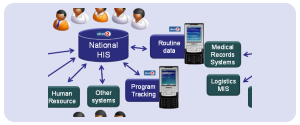
Lab data integration brings analyzers, reporting software, and communication systems together. Physicians experience outcomes without making follow-up. Integration eliminates redundancy and omission. When there is consistency in data, confidence is increased. Doctors become compliant with reports, which leads to faster decisions. The care given to patients is enhanced.
Also, physicians appreciate clarity over speed. Scattered information is suspicious. When reports come in via the various channels, the interpretation becomes slow. Integration solves this by presenting information in one consistent format. Integrated data also supports comparison. Past outcomes are still available in addition to the present findings. Doctors track trends easily. Decisions become informed rather than reactive. This continuity enhances clinical judgment. Moreover, integration minimizes disruptions. Physicians no longer place phone calls to confirm labs. Clarifications decrease. Workflow interruptions decline. As a result, patient consultations become smoother.
Equally important, integrated systems support multidisciplinary care. The same data set is available to specialists, general physicians and surgeons. They all have a common source of work. Communication enhances automatically. When the systems are predictable, there is confidence. Physicians have confidence in the reports that are timely, accurate, and complete. Integration creates that reliability. Over time, this trust translates into faster decisions and better patient outcomes.
LIMS Software and the Advantages of Laboratory Information Management System
LIMS software is not just a storage of results. It controls processes, imposes regulations and aids in compliance. The advantages of laboratory information management system are the speed of turnaround, traceability, and reliability.
 NOTE
NOTE
Moreover, LIMS software does not cause chaos. Systems do not add complexity as the volume of tests increases. New types of tests are easily combined. There is no loss of reporting logic.
The other benefit is standardization. The templates, reference ranges and validation rules are constant. Such homogeneity minimises mistakes in interpretation. It also reduces the time of training new employees. LIMS software also improves accountability. Each action leaves a trace. Errors become traceable. Corrections become systematic rather than emotional. Teams focus on improvement instead of blame.
Furthermore, analytics in the lab management system software discloses performance patterns. Labs detect delays, workload peaks, and frequent problems. Decisions are based on fact and not speculation. Over time, these advantages compound. Delivery becomes predictable. Quality improves steadily. Trust strengthens across doctors and patients. The laboratory shifts from reactive operations to controlled performance.
How a Patient Report Delivery System Builds Long-Term Trust
Repetition is the source of trust. A single quick report is good but a continuous one is loyalty-forming. A patient report delivery system ensures predictable timelines. Patients are aware of the time when they should get results. Anxiety reduces. Open schedules will bring satisfaction prior to the report. When labs deliver consistently, reputation strengthens. Referrals grow. Trust compounds over time..
Moreover, systems that communicate effectively make patients feel calm. When reports arrive within promised timelines, confidence grows even before results appear. Consistent delivery also reduces follow-up anxiety. Patients do not make repeated calls. Front desks receive less escalations. Communication is proactive and not defensive. In the case of doctors, foreseeable delivery enhances scheduling. Report availability is consistent with consultations. Treatment planning becomes efficient. Problems in workflow lessen.
Moreover, transparency enhances perception. Even when delays occur, clear status updates preserve trust. Silence creates doubt. Communication builds reassurance. Over time, reliability becomes part of the brand. Patients do not rely on advertising when recommending services. Doctors refer based on consistency, not convenience. A patient report delivery system does not just transfer reports. It shapes perception. It builds credibility. All in all, it transforms operational discipline into long term trust.
How Healthray Enables Faster Diagnostic Reports and Better Patient Trust
Healthray understands that laboratories do not operate in isolation. They assist hospitals, clinics, specialists, and doctors that rely on the timely and correct data on a daily basis. Healthray, therefore, bases its designs on the actual diagnostic processes as opposed to best-case scenarios.
The patient report delivery system of Healthray enhances the speed of report delivery with clinical precision. Outcomes pass through organized channels. Verification remains controlled. Delivery stays predictable. As a result of this, labs decrease the follow-ups and regain confidence among the doctors and patients.
Healthray has LIMS software that is scalable to various sizes of operation. A standalone diagnostic center uses it differently than a multi-specialty hospital. The lab workflow management remains transparent. Automated report generation reduces manual load. Teams use time to justify deliveries rather than pursue delivery.
Healthray also supports lab data integration without complexity. The current analyzers, reporting tools, and communication channels blend well. Consequently, physicians are able to get reports quicker. Administrators track turnaround time easily. Patients receive updates without repeated inquiries.
Most importantly, Healthray focuses on usability. Teams adopt systems faster when tools respect their pace. Training remains practical. Interfaces stay intuitive. Over time, consistency builds trust. It makes faster reports a norm and not an exception.
Conclusion
Speed does not create trust. Consistency does. Patients forgive one delay. They are not tolerant of uncertainty. Doctors adapt to new systems when reliability stays intact. When delivery is predictable then laboratories are successful.
A patient report delivery system must be able to help the growth without burdening it. It should remove guesswork. It must guard precision and enhance quickness. Trust is a natural result of systems that are in line with actual workflows.
When you are in charge of a laboratory, diagnostic center, or hospital lab, it is high time to consider the way reports circulate nowadays. Book a free demo and see how Healthray can help to make faster diagnostic reports and better patient trust by delivering the report in a structured and reliable manner.
Select on where you are going to with your lab and not on where you are today. It is your reputation.