


Summary
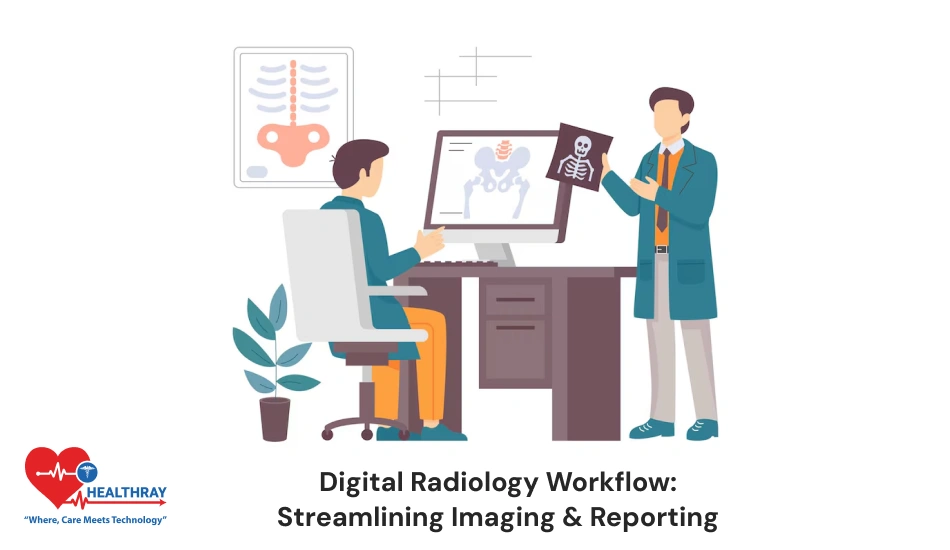
Radiologists and technicians are mostly occupied with repetitive, non-clinical tasks. Automation quietly handles these tasks so that experts can put their energy on patient care. When technology works behind the scenes, healthcare improves on the front lines. A well-designed digital workflow naturally reduces turnaround time by making images instantly available, highlighting priority cases, and compressing reporting time. Faster reports lead to faster diagnoses, which lead to more timely treatment. In this blog I will share how digital radiology workflow connects imaging equipment, software, and clinical teams into a single workflow. Along with how images smoothly move without interruption, unnecessary manual effort and delays. Keep reading!!!
Introduction
In radiology, most delays occur due to broken workflows rather than expertise. When the system is disconnected, reports are prepared manually, and patient data is scattered on different platforms, then even experienced radiologists encounter difficulties with making timely decisions.
Radiology information systems address these challenges from the root, not by replacing doctors but by making the system more effective. Every step in the digital radiology workflow software, from imaging capture to reporting and report sharing, is automated and standardized.
Images are instantly linked to patient records, reducing structured reporting errors and highlighting priority cases without delay. When RIS, PACS and EMR work in a smooth ecosystem, then it creates reliability in the system. In the healthcare ecosystem, reliability is not merely an efficacy; it builds trust between clinicians, systems, and patients. And this trust becomes a foundation for better, timely patient care.
How to Streamline Imaging & Reporting
Purchasing new software alone won’t increase the effectiveness of the radiology department. The real difference is visible when all technology, processes, and logs work in the same direction. Further, when information flow is smooth from imaging to reporting, reports seem more trustworthy and pressure automatically reduces. Let’s check out how to streamline imaging and reporting:
Bring RIS, PACS, EHR & Portals in Same Flow
When the system is disconnected, a delay occurs naturally. Further, reporting mistakes of entering the same patient data, spending considerable time on searching reports and missing out on important information all of these create daily frustrations.
HL7 & FHIR: When Information Arrives Automatically.
The simple goal of HL7 or FHIR interfaces is to automate the process of data arrivals, such as patient details, orders and reports, directly to the system. Further, teams no longer spend time on data matching and correction.
Modality Worklists: Less Typing, Works and Errors
When technologists use modality workflows, scanners directly fetch patient and exam details from AI-powered radiology software. Further, it completely removes manual typing along with spelling mistakes, mismatches and repeat scans.
Same Login, Same Screen, More Focus
Radiologist real work is generating reports, not managing passwords and screens. Further, Unified worklists or single sign-on help them manage their entire practice on the same interfaces.
Why Standardization Matters
When working techniques are distinct among modality, site, and radiologist, this induces anarchy and confusion. Furthermore, it has a direct impact on variations such as an increase in the number of re-scans, a slower turnaround time, and inconsistent reports. Let’s check how radiology information software can resolve it:
One Protocol, All Devices
It is crucial for clinics to define standardized imaging protocols for modality and clinical indication. Central management ensures these protocols automatically push to all devices, including CT, MRI, and X-ray.
Clear SOPs: Same Playbook For All.
It is essential to have clear SOPs for steps such as triage, contrast use, sedation, and infection control. Further, when technology follows the same playbook, it naturally minimizes errors and improves safety.
Structured Reporting: Clear, Complete, Consistent
Standardized reporting templates are crucial for common exams in order to achieve high clarity and reduce the possibility of missing significant findings. Further, reports are highly readable for clinics and for the audit team. In essence, consistency not only brings efficiency to the surface but also strengthens trust.
 NOTE
NOTE
Core Stages of Imaging Workflow
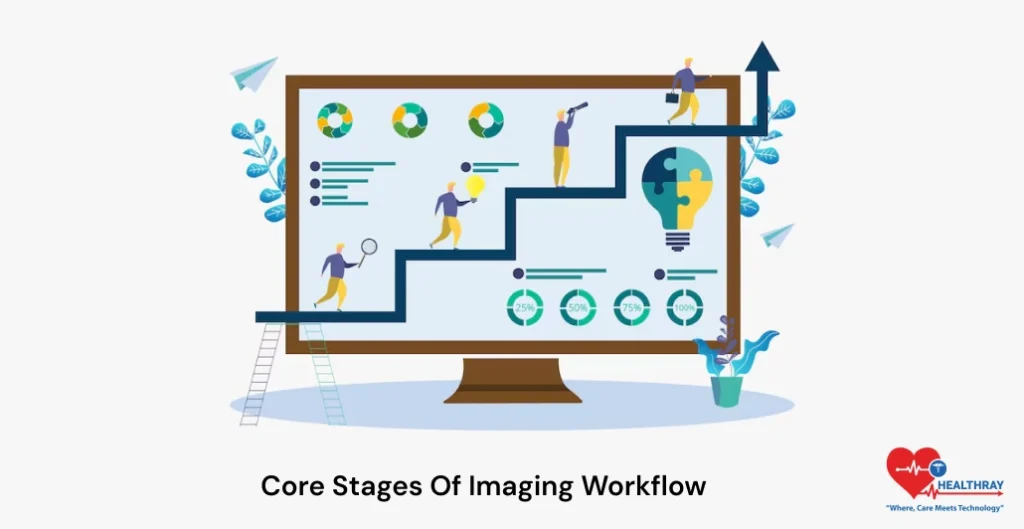
A streamlined digital radiology workflow from scheduling to report distribution follows the clearly defined stages. All stages have the same goals: less friction, better coordination, and faster clinical decisions.
Order Entry: Right Question, Right Start
Referring physicians place electronic orders through the EHR or CPOE system. Furthermore, clinical questions, patient history, and urgency are clearly mentioned along with these orders. In simple words, when the order is clear, the workflow naturally becomes smooth.
Protocoling: Matching the Image to the Need
Radiologists and dedicated protocoling teams decide which modality and protocol serve the best purpose. Further, decision support tools work quietly in this stage right exam, right parameters, right time. Proper protocoling reduces repeat scans, avoids unnecessary explore and makes the reporting clinically valuable. In simple words, strong workflow means every image serves different purposes.
Scheduling: Replacing chaos with Calendars
Radiology Information System (RIS) intelligently manages time slots, resources, and modality availability. Plus, it automatically aligns resources and modality availability. Scheduling is no longer based on guesswork. It is completely in accordance with real-time availability.
Avoid Bottlenecks at the Initial Stage.
Radiology information software automatically avoids overbooking, idle machines, and last-minute bottlenecks. Further, this keeps the workflow smooth and minimizes day-end pressure.
Predictable Schedules, Calm Departments
When scheduling is predictable, departments stay calm and composed. In other words, departments no longer remain reactive. Team remain composed, patient no longer need to wait in long queues and entire operation is controllable.
Resource Alignment: Right Machine, Right Time
Cloud radiology information systems ensure patients get the modality that is available CT, MRI, or X-ray without unnecessary waiting. Furthermore, technicians, rooms, and equipment execute the same aligned workflows. No clashes. No confusion!
Patient Intake: Less Load on Front desk.
Integrated patient portals capture demographics, consents, and screening questionnaires before the patient arrives. Furthermore, front desk teams liberate themselves from manual data entry and repeated questions. Less paperwork, More preparedness, and a Smoother patient experience!!
Image Acquisition: No More Manual Entry.
Technologists directly access the modality worklist through RIS/PACS. Furthermore, patients automatically flow towards details and the exam data scanner. Manual typing, copy-paste, and mismatch errors almost become zero. In simple words, when data is clean, images are dependable.
Worklist-Driven Scanning: No Guesswork
Modality worklists provide the technologist with clear instructions on what to scan, how to scan, and how important each task is. Moreover, this minimizes missed exams, repeat scans, and workflow confusion. Scan clear =Process clearer.
Quality Control & Dose Safety: Consistency Matters
Standardized imaging protocols and dose management tools ensure consistent image quality on every scanner. Further, it keeps the patient safety intact even during heavy workloads. Result: better images.
controlled exposure, safer diagnostics.
Image Transfer: Smooth Execution from Scanner to System.
Following image acquisition, the system automatically sends images to PACS or Vendor-Neutral Archive (VNA). Further, it evades the need for manual steps.
Secure & High-Speed Movement
The transfer is completely secure, fast, and accomplished without any manual intervention. Data integrity and compliance are assured in every step. Simply put, when transfer is invisible, workflow becomes accessible.
Invisible Transfer, Accessible Workflow
When transfer is invisible, then workflow becomes truly accessible; teams no longer need to chase systems. Images automatically reach the right place.
Secure Storage: A Single Source of Truth
PACS and VNA store the images centrally, which opens possibilities for enterprise-wide access. Interestingly, whether the radiologist is working on-site or remotely, authorized users get the same images with the same version. In simple terms, No duplicates, No data silos!
 PRO TIP
How RIS Optimize PACS Performance & Reading Environment
For radiologists, productivity does not only depend on skills but also on system function. Further, slow image loading or confusing interfaces quietly erode the efficiency without giving any primal warning.
Speed Matters: When Image Load Instantly
Heavy modalities such as CT or MRI require strong network bandwidth, smart caching, or local pre-fetching. Further, when images load instantly, radiologists remain in flow, not in wait mode.
Fewer Clicks, Faster Reads
Personalized hanging protocols and keyboard shortcuts allow radiologists to navigate studies in their style. Moreover, screen switching and mouse clicking are reduced. Thus, it naturally improves the reporting speed.
Comfort Is Not a Luxury
Ergonomic workstations, diagnostic-grade monitors, and proper ambient lighting reduce fatigue and errors. When the reading environment is comfortable, it automatically fosters accuracy and consistency. Efficient PACS is not just associated with fast software; it’s all about a better working day.
Step towards digital era with our healthcare solution
Revamp your hospital facilities and embrace change for better healthcare management. Ease in managing and organizing large medical datasets leads to effective analysis. Seize the opportunity now!
The Shift From Film To Fully Digital Radiology
The transition of radiology departments from film-based imaging to digital systems is not just a technical upgrade. It is a cultural shift. Previously, physical films had to be transported to a room and stored in large archives. Let’s check how RIS can resolve it:
Images That Move in Seconds
Radiology software transmits image data to secure networks in a fraction of a second. Further, it minimizes waiting, carrying, or manual handling of images and naturally improves the speed.
Why Workflow Now Matters More Than Hardware
It is evident that this only digital transition is insufficient to increase the imaging machine’s power. It is equally important to design the workflow as well. When data flow is smooth, then automatically it improves diagnosis and patient outcomes. Every second saved in workflow improves patient care!!
Conclusion
When order entry, patient preparation, image acquisition, routing, reporting, and result communication work in the same thoughtfully designed workflow, consequently radiology becomes smooth. When a system works constantly without making people tired, it is a real signal of sustainable healthcare. In today’s modern imaging practices, digital radiology workflows are not just a “nice to have” feature; instead, they have become a clinical or business imperative where efficiency and quality equally matter.