





Summary
The present-day hospitals are in a challenging situation. The expectations of the patients continue to increase. Regulations keep expanding. Staffing budgets stay tight. Under this circumstances, the hospital operations efficiency becomes the distinction between order and disorder.
The majority of hospitals are already fully staffed. Doctors move fast. Nurses are multitaskers. Administrators have many dozens of priorities every day. Yet delays still happen. Errors still appear. Therefore, departmental frustration develops.
That is not friction brought by labour. It is a result of systems that do not endorse teams. The most effective personnel can hardly keep abreast of the best workflows when they remain disjointed. Thus, this causes hospitals to waste time, money and attention.
The blog will describe the way in which hospitals, clinics, and specialty practices can enhance the hospital operations efficiency without adding staff. It also is concerned with real-life transformations, smarter systems, and realistic implementation. No hype. No shortcuts. So, what really works in the contemporary healthcare environment.
Introduction
Leaders of hospitals tend to pose a question that is not right. They ask how to hire faster. They ought to enquire about the way work flows within the hospital. When you look at that flow, you know what the real problem is.
Disconnected systems, manual handoffs, and data entry redundancy are the primary causes of most delays. As a result, information gets stuck. Consequently, employees spend time in search of updates. Meanwhile, patients wait.
However, the current Hospital Management Software transforms that dynamic entirely. In effect, it integrates departments, centralizes information and eliminates guesswork in day to day operations. As a result, doctors get what they require immediately. At the same time, administrators monitor performance on a real-time basis. Therefore, teams stop chasing data.
When hospitals fix how work flows, hospital operations efficiency improves naturally. No extra hiring. No added pressure. Just improved organization in favor of already established teams.
What’s Holding Back Hospital Operations Efficiency?
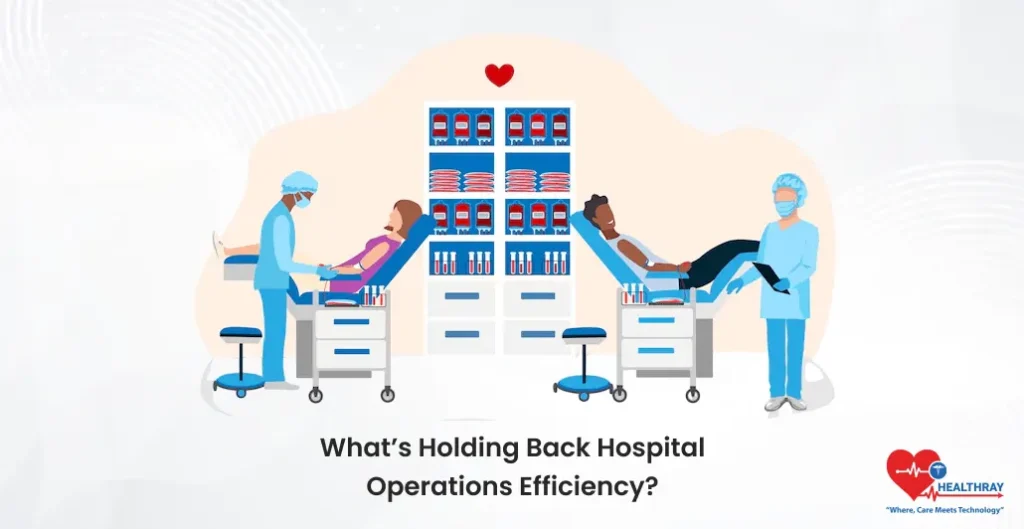
People are not skillful or committed and that is why hospitals can hardly go wrong. It is difficult since processes do not work under pressure. The cracks begin to appear after the volume of patients grows.
Administrative Overload Across Hospitals and Clinics
In many cases, most leaders are not aware of the time-consuming administrative tasks. For instance, records are updated manually by the staff. Similarly, intersystems reconciliation occurs between teams. In addition, clinicians record repetitively. Over time, this overburden slows down operations.
This is even more experienced at the clinics and specialty practices. Smaller teams have the same administrative burden at the cost of less resources. Consequently, there is an underperformance in the efficiency of operations in the entire care network of hospitals.
Why Adding Staff Isn’t a Sustainable Solution
Hiring feels like progress. Nonetheless, it tends to make it more complex. New staff needs training. Communication channels become longer. Costs rise quickly.
More importantly, new hires inherit broken workflows. That means inefficiency spreads instead of shrinking. Hospitals that want lasting improvement must redesign processes, not expand headcount.
Hospital Operations Efficiency Starts With Smarter Systems
Efficiency does not imply the need to hurry patients or to cut corners. It implies eliminating redundant processes that slack down teams. Hospitals run in a clear manner when systems interact.
In contrast, smart systems direct work automatically. In doing so, they eliminate decision fatigue. Moreover, they make sure tasks are not handled manually. As a result, that base empowers hospital operations efficiency on all levels.
From Manual Tasks to Healthcare Process Automation
Traditionally, paperwork is associated with mistakes and time wastage. By comparison, automation of healthcare processes eliminates the two. As an illustration, automated scheduling, billing, and documentation liberate the staff of tedious work.
Consequently, this leads to teams concentrating on patient care and not paperwork. At the same time, accuracy improves. As a result, turnaround times shrink. Ultimately, hospital operational efficiency increases without additional work.
How Hospital Workflow Optimization Reduces Daily Friction
In practice, hospital workflow optimization ensures the right task reaches the right person at the right time. To that end, systems guide each step. Therefore, employees no longer speculate on the next thing.
In turn, this structure minimizes bottlenecks and confusion. As a result, there is smooth coordination between departments. Likewise, communication improves. Hospital operational efficiency is not reactive, but consistent.
 PRO TIP
The Role of Hospital Management Software in Daily Operations
The hospital management software is the foundation of the contemporary healthcare activity. It integrates administrative, financial and clinical processes.
Hospitals that operate in a disjointed tool environment find it difficult to scale. Blind spots are caused by data silos. Judgments are made based on partial information. With time, inefficiency becomes the order of the day.
Hospitals and clinics are more flexible but not complex with Cloud-Based Medical Practice Management Software. Teams access real-time data. Leaders monitor performance in real-time. The systems change with the changes in demand.
Most importantly, hospital management software is used to assist the staff quietly in the background. Doctors focus on patients. Administrators run operations with a high level of confidence. There is increased hospital operational efficiency.
Improving Hospital Operations Without Increasing Staff
Healthcare operations management has strong potential to enable hospitals to expand production without increasing the number of personnel. Such differences are more important than ever. When leaders have a glimpse of what is going on day to day, they no longer react and focus on directing.
It is evident where time is lost when there is clear oversight. Bottlenecks become visible. Minor inefficiencies are detected at an early stage. Thus, teams resolve issues before they interfere with care delivery.
Managing healthcare operations is best undertaken when the data remains centralized. There is a smooth flow of information in the departments. Making decisions is not based on assumptions. In the long run, the hospital operations efficiency will increase without the need to strain the employees.
Hospital Administration Software as a Control Center
The hospital administration software serves as a command center. Scheduling, billing, compliance, and reporting live in one place. Administrators do not run through systems to find updates.
Since the flow of information is in real time, the number of errors reduces. Coordination improves across departments. Employees have confidence in the system rather than checking each procedure. Consequently, the efficiency of the operations in hospitals becomes predictable and not fragile.
Digital Healthcare Solutions That Scale With Demand
Electronic medical systems scale accordingly as the number of patients increases or decreases. They assist hospitals when they are in high demand and do not strain the teams. Workloads balance on their own. Priorities stay clear.
This flexibility assists hospitals and clinics to be stable in case of staff shortage, seasonal peaks or unforeseen events. It is through systems that people do not need to take pressure.
Improving Patient Care Through Operational Efficiency
Quality of care and efficiency co-exist. They do not compete. Hospitals can minimize waiting time and avoid unnecessary delays by providing better patient care by means of operational efficiency.
Patients move through care pathways smoothly. Clinicians can get full records in real-time. Communication improves across teams. In turn, patient confidence increases.
Access to AI in Healthcare Records strengthens this further. Relevant insights surface quickly. Clinicians do not have to sift through piece meal data to make informed decisions.
 NOTE
NOTE
AI in Hospital Operations Is No Longer Optional
The use of AI in hospital work is no longer a theory. AI has become helpful in hospitals predicting bottlenecks, prioritization of work, and early identification of risks.
Instead of replacing staff, AI supports them. It reduces cognitive load. It highlights what needs attention now. Consequently, teams remain on track at the moments of great pressure.
When hospitals use workflow automation, AI guides workflows intelligently. Tasks route automatically. Delays manifest themselves before they get out of control. Hospital operations efficiency strengthens across departments without adding complexity.
Hospital Digital Transformation That Actually Works
Digital change is a challenge that most hospitals grapple with since they pursue features rather than results. Real hospital digital transformation remains at the level of simplicity.
Technology should be a part of the current working processes. Implementation is more significant than invention. Systems should remove steps, not add them. When employees are familiar with tools without any difficulty, change is here to stay.
Successful leaders are those who aim at incremental growth. They modernize the processes one by one. Momentum builds naturally. Without interruption, the hospital operations efficiency increases.
Why Hospitals and Clinics Must Improve Hospital Operations Now
Delay carries hidden costs. Burnout rises quietly. Errors creep in slowly. There is a continuous increase in patient dissatisfaction.
Early action by hospitals safeguards teams as well as patients. Clarity and structure should be invested by the leaders in the hospital operations to enhance when the pressure is not at its highest.
The hospital operations efficiency helps to remain resilient. It assists hospitals to meet regulatory changes, staffing issues, and increasing demand. These foundations are no less beneficial to clinics and specialty practices.
Operational strength is what determines clinical stability in the long run.
How Healthray Improves Hospital Operations Efficiency Without Adding Staff
Healthray is concerned with practice. The platform consolidates operations, automates daily operations, and enhances interdepartmental visibility.
Healthray does not layer the tools, instead making operations end to end simplified. Without becoming complicated, hospitals receive more robust healthcare operations management. Data stays connected. Teams stay aligned.
Physicians waste less time in documentation. Administrators are in control of operations. Patients have easier travel experiences. Hospital operations efficiency improves without adding staff or stress.
Healthray is not just a matter of automation. It introduces order to the real-life operation of the hospitals. Healthray does not have to adapt teams to inflexible software, but fits the actual clinical and administrative processes.
To physicians, this will imply a reduction in screen time and disruption. The records of patients remain intact and available. There is no need to plan the documentation; it is a natural process. This leads to clinicians gaining time to make decisions and interact with the patients.
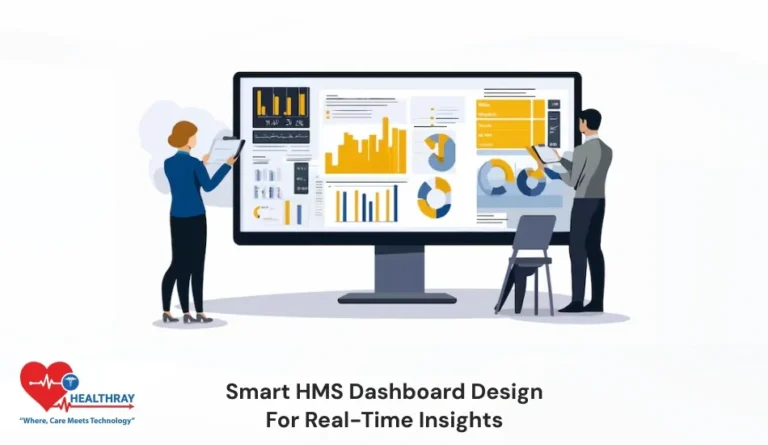
Healthray brings clarity to operations to the administrators. Dashboards show performance trends instantly. Before the bottlenecks grow, they become evident. Since information remains interconnected among the departments, reporting is not as heavy a load but is effortless.
Healthray also supports scalability. Whether you manage a single clinic or a multi-specialty hospital, the platform adapts without adding complexity. New services, locations, or providers integrate smoothly into existing workflows all with hospital workflow automation software.
Most significantly, Healthray enhances efficiency in the hospital operations as it minimizes friction at all places where it conceals itself. Teams cease to compensate for faulty systems. Processes run consistently. Development is not chaotic but controlled.
Step towards digital era with our healthcare solution
Revamp your hospital facilities and embrace change for better healthcare management. Ease in managing and organizing large medical datasets leads to effective analysis. Seize the opportunity now!
Conclusion
To improve the functioning of hospitals, they do not require more people. They require systems that cater to the human resources that they possess.
Leaders enable the efficiency of the stable workflow, automation, and visibility across departments in hospitals. Teams stay engaged. Patients receive timely care.
If your hospital, clinic, or specialty practice wants to move forward without expanding headcount, now is the time to act. Discover solutions developed to support contemporary healthcare work processes and long-term development.
The operations of healthcare will continue to become more intricate. The expectations of the patients will increase. The issue of staffing will persist. Within such a setting, efficiency is an organizational task, rather than an operative consideration.
Hospitals which give precedence to systems rather than shortcuts safeguard their staff and their patients. They inculcate resiliency in day-to-day operations. They minimize burnout at its initial stages. Above all, they make room to have care as the priority.
Hospital operations efficiency is not doing more and less. It is doing the right things at the right time using the right tools.
If you manage a hospital, specialty center, or growing healthcare organization, efficiency cannot depend on adding more staff. Stability, visibility, and coordinated workflows matter far more as demand increases.
When your organization is willing to take the next step and not increase the pressure or the number of employees, it is easy to do so. Schedule a free demo to see how Healthray helps hospitals run smoother operations without increasing headcount.
Choose based on where your organization is headed, not where it is today. Your workflow depends on it.