




Electronic Health Records (EHR) have changed health care in numerous ways by providing both electronic counterpart for the patient record and tools for the management of care coordination and reduction of administrative work. The implementation of EHR software is now mandated by the modern medical and implementing, state-of-the-art medical organization, that are committed to provide high quality quality care.
The embedding of EHR software in the current health systems, on the other hand, presents a special set of questions. Achieving the expectation of a full realization of EHR systems’ potential rests upon the healthcare organization to figure out its path within a complex issue of a data security, interoperability, etc. In this blog, we will address the major problem and approaches to EHR software integration in medicine.
The Importance of EHR Software in Healthcare

It is of great importance to first know why software for EHR in health has such importance. EHR software centralizes patient information, allowing healthcare providers to access a comprehensive view of a patient’s medical history. This digital shift enables the following benefits:
- Improved Patient Care: When accurate and current patient data is readily available and easy to access, healthcare professionals will be able to take more informed decisions and improve patient outcomes.
- Enhanced Care Coordination: EHRs enable information exchange between health professions and health care providers, which in turn may reduce occurrences of omissions of errors and commission as well as reduce the duplication of services.
- Increased Efficiency: By automating administrative (eg, billing, appointment scheduling, and charting) activities, EHR software, frees physicians from the task of spending more time performing those activities on behalf of their patients.
- Regulatory Compliance: Medical laws and regulations are helped by EHR systems to ensure that the private information of patients is protected, by following, for example, HIPAA (Health Insurance Portability and Accountability Act).
- Data Analytics: EHR software allows healthcare organizations and physicians to harness data to better optimize operational performance and treatment outcomes.
Although it has advantages, the integration of EHR software into existing HC workflows and systems is a restriction that needs to be carefully considered.
Challenges of Integrating Software for EHR in Healthcare

Interoperability Issues
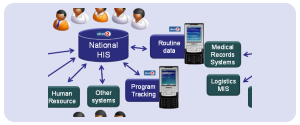
Among the key problems in the combination of software in the field of EHR for health care, is the attaining of interoperability, i.e., the capacity of various programs and software to process and exchange information appropriately. A diverse range of software applications for various functionalities is quite commonly applied in healthcare facilities, such as radiology, laboratory management and billing. When these systems are unable to automatically and uniformly transfer data between the EHR software and the system, it leads to fragmented data and inefficiencies.
- Proprietary Systems: There are unfortunately many proprietary legacy systems in health care and for that reason it is possible for them to only be used within those organizations, which is very difficult to transfer with third party applications.
- Lack of Standards: Despite attempts, including HL7 (Health Level Seven), to create the clinical data standard data exchange, clinical systems do not all implement or adhere to these standards.
Solution:
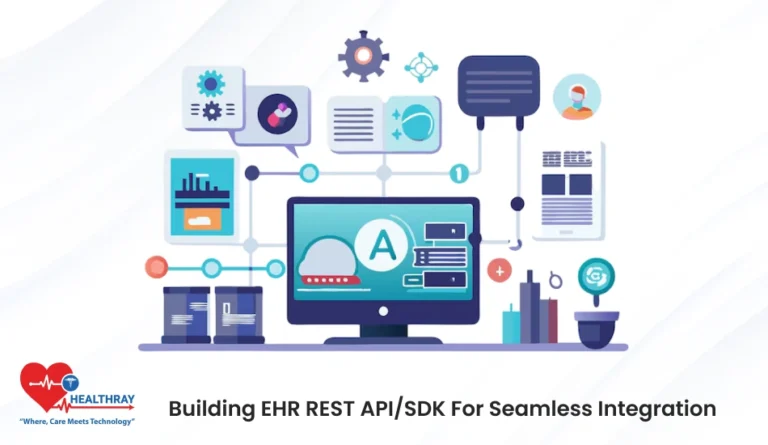
In order to address interoperability issues, healthcare institutions need to implement EHR systems using open standards such as HL7, FHIR (Fast Healthcare Interoperability Resources), and DICOM. These standards ensure that systems can share data seamlessly. Additionally, health care providers should give priority to vendor selection to focus on interoperability and provide API-based vendors to enable integration with third party systems.
Data Privacy and Security
Privacy and security are, of course, important issues to address when software is envisaged to be used for EHR [1]. Because of the digital nature of EHRs it is a leading target of cyberattacks in which hackers frequently try to get into sensitive patient data. Healthcare is subject to strict regulation, with violations of data protection legislation leading to severe financial penalties and credibility loss.
Cybersecurity Threats
Ransomware, phishing and data leaks are becoming more common in the healthcare sector. Unlawful access to EHR data may leak protected patient information and lead to identity theft or deterioration of treatment outcome.
HIPAA Compliance
Healthcare professionals need to make sure their EHR systems meet HIPAA and other regulatory standards like the General Data Protection Regulation (GDPR) if their system(s) operate outside the US.
Solution:
It is recommended that health-care institutions implement robust cybersecurity best practices, such as encryption, multi-factor authentication and 24/7 threat monitoring for suspicious behaviour. Regular audits and compliance monitors are essential in order to ensure that EHR systems fulfil all regulations. In addition, workforce training in data security best practices may reduce human caused errors, of which human caused errors are the most frequent perpetrator for data breaches.
High Implementation Costs
Nonetheless, for small healthcare facilities that have limited financial resources, electronic health record (EHR) software for healthcare can be very expensive. Costs are not restricted to the purchase of software, but also hardware augmentation, education and, ongoing support. With regards to the implementation phase, some of the facilities might also experience degradation/downtime that will negatively impact revenue.
- Upfront Costs: EHR software has high initial costs, such as buying licenses, clinic infrastructure and system integration.
- Ongoing Costs: Setting up, however, requires healthcare professionals to consider associated costs, e.g., software updates, support and cybersecurity.
Solution:
Healthcare organizations can also look at different pricing models (e.g., Software-as-a-Service (SaaS) in which they pay for the service on a monthly subscription basis instead of buying the system as one time big purchase). This model could, for example, help spread the costs over time and in general, make EHR software less expensive. Another is search for governmental incentives and grants to the EHR adoption can be helped to reduce the cost, to a certain degree. The financial implications of the long-term cost should also be well planned and budgeted through, however, to avoid financial burden when and after implementation.
Resistance to Change from Healthcare Professionals
Healthcare professionals, especially those who have been in practice for many years, can be resistant to adopting new technology. There are many doctors and nurses currently operating on paper-based systems and, as a result, may assume that any transition to an EHR system will raise their workload, or increase the time they will need to learn. This resistance may prevent it from operating at full speed, or even coming to an standstill, in the successful implementation of EHR software.
Learning Curve
It is not easy for health care professionals to use EHRs, especially when a physician is not also computer-literate. The learning curve may result in frustration and a lower output during the adaptation phase.
Fear of Job Displacement: Concern has been expressed by certain health care workers that automation through EHR will lead to job displacement with an added impact on administrative staff.
Solution:
Effective change management strategies are essential for overcoming resistance. Inclusion of HCPs in the selection and implementation phase could lead to increased buy-in and less resistance. Comprehensive training programs should be offered, and electronic health records (EHR) systems should be easily navigable to reduce the steepness of the learning curve. In addition, detailing the lasting benefits of EHR implementation, such as better patient care and administrative burden reduction, is an effective way to mitigate concerns.
Conclusion
Software to collate health record EHR tailored for health applications is one aspect of improving patient care, clinical efficiency, and adherence to legislation. However, it does have limitations including interoperability issue, data privacy and security concerns as well as hesitancy on the part of medical professionals. Using standardisation, robust security measures, and the delivery of an adequate level of training and support to all health workers, healthcare facilities will be in a position to use Hospital Management System.
Ultimately, the key to successful EHR into workflow integration is thorough planning, doing the right thing with respect to technology, and fostering a culture of innovation and openness to flexibility in the context of the health care delivery organization. As the EHR technology advances, eHRA solutions will empower healthcare users to provide quality of care, efficiency of care, and patient-centered care more effectively. thorough planning, choosing the right solutions, and fostering a culture of innovation and adaptability within the healthcare organization. As EHR technology continues to evolve, healthcare providers that embrace these solutions will be better equipped to deliver high-quality, efficient, and patient-centered.