

Summary
Cloud-based teleradiology with RIS is a silent revolution that makes no noise but has a profound impact. The clinics generally face issues with disjointed workflows rather than technology. Cloud RIS erases distance and streamlines the reporting and provides the right study to radiologists at the right time. It slowly evades manual handoffs, delays, and data chaos. Also, security, scalability, and compliance become a natural part of the RIS system. In this blog, I will discuss how Cloud-based teleradiology platform creates faster reports, better collaboration, and a dependable radiology ecosystem that performs calmly even during workload pressure. Keep reading!!!
Introduction
Building a cloud-based teleradiology platform is more than just a technological advancement; it is a practical solution to radiology’s daily problems. In the current healthcare ecosystem, images are moving in seconds. But reporting still remains slow due to location, manpower shortage, and disconnected systems. Here cloud-based RIS makes a difference in a simple scalable and reliable way. The issue is not with radiologist capabilities; rather, it is with system gaps. When RIS operates on the cloud, geography becomes irrelevant. With a radiology information system, a scan can reach the right subspecialist radiologist without any manual efforts. No data copying, no local servers, no confusion!!!
Teleradiology, when integrated into a Cloud-based teleradiology platform, organizes the entire workflow. All features, such as auto study assignment, modality-based routing, turnaround time tracking, and quality checks, become a part of the system. The entire process becomes smooth from Image acquisition to final report delivery. It evades the need of Pen drives, WhatsApp images, and follow-up calls. Also, security and compliance become strong. Role-based access, audit logs, and encrypted data sharing keep the patient data safe without weakening the accessibility.
Furthermore, scalability becomes an inherent advantage regardless of multi-location expansion, high-volume days, or night reporting. To put it briefly, RIS-PACS interoperability teleradiology software does not complicate radiology. It makes the system faster, calmer, and more dependable. Moreover, in healthcare, patient trust is the biggest currency.
Cloud-Based Teleradiology Platform and RIS Essentials
Imaging Without Borders
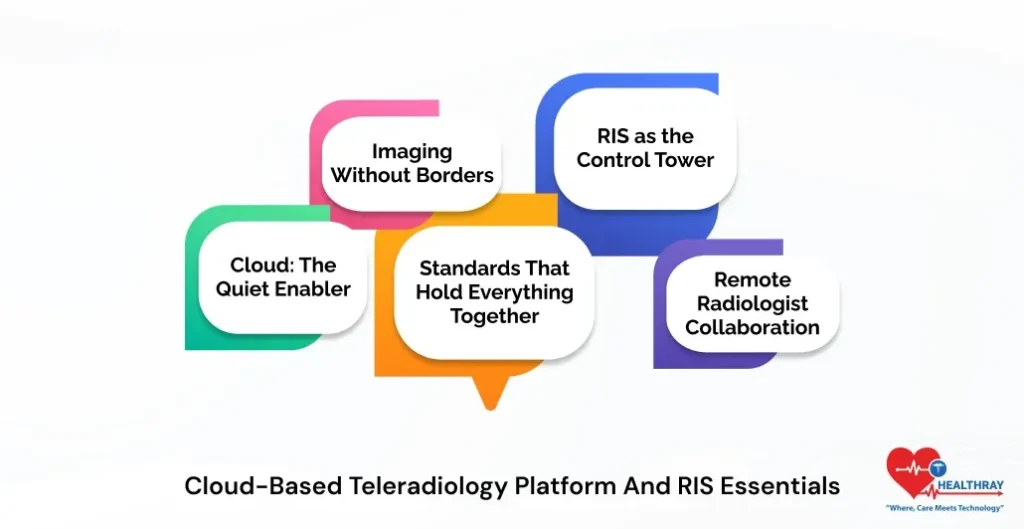
Teleradilogy core idea is simple. Images can be reported from anywhere. Furthermore, a Cloud-based teleradiology platform provides structure to this freedom. In order to maintain traceability and control over the workflow. Imaging without borders is not just about location freedom. Radiology’s real problem is not about distance; it’s about delay. A single scan is carried out in a small town, and any metro subspecialist can interpret the results. Without any unnecessary friction. Moreover, RIS here works as a traffic controller to ensure image, patient context, and urgency move in parallel. It dissolves border-related challenges and keeps the accountability and accuracy intact.
RIS as the Control Tower
The RIS role is not just limited to appointment booking. Simply put, RIS within a Cloud-based teleradiology platform is an invisible system that operates the radiology department smoothly. From patient registration to exam ordering, modality coordination, reporting, billing, and audit. Every step has connected workflows. Further, RIS silently works in the background and prevents delays, errors, and data loss. More importantly, radiologists can focus on diagnosis and the system quietly handles the chores.
Cloud: The Quiet Enabler
Unlike on-premise limits, a Cloud-based teleradiology platform provides elastic scaling. Further, the system performs calmly even if the volume increases or encounters surges. Whether clinics need to add new centers or want to extend night reporting, RIS is adept at handling this. Instead of becoming bottlenecks, infrastructure smoothly works in the background.
Standards That Hold Everything Together
DICOM handles images, and HL7 handles the patient details. Both work together to ensure that images and patient data remain aligned within a Cloud-based teleradiology platform. Furthermore, it helps the system to clearly communicate with others. It also assists the clinic in maintaining data consistency throughout the journey and preventing duplication. Additionally, it ensures information should move smoothly from scanners to reports. Overall, the RIS compliance & audit trail system relies on simple standards, prevent errors and assists clinics to make every step easy and reliable.
Remote Radiologist Collaboration
Remote collaboration is not about generating reports while sitting at home. In a Cloud-based teleradiology platform, radiologists can work on the same shared system. Further, radiologists can easily review the peers. They are able to get second opinions. Plus, they can escalate the urgent cases quickly to senior radiologists. All department works are executed on the same platform. Thus, it minimizes confusion and makes the quality better. Simply put, it eliminates distance barriers and allows teams to work smoothly.
 PRO TIP
Core Architecture Overview
Microservices at the Center
Microservices-based RIS is the base of the cloud teleradiology foundation. Here all functions, including scheduling, routing, and reporting, work independently. Thus, the RIS system remains flexible and stable throughout the journey.
RIS–PACS Strong Connection
In cloud architecture, the RIS is connected through PACS DICOM gateways. Furthermore, this system ensures images and metadata always remain in synchronization.
Local DICOM Gateways
Local gateways at hospital sites process studies. Further, they fetch data from scanners and securely move it to other departments without disrupting the workflow.
Smart Data Anonymization
Patient privacy starts from here. Additionally, when studies switch to remote reporting, gateways anonymize the data.
Rule-Based Study Routing
Rule-based study routing makes a Cloud-based teleradiology platform more intelligent. Further, RIS automatically prioritizes the urgent studies, such as neuro cases. Instead of random assignment help system workflows move as per case specialty and urgency.
Cloud Storage with Context
Cloud storage is not just about saving images. As the studies reach the cloud, the system automatically pulls old scans and images along with it. Moreover, the radiologist no longer needs to search histories, as the entire patient context is presented on the same screen.
Unified Worklists
RIS unified worklist minimizes the stress of radiologists. Further, cloud RIS creates a clear worklist of all studies fetched from different sites. It evades the need of multiple queues , radilogit can calmly handle multiple cases from a single place.
Edge Computing for Low Bandwidth
Edge computing is a vital resource for locations where internet facilities are not reliable. Further, clinics can perform basic processing, caching, or temporary storage on local systems. When the connection is stable, data smoothly synchronizes to the cloud. This makes the reporting process consistent and allows clinics to smoothly execute the daily operation even in remote locations.
Built to Scale Calmly
It implies clinics should evolve silently without making any background noise. Furthermore, a Cloud-based teleradiology platform remains functional even if the architectural volume increases. Whether it’s an imaging center or an entire network, the RIS system smoothly handles the loads. User can only view speed and stability; complexity is hidden in the background.
 NOTE
NOTE
Advanced Security Framework
Security Beyond Passwords
Only encryption will not save the cloud teleradiology data. Furthermore, the RIS system checks every access request in real time. It thoroughly checks user details, which system the user is using and overall context. Therefore, RIS prevents the practices from unauthorized access. It keeps the patient data protected at every step, whether the network is remote or multi-site.
Zero-Trust by Default
This is one of the best features of digital radiology workflow software. Furthermore, the system doesn’t automatically approve of any user-submitted content. The system authenticates login and action in real time. Regardless of whether the user is internal or external. Moreover, RIS validates every particular, such as authenticity, equipment, and geographical location. This radiology data backup strategy prevents the medical software from malicious attacks and illicit usage. Thus, it safeguards the confidential private information.
Identity-First Approach
Radiology access is not verified solely through a username and password. It is verified at three layer levels. First, it confirms the user identity. Secondly, it checks the device thoroughly. It verifies the authorized machine and network. And the individual who is registered in the system. Next, it examines the context factors, such as location, duration, and task relevance. These three layers ensure only the right person can access patient data and reports. Overall, it keeps the RIS system completely secure and accountable.
Smart Session Timeouts
If a user remains inactive in the system for some time, the RIS system automatically logs out the sessions. It is especially critical for shared workstations and public terminals. It prevents accidental exposure to sensitive data of patients. Apart from that, it minimizes unauthorized risks and keeps the workflow secure and compliance-friendly.
Geofencing for Control
Geofencing for control makes the system cognizant of location. Furthermore, access is permitted only from registered healthcare facilities, cities, and geographic areas. Ris automatically restricts access or transmits alerts if a login request is made from an unusual location or at an unexpected time. As we know, India has wide and diverse geography. Such additional control in the RIS system is a strong defense against data misuse and credential theft.
Learn more: Achieving Seamless RIS-PACS Interoperability
Implementation Best Practices
Start Small, Think Scalable
First initiate with MVP. Clinics should utilize RIS core and DICOM gateway only for 2-3 sites. This helps team members to understand the system functionalities thoroughly without creating unexpected operational situations.
Automate What Matters Most
Always keep a target that at least 80% of the workflow, such as registration, worklists, routing, and reporting, must get automated.
Measure ROI, Not Just Features
Success is not about making the system live without considering measurable inputs. It is crucial to measure Throughput, TAT, and reporting speed. A minimum 30% productivity gain is a practical benchmark.
Align with ABDM Early
Don’t make ABDM federation a final step. Furthermore, integrate it in advance. In order to facilitate incentives, compliance, and data continuity for clinics.
Choose the Right Integration Partners
For Custom APIs, clinics should work with experienced integrators like Healthray. A right-fit integration provides deeper long-term success than off-the-shelf. Also, read our blog RIS integration with EMR to know more about interesting features.
Conclusion
Cloud-based teleradiology provides a new shape to radiology by smoothly unifying rural needs with urban expertise without creating any delays or location barriers. Platforms like healthray provide fast ROI through automation. In 2026, providers using cloud teleradiology will be at the forefront of precision diagnostics nationwide.