
Revenue leakage in hospitals is money earned by treating patients but never collected. It commonly occurs when IPD charges are missing from bills, TPA and government-scheme settlements come back short, or cash counter discrepancies go unnoticed.
One of the difficulties is that these gaps are not always visible in the final bill. A service may appear in the nursing chart, OT register or lab register without its corresponding charge being recorded.
Identifying such gaps requires comparing the bill against the patient’s other records to establish what was delivered, what was billed and what remains uncollected.
This guide covers 15 common hospital revenue leaks, the records to check for each one, and which gaps to prioritise fixing first.
What Counts as Hospital Revenue Leakage, and What Does Not
Revenue leakage is revenue a hospital has earned but failed to collect in full. It usually happens in one of four ways:
- Unbilled: The service was delivered, but no charge was posted.
- Billed incorrectly: The rate, room category or payer was recorded incorrectly.
- Avoidable deductions: A payer reduced the claim because of a preventable error, such as missing documentation or incorrect coding.
- Uncollected: The bill was raised, but the outstanding payment was not recovered.
Lost opportunity is different. A patient buying medicines from an outside pharmacy is not revenue leakage. An idle operating theatre is not leakage either. In these cases, the hospital has not earned the revenue in question. These are growth opportunities and need a separate plan.
How to Find Leaks in Your Own Records
Start with a small sample of recently discharged IPD files and compare them against the relevant hospital records.
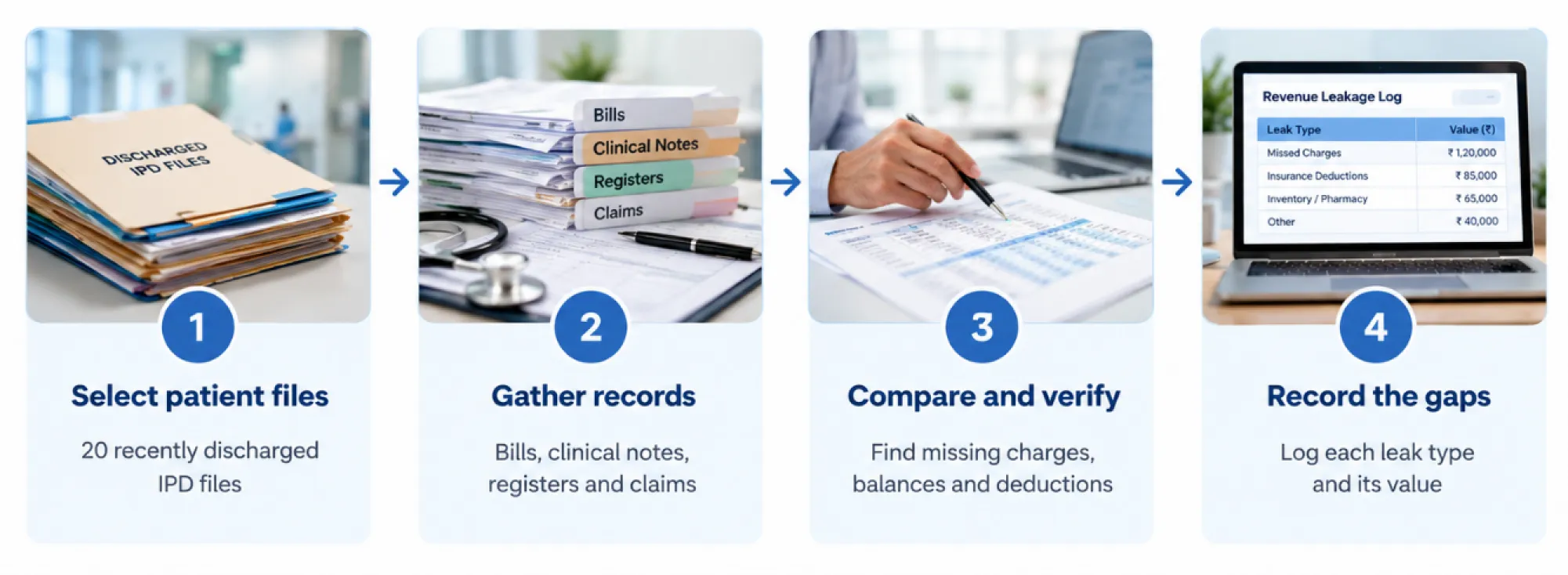
Step 1: Pick 20 files. Choose 20 recently discharged IPD files. Include cash, TPA and government-scheme patients.
Step 2: Collect the records. For each file, gather:
- The final bill
- Nursing notes and procedure records
- Ward and OT consumable issue registers
- Bed-transfer logs
- Claim and settlement records, where applicable
Step 3: Compare. Match each record against the final bill. Look for four things:
- Missing charges
- Incorrect rates
- Outstanding balances
- Unexplained deductions
Step 4: Tally up all the discrepancies on one paper, having one row per document file and one column per type of leak. Indicate the value of each discrepancy and whether it was verified.
The results give you an initial baseline of the gaps found in the sample. These numbers do not account for the overall monetary loss your hospital is experiencing. Utilise the data in order to determine where the problems lie.
Paper records work as well as software for this initial check. What matters is comparing the records consistently.
 PRO TIP
Leaks at Registration and Admission
The first three leaks originate during registration and admission. Catching these errors early helps prevent incorrect billing, authorisation issues and avoidable payment delays at discharge.
1. Wrong Payer Category at Registration
What it looks like: A cash patient is registered as insured, or a TPA, CGHS, ECHS or PM-JAY patient is assigned the wrong payer category. This can result in charges being calculated using the wrong rate card.
Record check: Compare the payer category recorded at registration against the patient’s policy or scheme details. Then check the final bill and settlement records, where available, for rate or payment discrepancies.
Fix: Verify payer eligibility and the applicable billing category before the first charge is posted. A card alone does not confirm eligibility for every service or package.
2. Pre-authorisation Missing, Lapsed or Not Enhanced
What it looks like: The treatment plan changes, the stay gets longer, or the authorisation expires without renewal or an enhancement request when required. The final bill may then exceed the approved amount, leaving some charges unrecovered.
Record check: Compare the approved amount and validity period with the interim bill, final bill and authorisation correspondence.
Fix: Assign one person to track approval limits and validity periods and request enhancements when needed. Follow up on the payer’s decision, as an enhancement request does not guarantee approval.
For PM-JAY claims, please use the appropriate pre-approval and treatment approval process. Incomplete documentation will result in a query or a delay depending upon the situation.
3. Deposit Not Collected or Topped Up for Cash Inpatients
What it looks like: The patient who pays cash has a bill that is more than the deposit, thus resulting in a balance that is difficult to collect from the patient after discharge.
Record check: Deposits, interim billing, receipts and balance at the time of discharge should be verified.
Fix: Verify the bill total against the deposit at certain times and inform the patient of the balance prior to discharge.
Leaks During the Stay
Many charge capture discrepancies happen while the patient is in the hospital. Services and supplies are captured by one department, while billing occurs in another department. Unless there is reconciliation, some charges may be overlooked.
4. Consumables Used but Not Charged
What it looks like: A nurse issues a catheter set or dressing pack from the ward store. The item leaves the shelf, but the corresponding charge never reaches the patient’s bill.
Record check: Compare ward and OT consumable issue registers with patient bill entries.
Fix: Record chargeable consumables against the correct patient and reconcile them with billing records. Automated charge capture in hospital billing systems can help record billable supplies and services from clinical workflows, reducing reliance on manual entries. Exclude items that were returned, unused or already included in a package.
5. Implants and High-Value Items Missed or Billed at the Wrong Rate
What it looks like: An implant is involved, but there is no charge for it. Or the charge is made at an incorrect rate as per the rate list of the respective payer.
Why it matters: One single implant mistake may be more significant than multiple consumable discrepancies.
Record check: Check the implant register, labels/stickers, procedure notes and billing entry. Compare the charged rate with the rate list of the respective payer.
Fix: Make sure that there is an appropriate implant charge and rate before closing the invoice. In case it is a package deal, then make sure you do not forget about the implant charge.
6. Bedside Procedures and Nursing Services Not Posted
What it looks like: A nurse applies a dressing or performs catheterisation and other bedside procedures for which there is a fee, but the service is not billed. An eligible nursing service could be overlooked if it is not documented and charged against the patient’s bill.
Not all nursing activities have separate charges. Bill according to the approved tariff and payers’ terms.
Record check: Compare the nursing charting and procedure sheets with the bill to find out if there are any payable services unbilled.
Fix: Use a clear charge checklist based on approved tariffs and payer terms. Assign responsibility for recording and posting eligible services during each shift.
7. Doctor Visits and Cross-consultations Not Billed
What it looks like: The expert comes to the ward, and the visit is recorded in the patient record; however, the consultation charge is not included in the bill.
Record check: The documentation of the visit by the physician and the cross-consultation are checked against the bills to see any eligible consultation charges that are not recorded.
Fix: Verify the recorded visits against billable consultations before billing. Also, look out for double-billing.
8. Bed or ICU Days Billed Under the Wrong Category
What it looks like: The patient is moved between the ICU and ward, but the charge classification remains the old one, or an incorrect number of days has been charged.
Record check: Check for consistency between bed transfer records, actual occupancy dates, and room/ward/ICU charges in the bill.
Fix: Ensure billing reflects documented bed transfers, the correct number of days and the applicable rates.
9. Package Overruns Not Reconciled
What it looks like: The patient spends more time or requires extra things apart from the package, but no one evaluates the difference.
Why it matters: Billing ineligible charges to the payer will result in rejection of the claims. Not billing eligible charges will cause the loss of revenue.
Record check: Compare package inclusions, actual services, stay duration and the payer’s rules.
Fix: Flag deviations early and confirm which additional charges the payer allows before billing them. Not every overrun can be billed separately.
For PM-JAY cases, check the applicable package guidelines before billing separately for additional services. Package rates generally cover the specified treatment and associated services, so extra charges are not automatically payable.
10. Pharmacy Issues Not Linked to the Patient’s Bill
What it looks like: Medicines are dispensed for a patient without any charges made against them, or there is an error in recording returns and credits.
Record check: Look for pharmacy issues related to patient returns and credits compared to the final bill.
Fix: Link dispensing and returns to the correct patient account. Reconcile any gaps before discharge, and check whether the package already includes the medicines.
Catch Missed Charges Before the Patient Leaves
Charge gaps can be resolved more easily when the patient is still hospitalised. Check out how Healthray medical billing software aligns with transitions between the wards, OT, pharmacy, and billing department.
Leaks at Billing and Discharge
Billing and discharge checks help hospitals identify unauthorised discounts, cash discrepancies and unpaid patient balances before the patient account is finalised.
11. Discounts Given Without Approval
What it looks like: A discount is given at the counter, but nobody with authority signed off. Sometimes an approved discount is applied twice.
Record check: Compare the discount register with approved limits, authorisations and adjustment records.
Fix: Set approval limits by role. Review exceptions regularly.
12. Cash Collections That Do Not Match Receipts
What it looks like: The cash in the drawer doesn’t tally with the total amount registered in the system.
Record check: Compare cash closing for every shift with receipts and refund totals entered in the system.
Fix: Collect money every day and reconcile it. A reconciled record for every shift, done by two people, will reveal any discrepancies. Any discrepancy should be investigated.
 NOTE
13. Patient’s Share on Insured Bills Not Collected at Discharge
What it looks like: An applicable co-payment, non-covered item or room-category difference remains unpaid after discharge, even though the amount is payable by the patient under the policy terms.
This leak applies to insurance and TPA bills where the policy makes the patient responsible for part of the cost. Under PM-JAY, hospitals must not charge beneficiaries for covered treatment under the scheme’s applicable rules.
Record check: Compare the estimated patient liability with the policy terms, final bill and amount collected.
Fix: Estimate the patient liability prior to discharging the patient and provide clear information regarding the same to the patient or relatives.
Leaks After Discharge: Claims and Settlements
After discharge, hospitals can lose revenue through delayed or incomplete claims and deductions that go unchallenged. The following checks help identify these gaps and reduce the risk of missed reimbursement.
14. Claims Submitted Late or with Missing Documents
What it looks like: Claims get delayed, queried or rejected. Documents are missing, incomplete or sent after the deadline.
Deadlines can be tight. The NHA’s PM-JAY Operation Manual expects empanelled hospitals to upload all claim-related documents within 24 hours of discharge of the beneficiary. Timelines can change, so confirm the current instructions.
Record check: Compare discharge dates, claim submission records, payer-specific document checklists and query-response records with the relevant steps in the medical billing process to identify where delays or documentation gaps occur.
Fix: Give each claim an owner. Check documents before submission, and track each payer’s deadlines. Do not assume one deadline fits every TPA or scheme.
15. Deductions Accepted Without Checking
What it looks like: The TPA or scheme pays less than expected. Nobody investigates the difference.
Why it matters: Accepting every deduction leaves recoverable money behind. Challenging valid ones wastes time.
Record check: Compare the submitted claim, the settlement advice, the applicable rate or package terms, and the recorded deduction reasons.
Fix: Sort deductions into groups. Spot the ones you may recover. Then challenge eligible deductions within the allowed time.
Some deductions are valid. An item that truly isn’t payable is not leakage. The aim is to differentiate between fixable and non-fixable items. Reviewing the healthcare billing workflow from charge capture to final payment also helps hospitals understand where gaps can affect collections.
Time limits matter here. Under the PM-JAY claim management guidelines, an empanelled hospital has a right of appeal against a rejected claim. An appeal may be made within thirty (30) days of the said rejection being intimated to the hospital to the District-level Grievance Committee. Rules can vary by state and scheme version. So confirm the current process before you file.
Which Leaks to Fix First
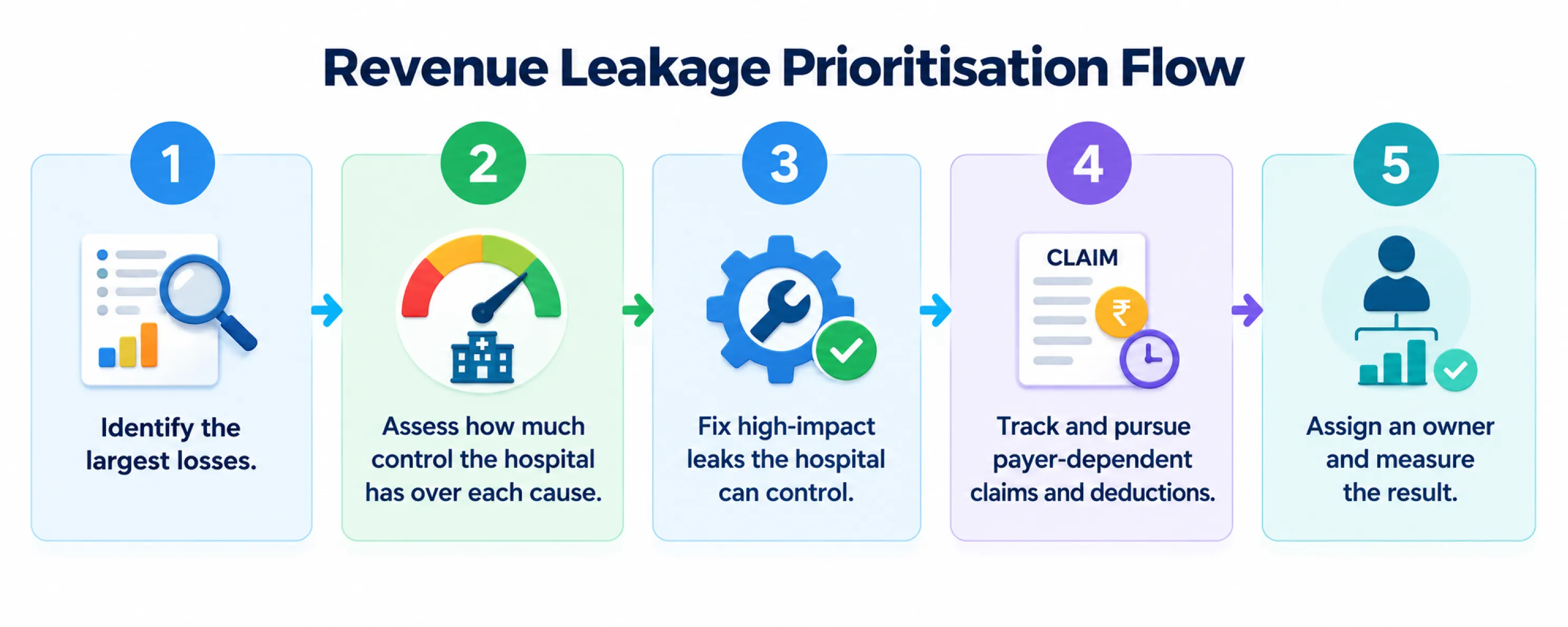
After your audit, the tally sheet will show where revenue is being lost. You cannot fix every gap at once, so prioritise leaks based on four factors:
- Amount: How much money is involved?
- Frequency: How often does the leak occur?
- Recovery: How likely is it that the money can still be recovered?
- Control: Can your hospital address the cause directly?
Score each leak from 1 to 3 on each factor, using higher scores to indicate greater priority. Fix the highest-loss leaks your hospital can control first, then track payer-dependent claims and deductions separately, as recovery may take longer.
Start with charge-capture gaps during the stay (leaks 4–10) if your audit shows they account for significant losses. One process change may resolve several recurring gaps. Next, address deposit shortfalls and uncollected patient shares (leaks 3 and 13) through clear collection rules and checks before discharge.
Claims and deductions (leaks 14–15) depend partly on payer decisions, documentation and deadlines. Track these separately, as recovery may take longer.
Hospital Revenue Leakage Map
Use this table to identify which records to check and which team should investigate each revenue leak.
| Leak | Stage | Records to check | Responsible team |
|---|---|---|---|
| Incorrect payer category | Registration | Registration and payer records | Front desk / TPA desk |
| Missing or lapsed authorisation | Admission | Authorisations and running bills | TPA desk / treating team |
| Deposit shortfall | Admission and stay | Deposit records and outstanding balances | Billing/accounts |
| Unbilled consumables | During the stay | Ward and OT issue registers | Nursing / OT / stores |
| Missed or mispriced implants and high-value items | During the stay | Implant register, procedure records and payer rates | OT / stores/billing |
| Unbilled bedside procedures | During the stay | Nursing notes and procedure records | Nursing/billing |
| Unbilled doctor visits | During the stay | Visit notes and consultation records | Clinical teams/billing |
| Incorrect bed or ICU category | During the stay | Bed-transfer logs and billing records | Ward desk/billing |
| Unreconciled package overruns | During the stay | Package records and payer rules | Billing / TPA desk |
| Pharmacy issues missing from the bill | During the stay | Pharmacy issue and return records | Pharmacy/billing |
| Unauthorised discounts | Billing and discharge | Discount register and approval records | Billing/accounts |
| Cash and receipts mismatch | Billing and discharge | Cash closing records and system receipts | Billing/accounts |
| Uncollected patient share | Billing and discharge | Patient-liability estimates and final bills | Billing / front desk |
| Late or incomplete claims | After discharge | Claim submissions and query records | TPA / claims desk |
| Deductions accepted without review | After discharge | Claims and settlement advice | TPA / accounts |
Wrapping Up
Hospital revenue leakage shows up as a gap between three things: services delivered, bills raised and payments received. The evidence usually sits in registers, notes and settlement advice your hospital already keeps.
Leakage is not a mystery number or proof of bad staff. It is a set of gaps that can be identified by comparing bills with existing records.
This week, select 20 discharged IPD files and run the four comparisons covered in this guide. Record the gaps you find and identify which ones need follow-up.