
Before deciding whether to buy hospital software, I’d look at what it may cost and what financial benefits it could bring to your hospital.
Your current records can help you estimate what might change. The result may show that the expected benefits cover the costs, or that they don’t. Either result is useful when making the decision.
In this Healthray guide, I’ll show you how to calculate hospital management software ROI before buying. You can use the method for software from any provider.
What Does ROI Tell You Before You Buy?
The ROI of hospital management software compares the financial benefits you expect it to bring with what you expect it to cost over a period you choose.
ROI (%) = [(estimated financial benefits − estimated costs) ÷ estimated costs] × 100
A result of 0% means the estimated benefits equal the estimated costs. Above zero, the estimated benefits are higher. Below zero, they are lower. You need a cost greater than zero to calculate the percentage.
Before purchase, the result is a projection, not a guaranteed return. It is only as useful as the figures and assumptions behind it.
Payback answers a different question: how long will it take for the expected benefits to cover what the hospital spends on the project, including ongoing charges? An ROI percentage for one period won’t tell you that on its own.
To estimate payback, add up the expected benefits and project costs as they occur. Payback is the point at which the total benefits cover the total costs so far. Your estimate may show that this does not happen within the period you’ve chosen.
Step 1: Choose the Period for Your Estimate
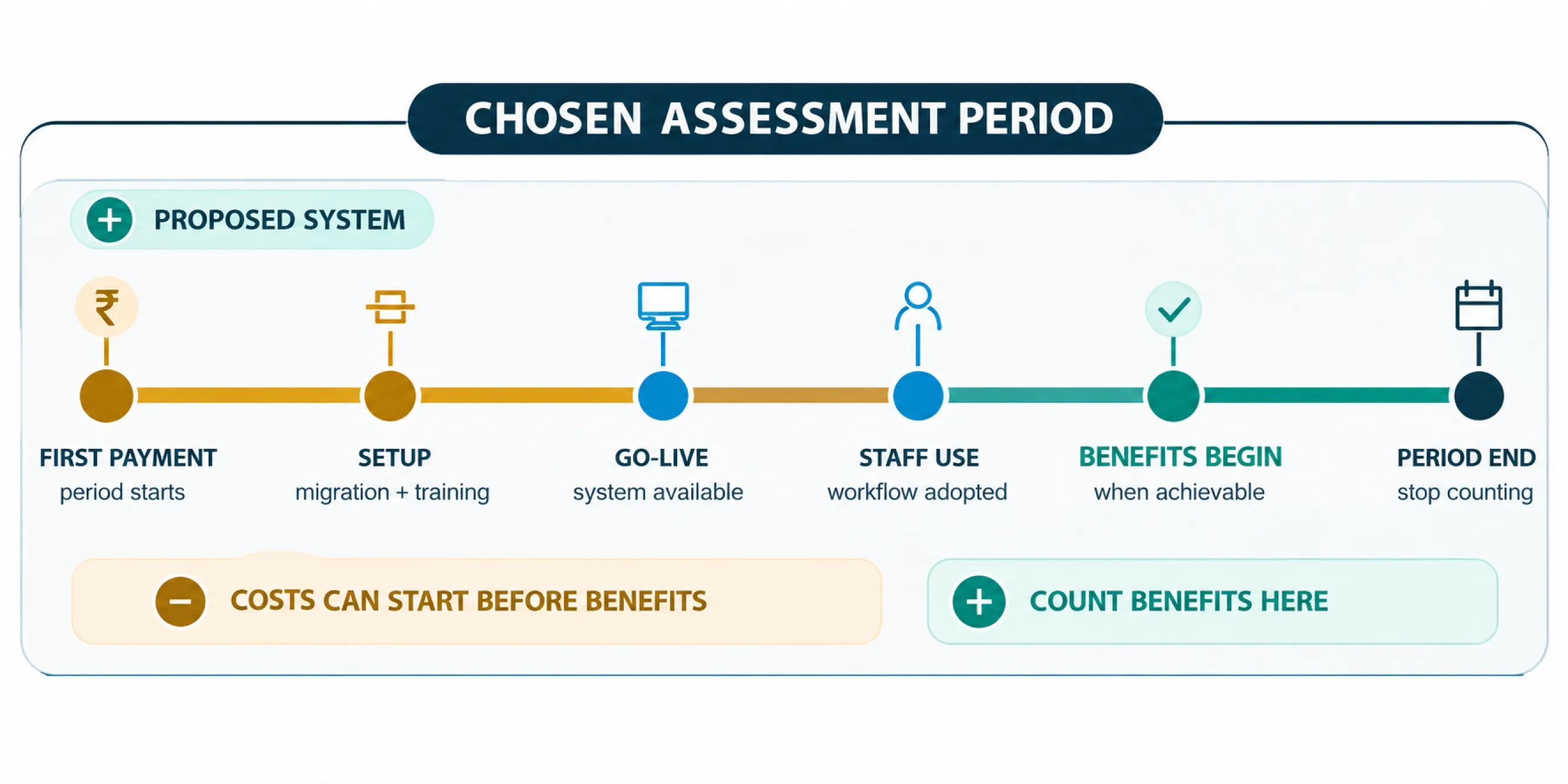
Decide how long you want to assess the investment. You might choose a year, a quarter or another period that helps your hospital make the decision.
To assess the investment, start with the first project cost you expect to pay, including setup before go-live. Include benefits expected within the same start and end dates.
If the system won’t be ready at the start of the period, don’t assume benefits begin on day one. Ask when it is expected to go live and when staff can use the functions behind each estimate.
Compare the proposed system with what you expect would happen without the purchase. That starting point might involve manual processes, existing software or a mix of both. Include changes you already plan to make without the proposed system, so you don’t credit it for those improvements.
Step 2: Gather the Figures Your Hospital Already Has
To estimate a benefit, first work out what is happening now. The records may sit with different teams:
- Billing and insurance: Service records, final bills, claim decisions, write-offs and receipts.
- Pharmacy and stores: Stock purchases, expiry reports and write-off registers.
- Laboratory: Test logs, bills and receipts, plus reagent purchase and expiry records.
- Accounts and HR: Invoices, payroll, overtime, agency costs and bank or overdraft statements.
- Operations: Patient admissions, discharge records and bed-use reports.
Pick the records relevant to the changes you want to assess. If a report is missing, check manual registers or ask the team to review a sample.
Record the dates, how the sample was chosen and any gaps. A figure reconstructed from incomplete records is an estimate.
When sharing the calculation, use totals and remove patient-identifying details.
 TIP
Examples of hospital records that can support your ROI estimate.
Step 3: Estimate the Costs
List the costs of introducing and using the proposed system during your chosen period. A supplier’s quote can help, but ask what it includes before treating it as the full cost.
- One-time costs: Setup, moving old data, connecting other systems, training and additional computers or network equipment.
- Running costs: Subscription, hosting, support and upgrades.
- Other project costs: Additional staff spending for setup or changeover and other expenses caused by the purchase.
Ask who will do the work during training or migration and whether that will create additional spending. Check what support covers and whether an existing contract has an exit charge or overlaps with the new one.
Decide When to Count the Payments
This guide uses a cash estimate: compare additional money paid, received or saved within your chosen dates with what would happen without the purchase. It is before income tax.
If you pay an annual subscription in full during the quarter you’re assessing, include the full payment. Review later costs and benefits separately; a negative quarter alone doesn’t establish that the whole investment will be loss-making.
If that subscription covers 12 equal months starting with the quarter, finance may instead allocate three months of cost to it. This accounting view does not change the cash paid.
Finance should record benefits in the periods they relate to, rather than simply when cash moves, and show actual cash payments separately.
In this guide, don’t count a bill as additional revenue if it would be paid later anyway. Record the earlier receipt and the corresponding reduction in a later period separately. Faster collection may reduce interest only if borrowing actually falls.
Record each figure’s source or assumption; mark an unknown material cost as missing, not zero.
Count a fee you would otherwise pay during the period as a benefit if the new system lets you stop it, not as a reduction in system cost. Fees you would pay anyway, and money already spent are not additional costs of this decision.
Step 4: Estimate the Benefits of Hospital Management Software
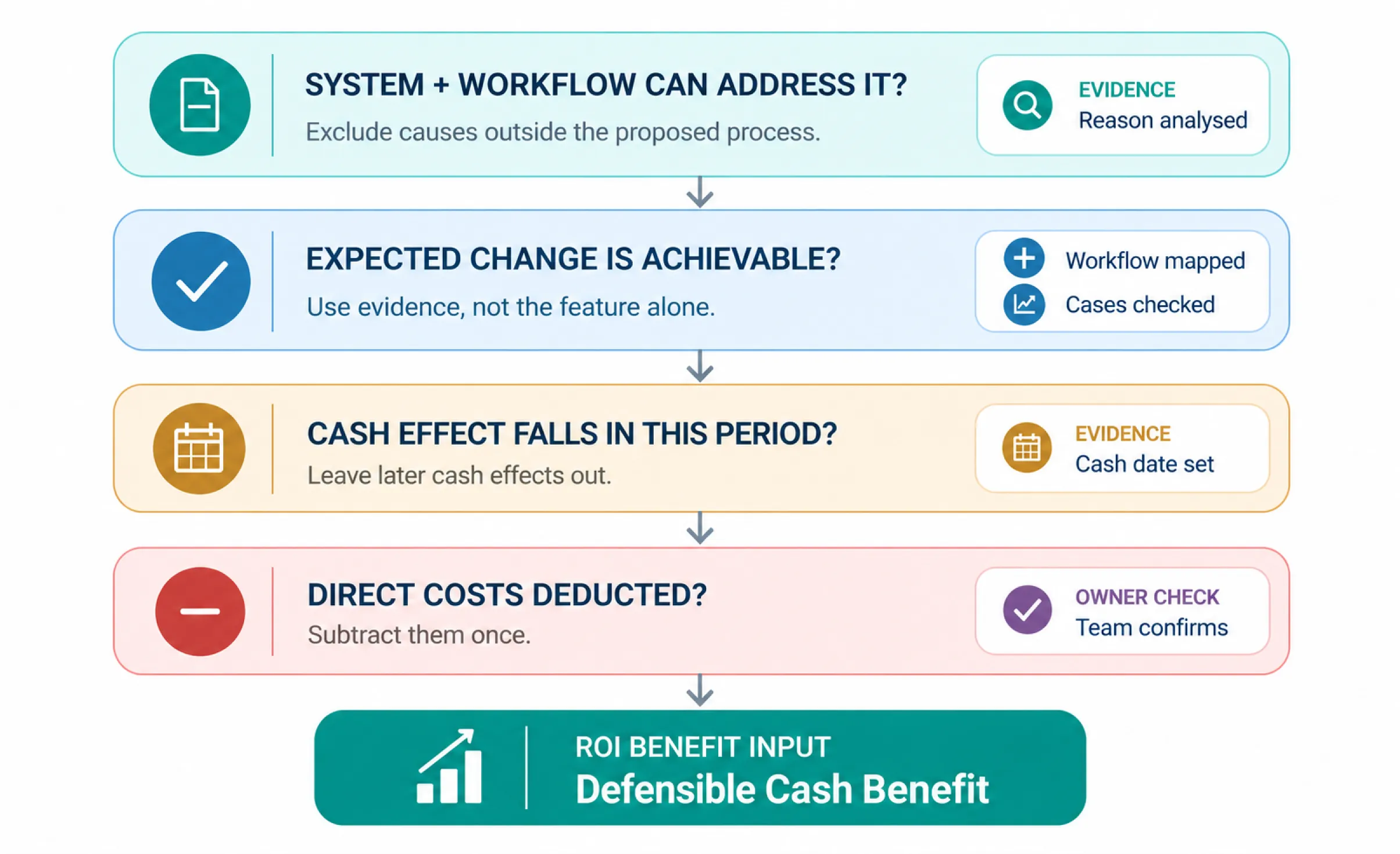
Look for changes that could affect money collected or spending during the period. Healthray’s guide to hospital management system modules can help you identify the areas to examine.
Choose the benefits relevant to your hospital and the proposed system. For each one, record the current figure, the change you expect, why you think it is achievable and when it could begin.
How Do You Estimate a Change Before Buying?
Records show your starting point, not how much new software will change it.
Ask the billing team to group a sample of finalised claim write-offs by reason. Identify which the proposed system and staff could address and which depend on payer decisions.
Ask the supplier what the relevant function does, and the billing team what work would need to change.
For the reasons the system could address, estimate the amount written off and how much could be prevented and collected. Check records of similar corrected or recovered cases; record your assumption and expected collection date.
A software feature alone is not proof of a saving. An Israeli primary-care study reported lower referral costs during a programme combining changes to an existing electronic record system, referral policies and staff training.
It does not establish that software alone caused the change or prove a hospital-wide ROI.
If you cannot support an important assumption, mark it as uncertain. Try more than one clearly labelled scenario; a scenario is an estimate, not evidence that the change will happen.
Count Each Cost Once
Deduct cash costs tied directly to a benefit from that benefit, such as claim-recovery spending from collections. Don’t also enter that spending in project costs; keep other setup and running costs there.
Different cost groupings can change the ROI percentage even when the cash gain is the same, so compare proposals on the same basis. Record expected lost revenue as a negative benefit and additional expenses as costs; don’t count the same loss twice.
Hospital Software ROI Calculation: A Worked Example
The figures are fictional monetary units, not a software price, real result or benchmark. The example uses three benefit areas; choose those relevant to your hospital.
The quarter begins with the first project payment. Assume the system is ready before the changes occur, the system and process cause them, and all collections and purchase savings occur within the quarter. There are no extra recovery costs.
First, Calculate the Claim Benefit
A write-off is an amount the hospital no longer expects to collect. Suppose 3,000 units in comparable claims reach final decisions this quarter. At a 10% write-off rate, 300 units would be written off without the purchase.
Suppose 120 of those 300 units relate to missing claim information the proposed system and staff process could address. Assume the hospital could prevent and collect 75% of that amount: 90 units within the quarter.
That leaves 210 units written off (300 − 90), or 7% of 3,000. The fall is 3 percentage points, or 0.03:
3,000 × 0.03 = 90 units in estimated benefit.
The 75% assumption is fictional, not a benchmark. Ask the billing team why your expected improvement is achievable and when collections could arrive.
Then, Calculate the Pharmacy Benefit
Suppose medicines lost to expiry cost 70 units in a comparable period. The hospital estimates that loss could fall to 40 units with the proposed process.
70 − 40 = 30 units. For the example, assume the reduction means the hospital pays 30 units less for replacement stock during the quarter.
Then, Calculate the Lab Benefit
Suppose 8% of separately billable tests are missed and would otherwise remain uncollected. The hospital estimates this could fall to 6%: a change of 2 percentage points, or 0.02.
For 500 eligible tests, 0.02 × 500 = 10 additional tests billed. Assume each brings 3 units within the quarter:
10 × 3 = 30 units. These directly billed tests are separate from the claim benefit.
Now Calculate Projected ROI
The three estimated benefits total 90 + 30 + 30 = 150 units. Assume the total software-related costs paid during the same quarter are 100 units.
Projected ROI = (150 − 100) ÷ 100 × 100 = 50%
The estimated net benefit is 50 units. The result depends on the assumptions above; it does not mean the hospital will achieve that return.
What If the Claim Improvement Is Smaller?
Keep the other figures unchanged, but suppose the team expects to prevent and collect 25% of the 120 units instead. The claim benefit is 30 units and the write-off rate falls from 10% to 9%.
Benefits total 30 + 30 + 30 = 90 units. With 100 units of cost, projected ROI is (90 − 100) ÷ 100 × 100 = −10%.
This fictional scenario shows why I’d check the evidence behind the largest expected benefit.
Not Sure If Hospital Management Software Is Worth It?
We’ll help you calculate the ROI using your own costs, free of charge.
How to Estimate Each Benefit From Your Records
1. Services That Were Not Billed
Ask the billing team to compare service records with final bills and identify missed charges. Estimate how much the proposed process could recover.
Count what you expect to collect within the period that would otherwise remain uncollected, less extra recovery costs. Don’t also count it under claims or lab billing.
2. Insurance Amounts Written Off
Use comparable claims with final decisions, grouped by insurer and service. Use the same set of claims for both figures:
Write-off rate (%) = value written off ÷ value of comparable finalised claims × 100
Ask finance how your hospital defines claim value and use the same basis across periods. Multiply the expected fall in percentage points, as a decimal, by the comparable claim value expected during your period.
Count only amounts expected to be collected within those dates, less extra recovery costs. A first-submission rejection corrected and paid is not a write-off; don’t count its full value as recovered revenue.
3. Interest Saved If Payments Arrive Earlier
The accounts receivable (AR) report shows money owed to the hospital. Days in AR estimates collection speed: average receivables ÷ average daily credit revenue (the amount billed per day for later payment). Definitions vary, so compare consistently.
Days in AR does not show how much borrowing would fall. Ask finance to estimate the change in loan balance and its duration. If borrowing falls, a simple estimate at a constant annual rate is:
Interest saved = average borrowing avoided × annual interest rate × days in the period ÷ 365
Enter the annual rate as a decimal and check the lender’s calculation and payment dates. Count only the savings that reduce an interest payment during your chosen period. If borrowing would not fall, don’t assume an interest saving.
4. Staff Costs That Could Fall
Review payroll, overtime and agency bills. Ask the relevant manager which spending could realistically fall under the proposed process, while maintaining the staffing coverage the hospital needs.
Time freed up is not automatically a cash saving. If the plan is to use that time for additional paid patients, estimate their contribution instead. Don’t count the same gain twice.
5. Pharmacy Stock Losses
Use stock purchase and expiry records to find the purchase cost of medicines currently lost. Estimate a reduction only where you can explain how the proposed process could prevent losses.
For a cash estimate, check whether purchasing would actually fall within your chosen period. Allow for changes in stock levels and activity. Use the purchase cost of medicines, not their selling price.
6. Lab Tests and Supplies
Compare completed tests with final bills and receipts. Check with lab and billing: a missing separate charge may be included in a package or claim, waived, or billed and paid later.
Count a test as eligible only if it should be billed separately. For this estimate, count a missed charge only if you expect it to remain uncollected without the purchase. Compare current and expected rates for similar work:
Missed-billing rate = missed billable tests ÷ all eligible tests × 100
One estimate is:
Lab billing gain = expected fall in missed-billing rate (as a decimal) × eligible tests × expected collection per additional billed test − extra recovery costs
Use expected collections within the period, not list price. Check receipts for comparable tests, including unpaid ones, and whether they were paid later.
Count the gain here or under missed bills or claims, not twice. Deduct extra recovery costs here, not again in project costs.
Review expired or discarded reagents. Estimate a saving only if purchase spending falls during the period; allow for test volumes and prices.
For repeat tests, ask the lab quality lead and a clinician which are avoidable and count only spending that falls. Clinically required repeats and required quality-control work are not waste. Don’t double-count reagent or repeat-test savings.
7. Extra Patients Treated
Check demand, staffing and capacity before assuming the proposed system will let the hospital treat more patients. Use admissions, bed-use, billing and case-cost records to estimate how many additional paid patients the change could support.
Multiply that number by the contribution per patient: the expected payment collected minus extra treatment costs, such as medicines or consumables. For a cash estimate, use collections and extra payments expected within the period. Ask finance which costs apply.
Don’t also include those extra treatment costs in the project-cost total. Bed occupancy or revenue per bed may help you examine capacity, but neither is the profit from an additional patient.
8. Paper, Printing and Storage
Review invoices and storage contracts. Estimate a saving only if spending could actually fall. For example, the hospital might reduce an order or change a storage contract.
Step 5: Check Tax for Hospital Management Software in India
Check whether GST is included in the expected payments; don’t add it again if it is already in the total. Ask your accountant whether the hospital can claim any credit and when that would reduce tax paid.
Also check whether tax associated with extra receipts would affect the estimate. Count each cash effect once and within the relevant dates.
The example above is before income tax. Ask your accountant how subscription, licence and setup costs would be treated, and whether depreciation applies. Depreciation is not a cash refund by itself; don’t treat it as a second cash payment on top of the purchase cost.
If you need an after-tax estimate, have your adviser adjust the expected cash figures consistently before using the ROI formula. Don’t assume a fixed tax saving.
Step 6: Put Your Hospital’s Estimate Together
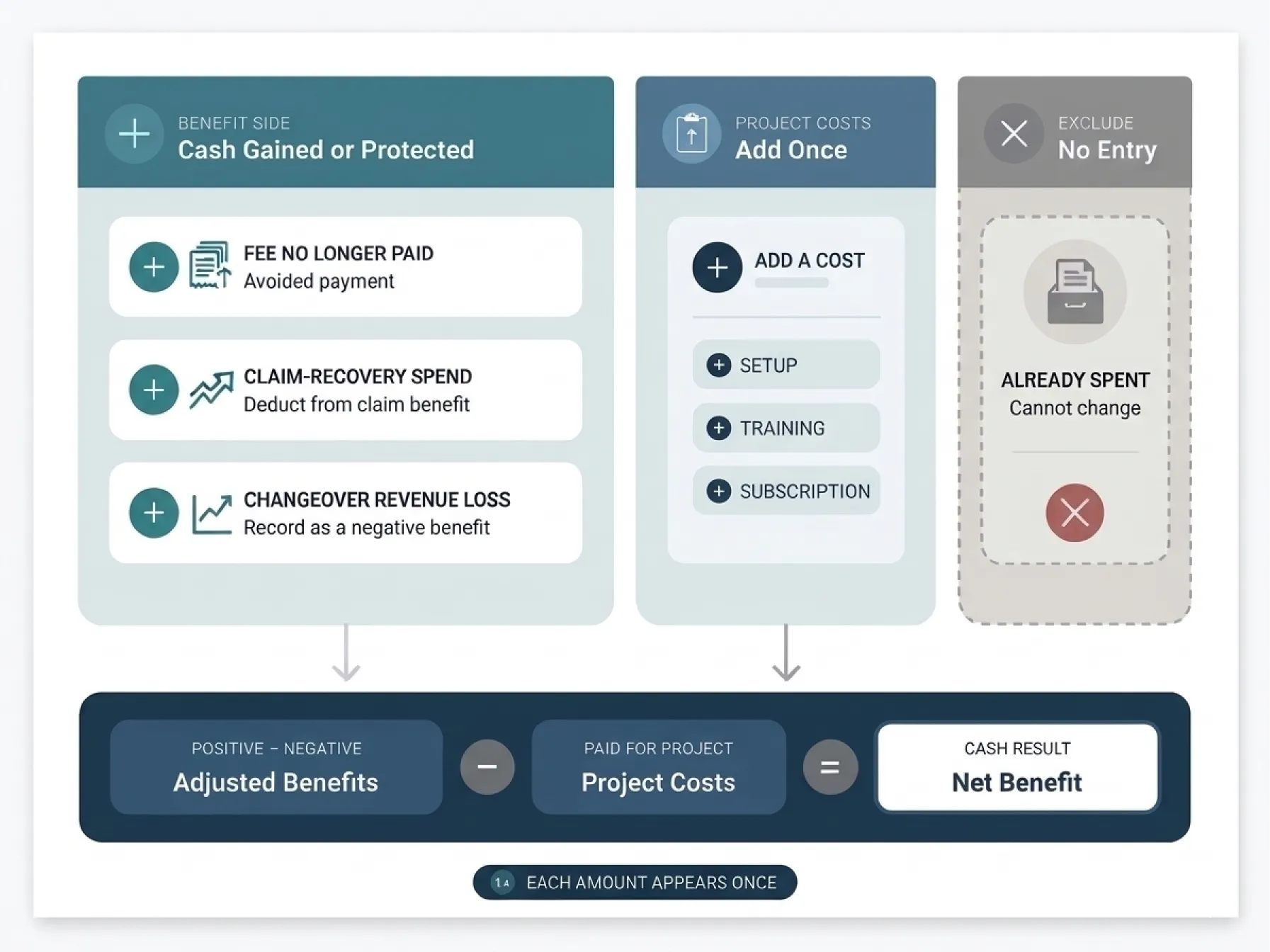
Once you have your figures, organise them like this:
| Item | Your figure | How it enters ROI |
| Additional collections and avoided payments | ______ | Add to benefits for the chosen dates. |
| Extra payments directly tied to a benefit | ______ | Deduct once from that benefit. |
| Software and other project payments | ______ | Add to the project-cost total. |
Record the source, assumptions and date for each figure, including the expected go-live date. Mark material unknowns as missing, not zero; a result that leaves them out is incomplete. Disclose the gaps when sharing it.
For the budget, add benefit-specific and project payments to see expected cash outflows for those dates. This is a separate check; don’t enter that total as a second cost in the formula. Note when payments and collections are expected.
Use the formula, then change an uncertain assumption to see how much the result moves.
Look Beyond the Projected Percentage
The financial result won’t capture everything. Nguyen and colleagues’ Australian digital-hospital framework considers effects on patients and staff as well as hospital finances.
For your decision, list expected effects on patient experience, clinical safety, staff workload and access to records beside the estimate, even when you cannot give them a reliable rupee value.
For example, ask how staff would access records during an outage, who would be able to view them and how the hospital could retrieve its data if it changed providers.
What Should You Do With Your ROI Estimate?
I’d review the largest expected benefits and costs with the teams responsible for them. Ask what supports each assumption, what could delay it and how much the result changes if the expected benefit is smaller.
Compare the estimate with the hospital’s budget, the cash it would need to pay and any commitments beyond the chosen period. Consider the clinical and operational points alongside it before deciding whether to continue evaluating the purchase, seek more evidence or wait.