


Overview
A new healthcare institution requires a custom-build healthcare solution, which turns overwhelmed workflows into the smart centered approach to tackle clinical activities for rendering excellent care. The EMR software, a future-ready clinical platform that requires strategic planning for implementing it. Here is the detailed explanation.
Introduction
As per the latest survey, over 95% of healthcare institutions leverage an EMR solution across the United States. Generally, hospitals fall into two categories. First, those who have already installed EMR and want to modify it with a new one. Second one, add the new EMR (electronic medical record) system.
Steps are almost the same for both categories, unexpected hurdles have been faced at the implementation time. Moreover, rendering great and practical guidance for making critical decisions. The electronic medical record system mitigates unnecessary loads, increases efficiency, and augments productivity level.
The EMR software creates a new standard of clinical workflows and renders a greater impact on the healthcare stakeholders, whether its physician or management team. Furthermore, several functions should be considered before EMR implementation like compatibility, intuitive interface, and scalability. Let’s have an elaborated guide on it.
Critical Elements of Implementation Success
Each of us know, successful HMS implementations have varied obstacles but the right steps and focusing on critical elements will reduce bottlenecks, supporting smooth clinical workflows. Creates an integrated clinical environment where it is easier to perform clinical functions, manage patient duties, and control healthcare inventories. Here are the critical elements of successful implementation :
Identify Smart Goals
The foremost component, determine your healthcare objective and merely focus on that while selecting the best EMR solution for you. Furthermore, examine what is the actual size of healthcare institutions, what are the actual KPI’s., and how the clinical procedure works.
After getting the actual goals, you will be able to pick the right one without much effort and streamline to take the clinic to the next level. You will be more clear why you need this hospital software, easier for you to align with the single goal. To support this process, strategic planning software can help healthcare teams track objectives, manage KPIs, and align technology decisions with long-term goals.
Draft a Detail Roadmap
Effective planning decreases most of your unnecessary efforts and focuses only on one single objective. Furthermore, how the implementation takes place and at what time, everything should be decided earlier.
Crafted the detailed outline of the EMR project phase wise, while writing the right steps you have to keep healthcare objectives in your mind. Furthermore, planning strictly requires focus on several aspects such as software budget, outcomes, and resources.
User-Centric Training
After creating a detailed plan and installing electronic medical record solution, necessary to provide training based on the users roles. Primarily, several persons of every division required training and then, it will provide training to subordinates.
Also, they have a duty to continuously monitor them. If it requires strict monitoring, training should be given to the responsible person not randomly to anyone. It considers one of the vital components of EMR implementation.
 NOTE
NOTE
Well Communicating With Team
The healthcare team should coordinate with project manager and development on a periodic basis to know how much portion of projects have been completed, ideally by using structured project management tools that provide real-time progress visibility. On the other hand, if you want to adopt a pre-built healthcare solution, you still need to coordinate them well for discussing requirements in detail.
If you harmoniously work with team members, there is less risk of misinterpretation and reduces software bugs. Create a strong relationship with the technical and project management team. They will know the clear instructions of using EMR medical software to enhance patient safety and improve efficiency.
The EMR Solution Implementation Checklist For Modern Healthcare Institutions
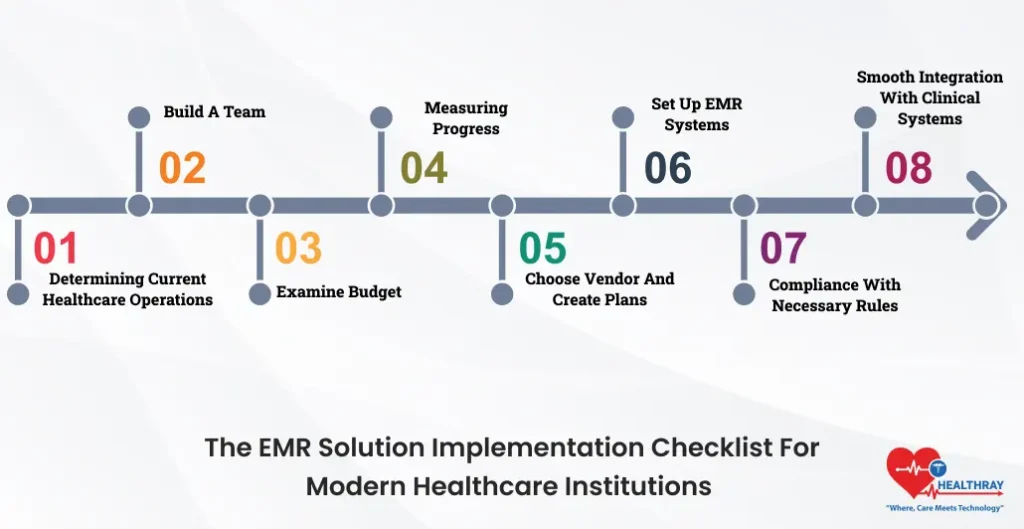
The electronic medical record solution has ultimate power to execute clinical operations and provide exceptional workflow performance. A vital clinical platform that brings greater healthcare efficiency, decreases operational expenses, and improves financial sustainability. Furthermore, When you deploy EMR, consider the following checklist that must be followed by every healthcare institution.
Determining Current Healthcare Operations
Crucial to understanding what is the current hospital workflows and how they currently administer it. What obstacles you find while performing the clinical workflows operation and it gives you the idea how your services run now.
Furthermore, ask your team about their routine tasks, what they do or they don’t do . Each of the clinical segments has their own struggles, which create hindrance in accomplishing KPI’s goals.
Build A Team
This step is going to be a bit hard for you, assessing the skills of your team members and picking a few employees along with the manager from every department for providing effective training to staff members.
In short, a team consists of managerial and technical leaders, a few employees with them. Mainly, it encompasses IT specialists that take care of security and technical aspects, all leaders which guide their team in all functionalities, and medical staff representatives that improves patient care.
Step towards digital era with our healthcare solution
Revamp your hospital facilities and embrace change for better healthcare management. Ease in managing and organizing large medical datasets leads to effective analysis. Seize the opportunity now!
Examine Budget
Just after knowing the requirements of each department, you have to set up a budget, assisting how much you can spend on clinical technologies. Moreover, it is helpful for you to pick the best healthcare platform.
If you don’t check the financial aspect, you will be in more trouble and might suffer loss instead of profits. Furthermore, you have to fully optimize financial funds and accordingly, select the best fit EMR for you.
Take this decision after carefully understanding software and its related costs like maintenance, upfront, and other.
Measuring Progress
There are some of the metrics that need to be evaluated before purchasing the electronic medical record solution. Furthermore, these are necessary to measure the performance of EMR software. Check testimonials and their reliable results in the specific metrics to understand how the electronic medical record solution impacts on healthcare institutions.
For eg: you have to check how much document efficiency increases, rate of patient satisfaction score, and whether the security regulations followed or not.
Choose Vendor and Create Plans
Picking the right EMR vendor, the crucial one to minimize risks and save medical expenses. Check the online site for selecting the top vendor, always taking demonstrations first before actually using it.
After selecting the correct vendor, creating the plans that initiates from the stakeholder requirement, data migration strategy, and rendering role-specific training or testing phase. Also, focus on the contingency plans.
 PRO TIP
Set Up EMR Systems
Check the network and whether the EMR system is compatible or not after the EMR implementation. Furthermore, you should check whether the EMR follows the security guidelines or not.
Cross-checked the electronic medical record system functionalities, whether they all present and work properly or not. Following the strict procedure that will not increase the down time while setting up the EMR system.
Compliance With Necessary Rules
Including varied security measures such as data encryption, multi-factor authentication, and applying HIPAA, GDPR, and other regulations. Also, have strict monitoring about who has the data accessibility or can modify information, and use strong passwords so no one can utilize it easily.
Moreover, the right EMR medical software requires the deployment of security regulations to prevent healthcare information, mitigates risks, enhances patient safety, and increases data integrity.
Smooth Integration With Clinical Systems
The number of related healthcare systems like the lab information system and pharmacy management system should be compatible with the electronic medical record solution. Furthermore, checking whether it is easy to fetch the clinical information or not. Testing the software whether it provides accurate details or not.
It’s crucial to prepare a blueprint to know exactly how electronic medical records will be connected with a number of devices with the security measures. Also, the standards of data exchange applied on the electronic medical record system like FHIR and HL7.
Conclusion
Every healthcare sector needs the EMR solution in their hospital, which augments clinical performance, enhances data accuracy, and improves financial performance. You should evaluate the EMR implementation checklist before the deployment of electronic medical record solutions. Several vital elements of successful implementation include identifying SMART goals, rendering user-centric training, craft a detailed roadmap, and well-coordinating with team members. The checklist of EMR implementation includes examining current healthcare operations, creating a team, analyzing budget, measuring progress, choosing vendor list, and creating plans, setting up EMR systems, compliance with required protocols, and seamless incorporation with healthcare systems.