When OPD waiting gets out of hand, the common responses are more staff, a bigger waiting area, or new software. Each can help, but only if it addresses the step that is actually slow, and only if the people who control that step agree to change it. Both depend on knowing how long patients spend at each stage of the visit: registration, the wait for the doctor, consultation, billing, the lab.
This article shows how to record those times with the staff you already have, and what to change at each stage once you know where the delay is, starting with changes that cost nothing.
Why the Wait is Long When the Consultation is Short
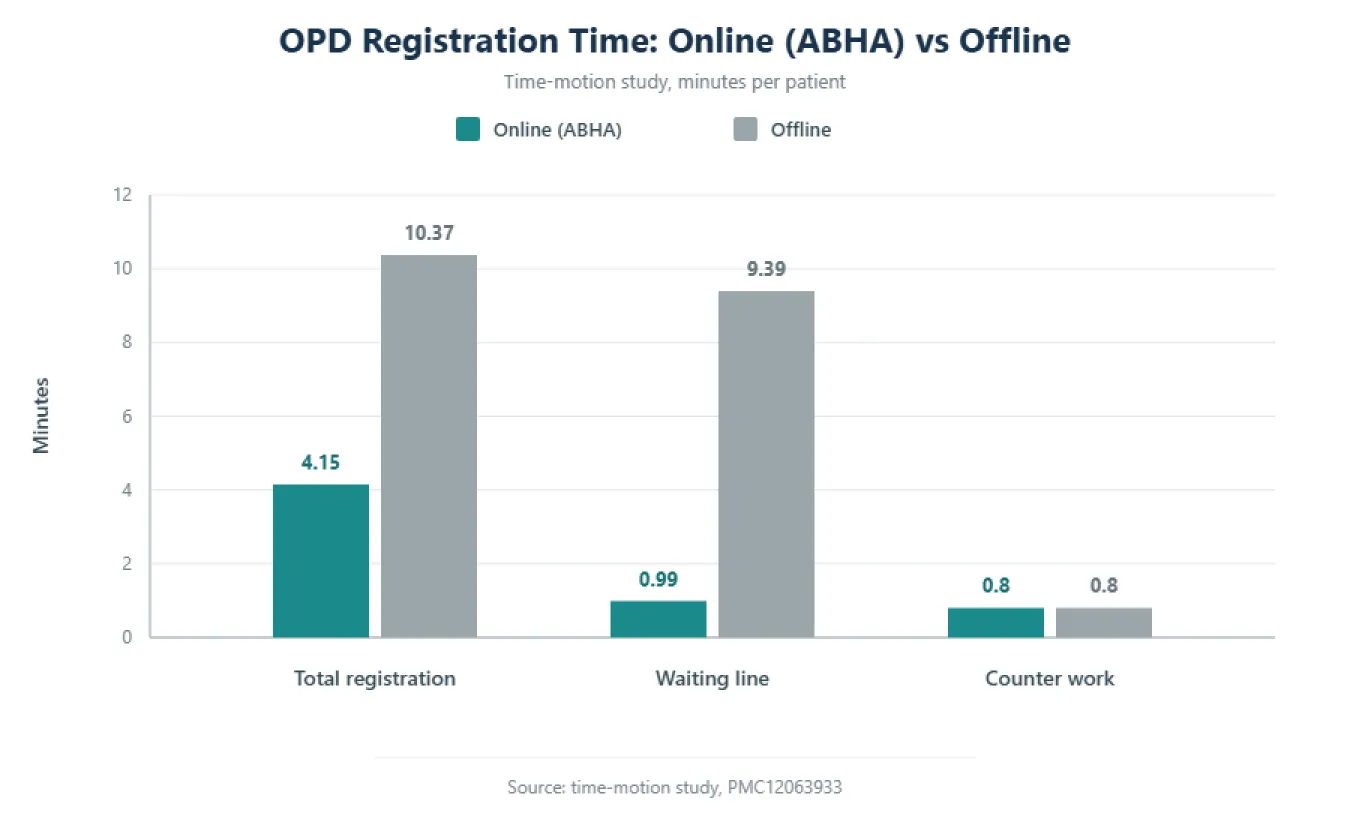
A 2024 time-motion study at an Indian tertiary hospital timed every step of OPD registration. The work at the counter itself took under a minute. The queue in front of the counter took about nine minutes.
The point is simple: the delay is not the time taken to register a patient. It is the time spent waiting for the counter to become free. That pattern repeats at every counter in the building, because of how an OPD is designed to work: each patient passes through several counters in sequence. Training the clerk to work faster does not fix a queue that forms because too many patients arrive at the same time.
Three causes come up most often:
1. Everyone Arrives in the First Ninety Minutes
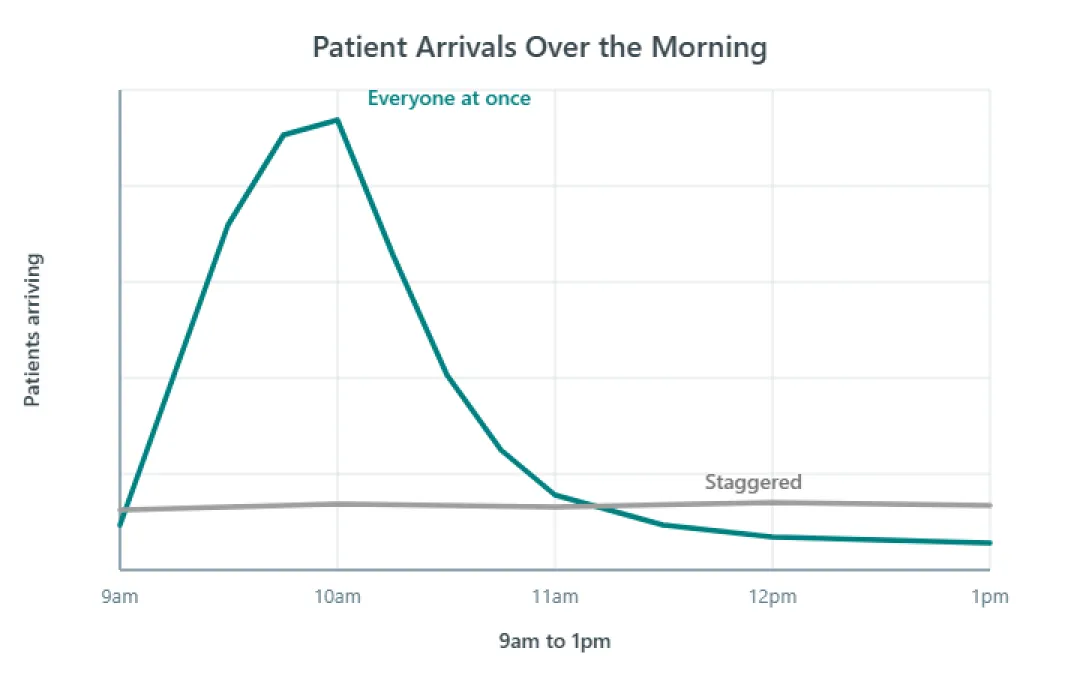
It is not total footfall that breaks the morning. It is that almost all of it shows up at once. Patients arrive from 9:30 expecting to be seen first, so the counter and the consulting rooms are crowded at 10 am and idle by 1 pm. The same number of patients, spread across the session, would barely form a queue.
2. Walk-ins And Booked Patients Share One Queue
A patient who booked watches a walk-in go in ahead of them, and argues at the desk about it. The front desk loses time it did not have, every time, and the booked patient leaves angrier than the one who never booked.
3. The OPD Starts Later Than It Says It Does
If the OPD is advertised at 9:30 and the consultant walks in at 10:15, forty-five minutes of waiting time is created before the process begins. Patients are waiting, but no step of the visit has started.
You can name these three causes. What you cannot do yet is say which one is biggest in your own hall. That is what you should measure this week.
Measure Your OPD Waiting Time This Week
Before changing staffing, appointment rules, or systems, find where patients are spending their time.
Start with timestamps you already have in your HMS, appointment system, or token system. Check what each timestamp actually records.
If those records are missing or not reliable, run a short manual audit. For a few days, note three times for each patient: OPD arrival, token issued, and consultation started. Include your busiest day. Give the audit to someone in MRD or quality, not the front desk being measured. Cover about 30 patients across the days.
From those timestamps, calculate three numbers:
- OPD arrival to token issued: time before registration is completed.
- Token issued to consultation started: time between registration and consultation.
- OPD arrival to consultation started: total pre-consultation waiting time.
The longer interval tells you where to investigate first. It does not by itself tell you the cause.
- If arrival-to-token is long, split it further – time before joining the queue, time waiting for the counter, and time at the counter. That separates poor directions, too few counters at peak hour, and a slow registration process.
- If token-to-consultation is long, first check what happens in between. Do patients complete payment, vitals, or triage in that interval? If they are simply waiting for the doctor, compare scheduled and actual start times, booked and walk-in patients, and how many patients are waiting against how many consultations start in each half-hour.
- Keep the time of day for each patient, not just the average. A 40-minute average may hide a severe queue in the first hour and five-minute waits later. Those two patterns need different fixes.
These numbers locate the delay. Confirm what is happening inside the slow stage before choosing a fix.
For example, if your days average 42 minutes from arrival to token issued and 11 minutes from token issued to consultation started, the counter and arrival flow are eating the morning. Fix arrival bunching and registration flow first. If the second interval is longer, look at scheduling and the consultant’s start time first.
How to Reduce OPD Waiting Time
Many OPD delays can be reduced through process changes, but the right change depends on where you found the delay and what caused it. Test the relevant change, then measure the same interval again.
If arrival-to-registration is long:
- Redesign the registration form so the clerk types less. A published Indian OPD intervention reported a significant drop in waiting time after this change.
- Put a care coordinator in the hall to guide patients, so the queue does not double as an information desk.
- Staff the OPD phone so callers stop walking in just to ask a question.
- Train the front office in how to schedule.
- Stop issuing every token at 9 am. Give booked patients a half-hour arrival band instead of “morning”. This flattens the first-ninety-minutes rush.
If registration-to-consultation is long:
- Give booked patients a slot instead of a token, and keep walk-ins in a separate queue. This stops booked patients watching walk-ins go ahead of them.
- Stagger appointment bands so patients do not all turn up at 10 am.
- Compare scheduled and actual start times. Publish the time the OPD actually begins against the time it is advertised to begin, every day, for four weeks. Show it privately, framed as the patient wait it causes.
Similar process mapping and workflow redesign have been published by state health programs in Tamil Nadu and in a 2025 study of a West Bengal government hospital. The changes are practical and low-cost, and they support the fixes above.
These process changes have a limit. They do not show what is happening in the hall right now, while it is happening.
Where OPD Software Can Help
| PROCESS CHANGES HANDLE | SOFTWARE CAN HELP WITH |
| Arrival patterns and staggering | A single queue holding walk-ins and booked patients together |
| Registration form design | Live visibility of who is waiting where, right now |
| Staff behaviour and training | Patients tracking their own position without standing in the hall |
| Published start times | Reallocation the moment a consultant is late or absent |
Without a timestamp at each counter, you can measure waiting time once, by hand, the way you just did. You cannot watch it live. You cannot see the queue building at 10 am and move a clerk before it breaks. That live measurement is what software adds: a timestamp at every point the patient passes.
There is one more queue you can remove instead of speeding up: the one that did not need to be in the building. A repeat patient coming in only for a report review or a follow-up can be seen on a video consultation. This takes them out of the physical hall entirely and shortens the line for everyone still in it. It will not fit every speciality, but for follow-ups it saves time for both the patient and the OPD.
Cut OPD Waiting Time with Healthray
One queue, live tracking, and timestamps at every counter.
Does ABHA Online Registration Actually Cut The Wait
For the registration queue specifically, the answer is measured. The same time-motion study compared ABHA-based online registration against the offline counter:
| ONLINE (ABHA) | OFFLINE | |
| Total registration | 4.15 minutes | 10.37 minutes |
| Waiting line | 0.99 minutes | 9.39 minutes |
| Counter work | ~0.8 minutes | ~0.8 minutes |
Roughly 60% faster overall, significant at p < 0.01. The counter work barely changes. The entire saving comes out of the queue.
AIIMS is already running this. Patients scan a QR code in the ABHA-linked health record app, get a token number instantly, and approach the counter only when it shows. The relevant pages: what ABDM compliance actually asks of an OPD and how ABHA-based registration works at the counter.
The caveat the study itself names: this path depends on a stable internet connection and the patient’s digital literacy, and it adds a two-minute app-download step for a first-time user. So it helps repeat patients far more than first-time patients, and it only touches one of your two queues. The consultation queue is still yours to fix.
When Buying Software Is The Wrong Answer
Three cases where software is not the right first step.
If you run under about 60 OPD patients a day with a single doctor, a printed slot sheet and staggered arrival bands will fix most of it. Come back when you grow.
If your main problem is a consultant who arrives late, software will not fix that. You have a start-time problem, not a queue problem.
And if you have not measured your baseline, do not buy yet. You will have no way to prove anything improved, which means in six months you cannot defend the spend and the system quietly stops being used.
There is a staff objection worth naming before you decide. Your registration clerk currently has the power to move someone up the queue as a favour. A system takes that away, and that is the real resistance you will meet, not “the software is hard to use”. Plan for it.
A hospital that buys before it measures cannot prove the thing worked, and that hospital stops using it. If you now doubt whether software is your bottleneck, look at hospitals that changed their OPD flow and find one your size.
What To Do Next
You can have a real number for your own OPD waiting time by Friday, without spending a rupee, and that number decides everything else. The process changes – staggered arrival bands, the form redesign, published start times – show up in the wait inside about two weeks, so you are not waiting a quarter to see if any of this worked.
Note three times: arrival, registration completion, consultation start, for 30 patients. Read which interval is bigger. Fix the relevant process changes first. Only when you have hit their limit, and you want to watch the queue live instead of measuring it once by hand, is it worth spending anything.