

Summary
Mobile RIS applications liberate radiologists from time and place boundaries. Imaging studies, patient details and reports are not just limited to workstations. With real-time access, doctors can make tangible decisions more quickly. Also, they can reduce approval delays and handle urgent cases right away. The RIS application is not just a convenient tool; it’s also a catalyst for efficiency. In this blog I will discuss how mobile RIS applications make the radiology workflows responsive, flexible and patient-centric. Also, I will discuss how it helps radiologists handle high-volume scenarios and emergency cases.
Introduction
Have you ever wondered why the radiology department is confined to dimly lit spaces? In simple words, technology exists where it is required. Mobile RIS applications make this idea realistic. It liberates radiologists from desks and fixed systems and puts the entire power in the hands of clinicians making it simple,fast and reliable. Nowadays diagnostic centers are established in multiple locations. Emergencies operate 24/7 and clinics require instant decisions. Mobile RIS apps provide imaging studies, patient details, reports and worklists and instant access to doctors, whether they are sitting in OPD, taking ward rounds or consulting from miles away. With a single notification and tap, they get the entire clinical context.
The most appealing aspect of the mobile RIS application is not only its useful features but also its ability to serve as a platform for high-impact actions. RIS software can easily approve reports, flag critical findings, and provide the ability to communicate with the team in real time. More than that, it also minimizes delays, provides better responses and boosts up radiologist confidence in patient care. In essence, modern radiology software makes medical practices flexible, responsive and humanized, where imaging access no longer depends on time and place; instead, it depends only on needs. Also read our blog, benefits of radiology management software to know about it.
Radiology in a Mobile-First World with Mobile RIS Applications
As we know, radiology is a center of time-critical decisions; whether it’s about emergency care, oncology, trauma, cardiology, or the ICU, every second matters. However, one question naturally comes up: when care teams are distributed and telehealth is rapidly growing, then why is imaging limited to fixed workstations? Mobile RIS applications bridge this gap by letting radiologists access studies anytime and anywhere.
Further, it provides clinicians easy access to image workflows and data without compromising security or diagnostic quality. With the combined strength of DICOM, this application provides secure, real-time imaging access to referring physicians and patients, irrespective of location. Next, we will check out some key aspects that make RIS a natural evolution of the current radiology ecosystem.
Key Aspects of Mobile RIS applications
Let’s dive in:
Imaging Access Outside Reporting Room
With RIS mobile applications, radiologists no longer need to be present at the reporting room to check images. Further, this software makes the imaging truly location-independent.
Faster Decisions During Critical Moments
In emergency and ICU settings, instant access provides quicker interpretation and timely intervention.
Smooth Integration of RIS–PACS
Scheduling, reports and images are constantly in the same flow that makes the clinical context clear and minimizes confusion.
Strong Security Along With Mobility
Role-based access, encryption and audit trails ensure mobility and data security remain unharmed.
More Control to Referring Doctors
Referring physicians can directly view images and reports; this naturally reduces calls, follow-ups and delays.
Perfect Support for Distributed Team
Mobile radiology data security application becomes a reliable backbone for multi-location practices and teleradiology.
Better & Faster Experience for patients
When decision-making becomes fast, patients get reports on time and coordination among team members becomes smooth. Consequently, it naturally elevates patient trust.
Simply put, mobile-first radiology is more than just a technological upgrade; it is a mindset shift in which imaging moves alongside the care team rather than remaining in waiting mode.
 PRO TIP
Why Anytime, Anywhere Imaging Access Really Matters
In simple words, information delay means decision delay. Further, the Mobile RIS application promises faster and safer clinical decisions. Moreover, anytime, anywhere imaging access removes the traditional bottlenecks where clinics are forced to wait to reach a reading room and desktop workstation. There are some driving forces working behind modern RIS applications that make this shift unavoidable. Let’s find out:
Teleradiology: Remote Work Real-Time Decisions
Nowadays, subspecialty radiologists are increasingly moving towards remote work. Furthermore, it is highly essential to interpret urgent cases even if you are traveling or sitting at home. Fortunately, mobile RIS applications make it possible.
Multi-Site Models: Access from Everywhere
Along with Satellite centers and outreach clinics, the health system requires centralized expertise without the need to shift patients and waste time.
Emergency Care: Critical Need of Imaging Along Bedside
There is no option of waiting for trauma surgeons, neurologists and intensivists. Further, instant access along the bedside facilitates timely intervention.
Patient Expectations: Digital Experience is a Basic Need
These days, patients are accustomed to patient banking and e-commerce-like digital experiences. Additionally, patients now expect simple mobile access to reports and images.
Imaging That Moves With Care
When RIS becomes mobile view, then imaging data moves parallely with clinicians–in hospitals, outreach clinics or during teleconsultations.
In short, mobile RIS radiology transforms a static system into a dynamic workflow that advances cautiously and quickly rather than falling behind.
 NOTE
NOTE
Operational and Business Advantages
Mobile RIS is not just limited to clinical convenience. Further, it poses clear operational or business benefits that make the imaging organizations more resilient or scalable.
Better Utilization of Radiologist Time
Modern RIS applications provide space for radiologists to work in flexible and productive ways. Further, non-diagnostic tasks, such as report approvals, clinician queries and worklist monitoring, are completed during meetings or off-site.Mobile RIS applications allow radiologists to manage these tasks directly from mobile devices, increasing flexibility and reducing delays. Also, workload balancing becomes easy as available studies are routed directly to radiologists without influencing the location.
Faster Turnaround Time (TAT)
When approvals and reviews are possible on smart devices, reporting no longer remains pending. Further, faster TAT means quicker clinical decisions and better referring physician satisfaction.
Improved Coverage During Peak Hours
In high-volume periods, mobile RIS provides extra flexibility. Further,Off-site radiologists can share the workload without additional infrastructure.
Minimises Operational Overheads
Advanced RIS software reduces travel, physical workstations and overtime dependency. Further, organizations can utilize their existing resources more efficiently.
Scalable Support for Multi-Center Operations
As the diagnostic network grows, mobile radiology information system software maintains centralized control and visibility without raising complexity.
Higher Referring Physician Satisfaction
Timely reports, quicker clarifications and smooth communication help build strong trust and engagement of referring doctors.
Business Continuity and Service Resilience
Even with power outages, travel disruptions and unexpected staff shortages; ongoing reporting or approvals function smoothly.
How RIS Applications Lower Infrastructure and Distribution Costs
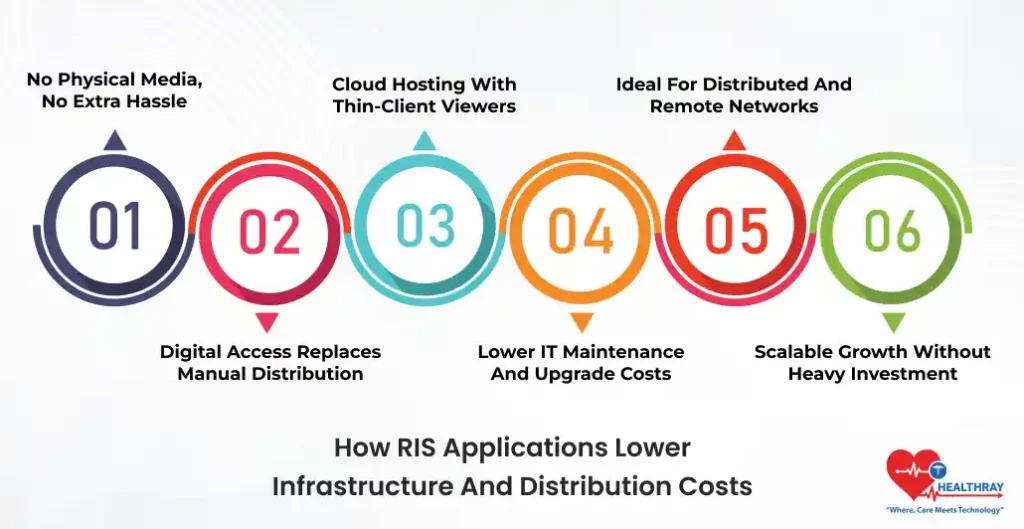
In layman’s terms, cost is generated where systems are heavy. Furthermore, cloud radiology information system platforms make the radiology operations lightweight and intelligent without losing functionality. Let’s check how RIS applications lower infrastructure and distribution costs:
No Physical Media, No Extra Hassle
In the traditional system radiologists print films and burn cds for image sharing. Now this is a completely old approach and will not work out in 2026. Further, mobile RIS applications provide standard digital access.
Digital Access Replaces Manual Distribution
Secure web or mobile access through broadband eliminates courier services and manual transport needs. Further, data move fast and smoothly.
Cloud Hosting with Thin-Client Viewers
Cloud-based RIS and lightweight applications reduce dependency on heavy local servers, costly workstations and complex VPN setups.Mobile RIS applications make it possible to securely view, approve, and share images without being tied to any workstation, lowering infrastructure demands.
Lower IT Maintenance and Upgrade Costs
Fewer expenses on on-premises infrastructure automatically reduce the cost of maintenance and upgrades and also minimize downtime.
Ideal for Distributed and Remote Networks
Here saving is especially significant for networks that encompass multiple small imaging centers, rural outreach programs and mobile diagnostic units.
Scalable Growth Without Heavy Investment
As the network expands, onboarding new locations becomes simple and cost-efficient. Furthermore, it minimizes the massive upfront capital.
Step towards digital era with our healthcare solution
Revamp your hospital facilities and embrace change for better healthcare management. Ease in managing and organizing large medical datasets leads to effective analysis. Seize the opportunity now!
Key Capabilities Checklist for Selecting a Mobile RIS
RIS systems that are adept at solving current problems and support scaling to accommodate future needs are the right investment. Further, while selecting Mobile RIS, do not just focus on selecting features. Also, consider capabilities that make workflow, security and growth resilient to change in the future.
Unified Platform, Not Disconnected Tools
Modern RIS applications should deeply integrate RIS, PACS and enterprise imaging viewers. Further, it prevents workflow fragmentation and keeps the data context intact.
Diagnostic-Grade Image Viewing
Ensure FDA-cleared or CE-marked viewers wherever required. Furthermore, don’t compromise tools such as measurements, annotations, MPR and adjustable windowing.
Teleradiology-Ready Architecture
RIS should be capable of supporting remote primary or preliminary reads, cross-site workload balancing and secure image routing.
Offline and Low-Bandwidth Resilience
Features like optimized streaming, progressive image loading and smart caching maintain performance even in inconsistent networks.
Patient and Referrer Access Portals
Through secure portals, patients and referring clinicians should get browser-based, zero-footprint image access without any complex installation.
Scalability with Cloud Support
Mobile RIS application should easily scale with volume growth or multi-location expansion, ideally through cloud-native architecture.
Regulatory Compliance and Certifications
There should be clear compliance proof for health data privacy or security standards. Certifications are not just badges; they signal trust. Simply put, a right mobile RIS application is one that supports clinical confidence, operational efficiency and long-term growth.
Competitive Differentiation and Patient Experience
Let’s check out:
Self-Service Access That Saves Time
Mobile portals and apps allow patients to download and share their own images, without repeat visits and unnecessary follow-ups.
Proactive Communication Through Mobile Channels
Mobile RIS apps deliver appointment reminders, scan preparation instructions and follow-up messages on time; this minimizes no-shows and confusion.
High-Tech Image Builds High Trust
When patients view providers in a “digital, responsive and modern” appearance, then it builds loyalty naturally and positive word-of-mouth gets spread. Furthermore, Mobile RIS applications enhance patient engagement by allowing them to access reports and images conveniently on their devices.
Conclusion
Mobile RIS applications liberate radiology from its traditional reading room boundaries and align it with real-world clinical workflows. Furthermore, secure, anytime-anywhere imaging access makes the diagnosis fast. Besides that, the RIS system improves coordination among clinicians and naturally closes communication gaps. In 2026, it’s high time for clinics to adopt a secure, interoperable and future-ready mobile imaging strategy.