

Quick Summary
The shift from traditional on-premises to modern cloud-based systems leads to increased potency to widen their software system and saves numerous expenses. Also, it helps to increase medical accessibility. The cloud-based Electronic Patient Records (EPR) software has wide importance which is discussed in this blog. Moreover, this software has some vital features that improve healthcare accessibility and help in mitigating conflicting situations.
Introduction
Electronic patient records software with cloud-based features is the plus advantage. Formerly, the EPR systems were in an on-premises system which makes the software more costly. This is the biggest reason for not using the software.
Additionally, on-premise systems do not assist in expanding medical services and are difficult to maintain security. For reducing your hospital expenses, it’s predominant to use cloud-based Electronic Patient Records (EPR) software.
The Electronic patient record has innumerable features such as seamless exchange of medical data information, persistently updating healthcare data, facilitating advanced analytics, and interlinking with diverse healthcare departments. Therefore, the cloud-based electronic medical records provides health care accessibility, minimizes several medical care costs, and configuration support in all digital devices.
What is Meant by Cloud-Based Electronic Patient Records Software?
Cloud-based Electronic Patient Records refers to the record of entire medical and patient information in one single location. Therefore, it helps in remote access to healthcare information. This cloud-based framework has immense potency in recording hospital departmental information. Also, can store different hospital branches’ data.
Not only provides the facility of recording diverse data but also provides extensive security protocols for safeguarding patient data. Further, this software is suitable for every hospital type whether it is small, mid, or large scale.
This EPR system has innumerable advantages such as minimizing healthcare costs, providing an intuitive workflow interface, and facilitating remote medical access. Also, it can integrate with other diverse medical departments. Therefore, cloud-based electronic medical records improve the working speed of hospitals.
The Key Features of Electronic Patient Record Software
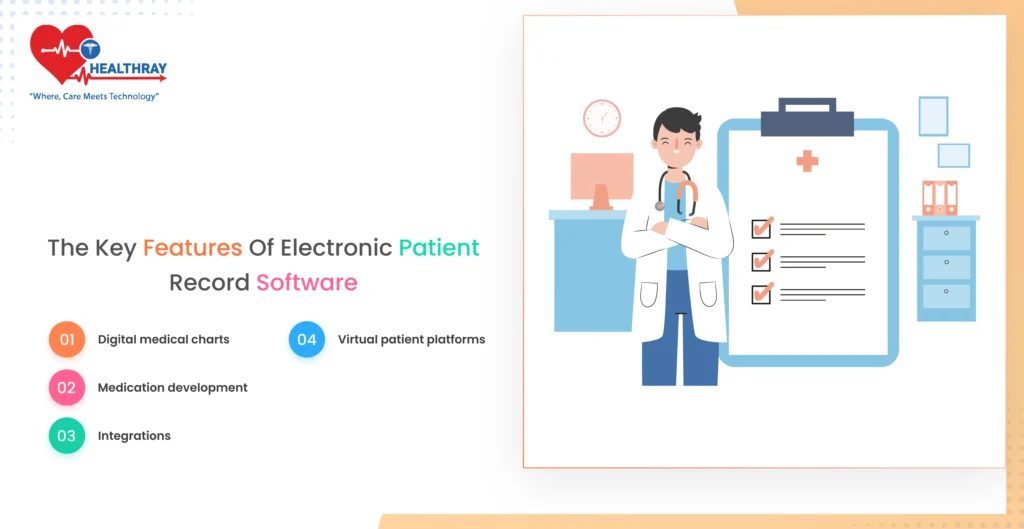
Electronic patient record software is trending in the healthcare organization because of its unique attributes such as limitless scalability and lower inventory downtime. Also, improving medical accessible information. Deep dive into the key features of Electronic Patient record software :
Digital medical charts :
EPR software is a sub-component of electronic medical records, allowing storage of wide patient data such as medical history, medical analysis reports, test results, consultation reports, and radiology reports.
Maintains detailed hospital information including ward information, general unit information, incorporates medical staff information, vendor information, and detailed inventory information.
Digital medical charts have various benefits such as improving healthcare efficiency, minimizing healthcare staff workload, reducing billing mistakes, and aiding in securing hospital transactions.
Medication development :
Medication development is not a simple task, it requires a lot of staff effort and careful planning. There is a huge support for electronic medical records (EMR/EHR) in precise medication discovery. Additionally, it involves certain steps such as :
- First, researching the patient’s medical reports carefully
- Second, identify and extract the chemicals that help in drug preparation
- Third, molecules and chemicals undergo in laboratory process
- Fourth, initial testing of drug candidates on animals
- Fifth, trial on some healthier people
- Lastly, dispense the developed medicines.
Integrations :
Electronic patient records are linked with distinct healthcare departments such as laboratory information management systems, pharmacy arrangement systems, and hospital information management systems. Simplifies the healthcare work tasks and enhances staff’s speed. Additionally, ease in transferring the medical information to other departments. Below are some integration advantages :
- Minimizes staff’s workload
- Quick inventory decision-making
- Eradicates the paper costs
- Enhances patients experience
- Elevates patient’s care
Virtual patient platforms :
Electronic patient records are specifically for patients and health care professionals. Therefore, patients are highly satisfied and increase their faith in healthcare organizations.
All EHR systems like Healthray, incorporate various features that help in providing mobile device accessibility such as teleconsultation, video monitoring, and cloud-based systems.
The cloud-based electronic medical records improves medical data analysis, lowers patient visits, minimizes paper charts, eliminates medical errors, and aids in efficient clinical practice. Overall, improves health care delivery.
Importance of Electronic Patient Records (EPR) Software
Healthcare services with electronic patient records transform the way to treat patients and turn their thoughts into optimistic directions. After EHR adoption, patient contentment is on a high level as it eases their medical procedure. Also, helping patients with quick medical services. Have a look below on the importance of Electronic Patient records (EPR) software :
Enhances Patient-centered care :
Health care providers must adhere to the best medical practices for enhancing patient care. Moreover, these practices include providing medical accessibility, and open communication, necessary to coordinate with other health care providers and carefully listen to their health problems.
Following these medical practices is impossible with traditional healthcare systems. So, it is predominant to embrace health information technology to enhance patient-centered care.
Persistently update medical records :
Eradicating paper records significantly optimizes the process of centralizing patient data information. Additionally, these health systems help patients to empower themselves in their healthcare activities. The major advantage of EPR systems is the continuous updating of medical records. The following are the advantages of up-to-date medical records :
- Maintains precise and comprehensive patient’s records
- Accurate data-based decision support
- Supports accurate patient diagnosis
- Ease to detect viruses
- Efficiently improves health care services.
Optimizes insurance process :
The insurance process is cumbersome. It’s difficult to streamline and digitalize the insurance process with traditional health systems. With an electronic patient record system, it is easier to ensure the insurance verification and claiming process. The benefits of optimizing the insurance process are :
- Lowers the patient’s expenditure
- Improves hospital’s cash flow
- Simplifies the insurance claim process
- Improves coordination with insurance companies.
Enhanced departmental integration :
It refers to maintaining interdisciplinary coordination among healthcare organizations. Moreover, every staff strives to accomplish hospital goals together through the seamless exchange of resources and medical documents. Consequently, the cloud-based electronic medical records improves the effective coordination across all hospital departments. The benefits of departmental integration are :
- Aids in open communication
- Minimizes the double efforts
- Increases the productivity rate
- Improves patient care
- Increases hospital revenue
Advantages of Moving to Electronic Health Records
Electronic health records are the most trending tool in the modern era. It encompasses various activities such as appointment management, and accurate diagnosis, and helps in recording vast patient information. Therefore, it reduces patient visits and assists in advanced healthcare delivery. Take an in-depth look at the advantages of moving to electronic medical records :
E-medical documentation :
Medical documentation is of various types such as patient information, diagnosis reports, discharge forms, vendor details, and inventory records. The advantages of electronic documentation :
- Ease in maintaining medical reports
- Improves the accessibility of medical records
- Maintain a standardized prescription format
- Helps to save time for patient care
- Supports in sharing medical data at anywhere
Step towards digital era with our healthcare solution
Revamp your hospital facilities and embrace change for better healthcare management. Ease in managing and organizing large medical datasets leads to effective analysis. Seize the opportunity now!
Eliminate paper record systems :
Maintaining clinical data in physical documents is a daunting task. Moreover, there are lots of challenges found in managing paper records such as difficulty in the accessibility of medical records, indulging numerous costs, and hard in securing patient records. Also, it is a time-consuming process.
In contrast, Heathray’s electronic health record systems have various advantages which are difficult to have with paper record systems such as seamless sharing of medical information and maintaining legality in medical records. Ultimately, it minimizes healthcare expenses.
Extreme security measures :
Electronic health records follow strict protocols to prevent sensitive medical data information. Furthermore, the security measures include encrypted data, control of accessible information, and use of mixed letter passwords. The advantages of extreme security measures are :
- Secures the patient data
- Follows entire healthcare regulations
- Building patient’s trust.
- Improves patient participation in their medical health.
Conclusion
The cloud-based Electronic Patient Records Software has a vast potency to transform patient’s medical facilities. Moreover, this system has numerous advantages which can’t be provided by an on-premises system. There are numerous features such as digital medical charts, mediation development, and a virtual patient platform. Consequently, it increases patient-centered care and helps in continuously updating medical records. As a result, it optimizes the use of healthcare resources.