

Advantages of a Pharmacy Management System in Your Pharmacy Operations
A pharmacy management system is quite significant in automating many important procedures, simplifying processes, and enhancing the security of patients along with business effectiveness in day-to-day pharmacy working. In the following exhaustive exploration, we cover core benefits a PMS holds for your pharmacy, starting with inventory management through regulatory compliance.
Key Pharmacy Management System Benefits
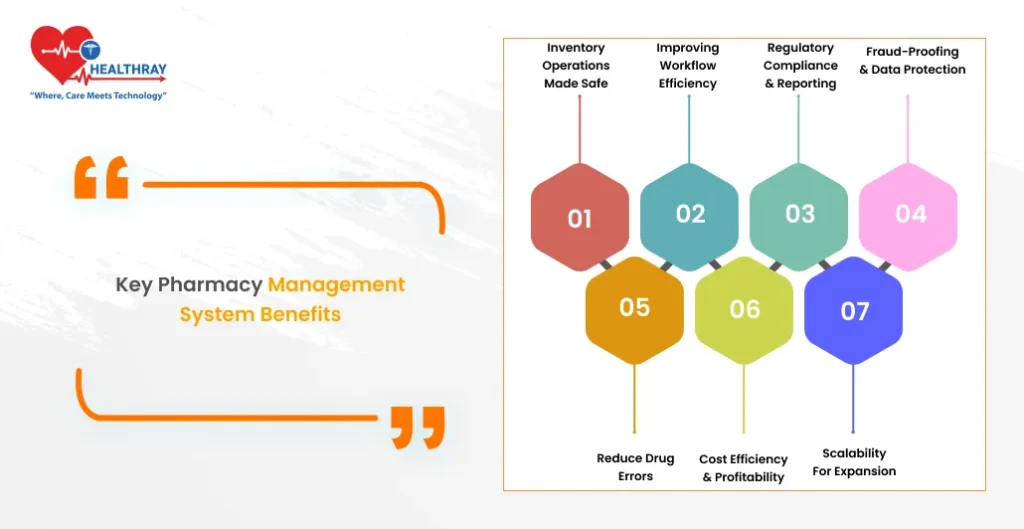
Inventory Operations Made Safe
A pharmacy management system automatically tracks inventory real-time, always giving you the right view on your stock status. With automation updates every time a medication has been dispensed, the PMS will control overstock and stockouts through ensuring that some drugs are made available at any given time. On top of this, PMS allows monitoring of expiring drugs that alert staff when products are going to expire shortly, and through this, the wastage decreases, ensuring safety for the patient. It saves human labor due to automation and permits pharmacists to concentrate on key tasks, including patient care.
Reduce Drug Errors
Medication errors are seriously important in healthcare, but a Pharmacy Management Software circumvents these risks by standardizing prescription verification processes. The system checks for possible drug interactions, allergies, and improper dosages before dispensing the drug. Through e-prescriptions, doctors can send orders directly to the pharmacy, reducing human error, such as misreading handwritten notes. Results in patients receiving higher accuracy and safety.
Improving Workflow Efficiency
In pharmacies, there are numerous administrative tasks done on a daily basis. In doing so manually, these things slow down operations. A PMS automates different things like prescription processing, insurance claim submission, and prescription label generation. This is what increases the overall efficiency of the pharmacy.
The staff is freed up not having to spend so much time on simple tasks so they can have more time to work with patients. Further, PMS systems usually send reminders for refilling prescriptions; thus, there is improved service and keeping patients on schedule with medication.
Patient engagement is a determinant success factor for any pharmacy.
A PMS makes that even more convenient by offering features such as online prescription refills and medication reminders. Patients can refill their medications without ever having to visit the pharmacy, which increases convenience. In addition, the system avails patients with access to their medication history, giving them greater control over their healthcare. This also makes the treatment experience more patient-satisfying and efficient as it fosters long-term loyalty.
Regulatory Compliance and Reporting
Pharmacies are tightly regulated, mainly on patient information and controlled substance handling. With a PMS, there would be compliance to regulation demands since sensitive information about patients will be kept safe, and all compliance reports automatically generated. The system aids in the control of controlled substances in that it produces an electronic trail for every transaction, so it is always prepared for auditing at any time. A PMS saves the pharmacy from errors of omission and commission in compliance and reporting in compliance thus saving the pharmacy from prosecution or operational setbacks.
Fraud-Proofing and Data Protection
Most pharmacies are the most vulnerable to fraud. Fraud patterns have to do with prescription abuse or insurance scams. Through real-time tracking of transactions, a PMS helps identify and prevent fraud. The system identifies potential fraud through suspicious activities such as frequent requests for controlled drugs. Other than fraud detection, pharmacy management system service providers data encryption and secure storage to ensure that patient information is not leaked through breaches. In this manner, PMS ensures that only authorized personnel have access to sensitive data, thus helping pharmacies maintain patient confidentiality and comply with privacy regulations.
Cost Efficiency and Profitability
A PMS not only improves operations but also contributes to the cost efficiency of a pharmacy. Managing the inventory automatically prevents waste through the ordering and stocking of medications only when they are required. It prevents overstocking and loss due to expired inventory. Automated billing and claims with regard to insurance will enhance the speed of payment and cut on error, which can be very costly, causing delays. The PMS provides detailed reports on the sales trends, enabling the pharmacy to make informed decisions regarding which products to offer and the pricing strategy to use, thereby improving profits.
Scalability for Expansion
The growth of your pharmacy would require you to have a system that can be easily scaled up or down. A PMS is inherently scalable, hence making it easy for new features, such as home delivery or telepharmacy, to be included without causing operational disruption. When you have different sites, it gives you central management to provide a uniform, streamlined operation from branch to branch. This scalability ensures that as your pharmacy grows, the system keeps up with your increasing needs without added complexity.
Conclusion
The Pharmacy Management System is not merely an upgrade in technology but a holistic solution for pharmacy operations. The reduction of medication errors, inventory management, and satisfaction of patients are some of the ways through which a PMS optimizes the overall functionality of the pharmacy. It ensures compliance with regulations, prevents fraud, and increases profitability by reducing costs in operations. As your pharmacy grows, a PMS can scale up with it to provide a flexible, long-term solution for maintaining efficient, compliant, and profitable operations.