





Quick Summary
Modern laboratories require new technologies for reducing excessive tasks, improving productivity, managing large databases and chiefly, increasing patient care. Therefore, the LIMS system is launched and it has various benefits such as stock management, predictive analysis and more. If you are curious to explore more, read this blog till the end.
Introduction
Laboratory information management systems are that sophisticated technology, which is more crucial to have in laboratories on account of its enormous functions. Furthermore, it helps to do multiple healthcare tasks in a matter of minutes.
The LIMS system captures, organizes, and protects the laboratory information. Moreover, it creates efficient sample workflows for completing the tasks on time with no mistakes. The laboratory information management system improves quality standards, creates accurate test results, and quickly analyzes the lab reports.
Laboratory documentation is tough to prepare, and maintain with proper security guidelines. Furthermore, it removes various barriers of laboratories, which makes it easy to accomplish long term and short term goals.
The Core Functions of Laboratory Information Management System
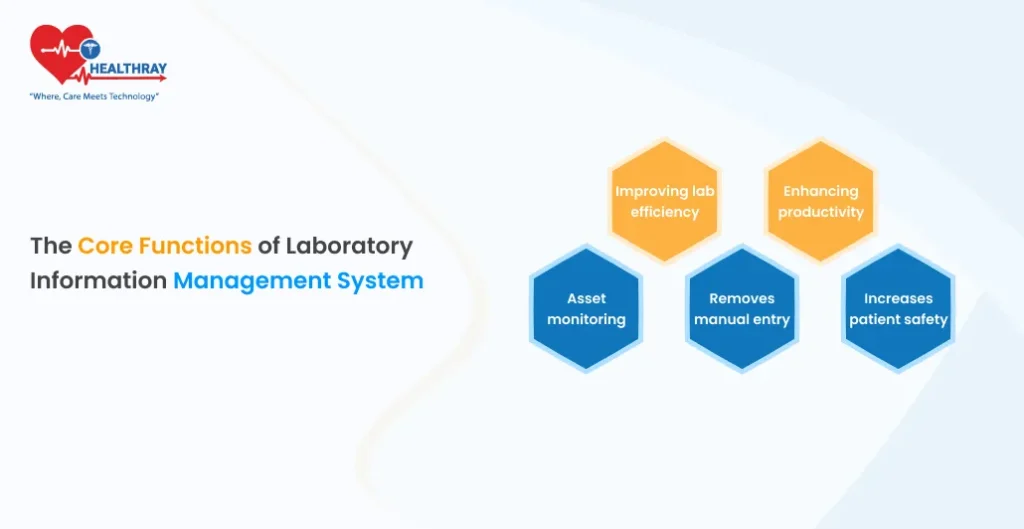
In the modern scenario, there is lots of historical and current information in the laboratories, which are very difficult to maintain. Moreover, the LIMS system is designed to overcome the obstacle and bring a new innovation in the laboratories, which is beyond anyone’s imagination. This software simplifies clinical operations, makes stock control, and increases efficiency. Here are some core functions of the lab information management system (LIMS) :
Lab equipment management
Equipment management of laboratories refers to keeping precise records, stored in a well defined manner, tracking their maintenance time, and monitoring their performance. Furthermore, the laboratory information system aids in managing lab equipment with accuracy and enhancing teamwork.
You can schedule the equipment activities. In short, preparing a time-table for laboratory inventory related to checking, maintenance and repairing date. Therefore, the pathology lab software helps to receive alerts on time. It can help to scan code through digital devices and get full-fledged information.
Tracking
The LIMS system contains various data including patient ID number and their other information, sample collection details, equipment data, lab worker details, and efficiently distributes tasks among providers. Furthermore, it can monitor each step of the laboratory process and workflow. The various benefits of tracking are :
- Improving lab efficiency
- Enhancing productivity
- Asset monitoring
- Removes manual entry
- Increases patient safety.
Order management
This is an electronic laboratory platform, which receives requests for laboratory tests and gets instant notifications. After that, the laboratory worker has the authority to reject and accept the order. Furthermore, the laboratory workflow will continue after accepting it.
Order management has numerous benefits such as minimizing operational costs, improves cash flow in the labs, inter-connected with segments, streamlined operations, digitizing system, creating medical reports, and e-invoicing from the portals. Therefore, it improves efficiency.
Data integrity
The LIMS system helps to maintain precise laboratory information from collecting samples to invoices details. Moreover, there are various lab documents, which are attached with registration forms such as aadhar card, pan card, and other details.
Complying guidelines is necessary in healthcare organizations and that is part of data integrity. Therefore, it makes your documents safe from cyber attackers. Sometimes, hazard is from internal departments that are also removed from applying information security.
Top 8 Benefits of LIMS Systems
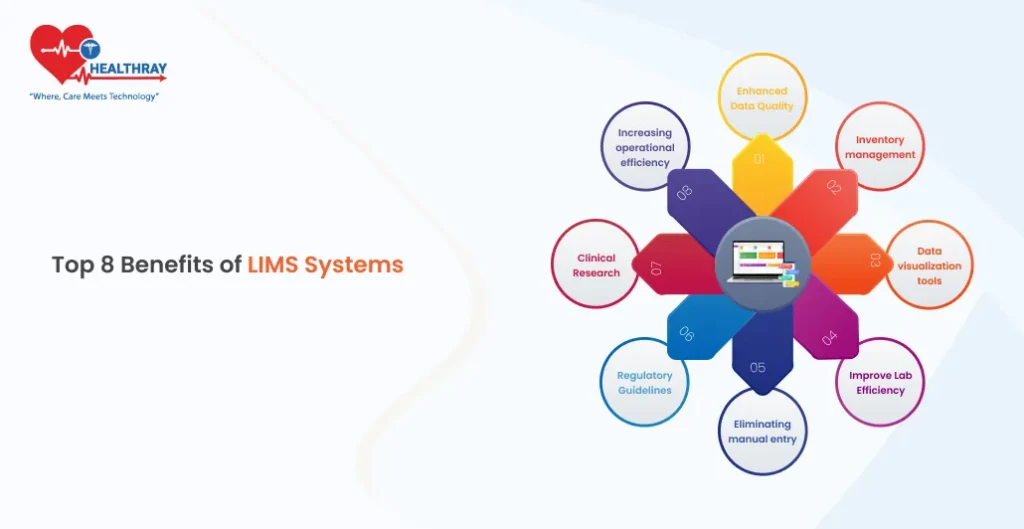
Laboratory information management systems retain the laboratory data and administrate them efficiently. Moreover, this software helps to continuously track samples and maintain quality. Primarily, it cuts down the need for paperwork and other stationery items, which reduces laboratory costs and improves cash flow. Let’s comprehend “what are the advantages of LIMS systems?”
Enhanced Data Quality
Achieving best data quality requires incredible labor efforts, effective organization of data, implementing regulations, and more. Moreover, it is effortlessly done through the LIMS software. Additionally. It helps to minimize lab errors, reduces repetitive tasks, maintains data standards, and combines various information in the center point. Enhanced data quality has various advantages such as :
- Making proper conclusion
- Provide informative data
- Enhances consistency
- Reduces human error
- Minimize healthcare costs
Inventory management
The LIMS system has a feature to manage stocks without any extensive trouble. Moreover, this system captures, arranges, and prevents inventory information. Moreover, this is also required to set the lab equipment at the desired level, which is easily done by the laboratory information management system.
It needed to store various laboratory materials and reagents for prompt delivery. Furthermore, the LIMS system can help to create space in laboratories and arrange lab material effectively. It helps to maintain adequate amounts of laboratory stock, quality control, and increase the age of medical equipment.
Data visualization tools
Large data sets captured in the laboratory platform from assorted lab departments such as microbiology, clinical, serology, and patient handling department. Moreover, It creates an analytical dashboard, which displays minimal information with visual elements. The LIMS system saves time and has other advantages such as :
- Simplifies to understand lab reports
- Create brief information
- Saves huge efforts
- Easy to share with other specialists
- Aids to make logical decisions.
Step towards digital era with our healthcare solution
Revamp your hospital facilities and embrace change for better healthcare management. Ease in managing and organizing large medical datasets leads to effective analysis. Seize the opportunity now!
Improve Lab Efficiency
Efficiency automatically has been increased through enhancing workforce productivity and saves costs. These are time-consuming tasks and impossible without strategic planning. Therefore, the LIMS system has been developed to improve production and minimize expenses.
LIMS solutions assist in effective disposition of resources across laboratory segments with a single click. Furthermore, it reduces wastage, effectively manages your time, minimizes error, and improves safety. Consequently, laboratory information management systems (LIMS) assist in lowering downtime and improving turnaround times.
Eliminating manual entry
There is a lot of lab information, which includes patient confidential data with their healthcare records, laboratory samples information, test data, and lab instrumentation information. Subsequently, it increases the workload on clinical workers for entering information. Therefore, the electronic laboratory notebook aids in holding the laboratory data and applying regulations easily. This system has multiple advantages such as :
- Fast completion of laboratory tasks
- Enhances productivity
- Reduced costs
- Improve worker satisfaction
- Accurate records
Regulatory Guidelines
Every laboratory procedure and workflow has been conducted through medical standards and compliance; each step is an arduous task. Therefore, the LIMS solution was introduced for protecting the laboratory documents through implementing various preventive measures and complying with all rules of good laboratory practices. Consequently, it improves laboratory operations.
There are various regulations for laboratory workers and other employees like washing hands before treating patients and wearing gloves at the time of treatment. Moreover, examining employees is also crucial and can remind them through laboratory platforms.
Clinical Research
The modern LIMS solution has included numerous elements, which helps in clinical research such as data management, study management, sample tracking, and regulatory compliance. Moreover, this software solution helps to determine the storage locations, record detailed information, and arrange items at a certain place. The advanced clinical research has numerous benefits such as :
- Fast spotting diseases
- Precise treatment
- Simplifying research process
- Saves time
- Maximizing efficiency
Increasing operational efficiency
Operational efficiency improved through the effective management of administrative procedures. Moreover, the ratio of output is greater than input. The LIMS system helps in reducing administrative expenses. Subsequently, it increases healthcare profit.
It includes a workflow automation tool which expedites the entry system, reduces efforts of lab workers, easy to consolidate data, aids to sample management, and effectively administering standard operating procedures (SOP) forms. Therefore, it advances clinical efficiency.
Conclusion
The cloud based LIMS software has various tools for particular departments that improves clinical efficiency, effective sample tracking, administering inventory, and regulatory compliance. Furthermore, the core functions of the right LIMS system are lab equipment management, tracking, order management, and data integrity. It has innumerable benefits including enhanced data quality, inventory management, data visualization tools, improved lab efficiency, eliminating manual entry, regulatory guidelines, clinical research, and increasing operational efficiency.