

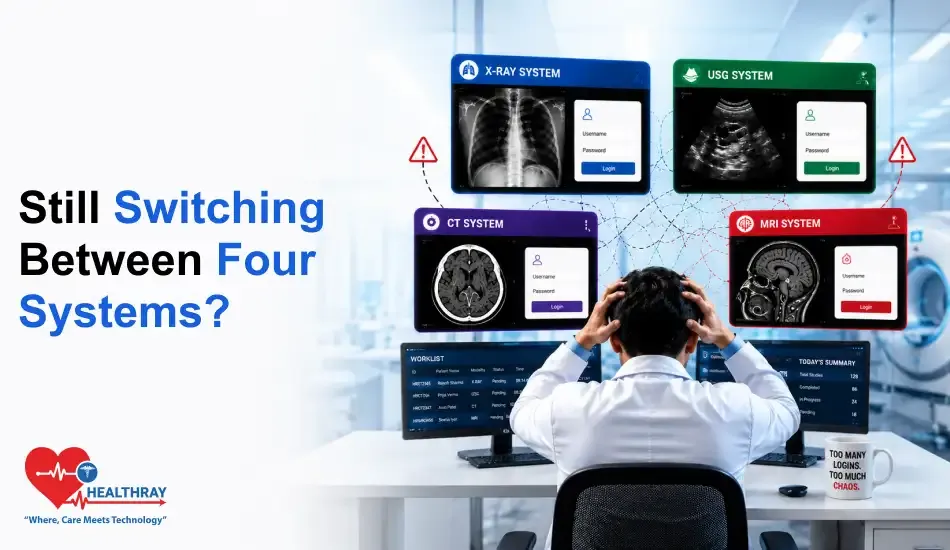
A radiology information system (RIS) is a software system used to manage, exchange, and store data in radiology departments (RDs) and standalone imaging centers. It connects patient registration, scheduling, DICOM imaging, reporting, and billing for X-ray, USG, CT, MRI, and ECG in one system. For multi-modality diagnostic centers, RIS replaces separate software logins with a unified workflow, reducing duplicate data entry, reporting delays, and billing errors. Here’s what this guide covers:
- The real weekly cost of running four separate radiology software systems
- Core modules of a modern radiology information system unify across modalities
- DICOM image flows from machine to radiologist without manual entry
- Single patient record across X-ray, USG, CT, and MRI in one visit
- Multi-modality billing and doctor commission tracking in one system
- Healthray setup for diagnostic centers – machines, modules, and migration
The Real Cost Of Running 4 Radiology Software Systems
Before your staff even starts their day, and patients come in for their scans, consider what these staff members are doing. They are not reading case notes or setting up exam rooms; instead, they are logging into various programs. In fact, most sites consume four logins by 9 AM.
- One login for X-ray scheduling.
- A second for USG reporting.
- A third for CT reporting.
- A fourth for MRI reporting.
And if you also run a Laboratory Information Management System (LIMS), that is one more login on top of all four. That is covered separately in its own guide. In between all those logins, the same patient coming in for a chest X-ray and abdominal USG gets registered twice. Nobody planned it. It just became the routine. This is not a one-day problem. It is what every working day looks like.
| FRICTION POINT | 4 SEPARATE SYSTEMS | 1 UNIFIED RIS |
| Staff Training | 4 learning curves per new hire | One system to learn |
| Patient Registration | Entered 2-4 times | Registered once per visit |
| Report Format | 4 formats per doctor | One standardized report |
| Billing Reconciliation | Manual merge at day-end | Automatic per-study billing |
| Dicom Storage | Separate archive per modality | One central archive |
| Weekly Time Lost | 14-20 hours weekly | One login, one worklist |
In multi-modality clinics, staff spend the majority of their shift on tasks that have nothing to do with imaging. Registration, reconciliation, manual data entry, and billing consolidation eat into reporting time every single day. If you handle 50 patients a day across four modalities, this is your daily reality.
The Healthray Modality Fragmentation Cost Index (MFCI) highlights the four pain points in multi-modality facilities that consume the most time due to fragmented systems: registration inefficiencies, DICOM inefficiencies, billing inefficiencies, and worklist inefficiencies. Inefficient multi-modality facilities lose time on all four simultaneously.
Why Scaling Makes This Worse
That is what no one tells you when you introduce a new CT scanner. In the absence of an integrated workflow, adding yet another imaging modality usually means adding yet another login, worklist, and administrative reconciliation. In the end, you have a device that makes your department scan more, but it becomes more efficient only as part of a larger integrated workflow. That will be discussed in the following section.
What A Modern Radiology Information System Actually Unifies
Typically, center managers think of radiology information software as a scheduling system. And that’s correct – it does manage your schedule. But scheduling is not where the real issue lies. The real fragmentation happens in your DICOMs, in your registration process, in your billing, and in your radiologist’s worklist. It takes more than just your schedule to be a true integration solution.
Modality Coverage And Reporting
A correctly implemented RIS covers X-Ray, Digital X-ray, USG, CT, MRI, ECG, 2D Echo, TMT, and PFT. All under one patient file. When a patient comes in for a chest X-ray and abdominal USG on the same visit, the system creates one entry. Not two. That means no duplicate registration, no duplicate billing, and nothing to reconcile at the end of the day. The reporting module takes care of:
- Modality-specific templates.
- Voice reporting for busy days.
- Digital sign-offs on one platform.
Viewing, Worklist, And Billing
- The built-in DICOM viewer allows radiologists to view chest X-ray and brain MRI studies on the same screen while supporting centralized image archival for secure storage and quick retrieval, eliminating the need to switch between separate PACS applications.
- The worklist of one radiologist displays all pending X-rays, USGs, CTs, and MRIs, making it easy to prioritize studies within seconds.
- Multi-modality billing creates invoices instantly once the study is done, and follows up with the referring physician’s commission for each modality.
- The patient portal sends the report to the patient and referring physician instantly, so that your front desk doesn’t become the delivery point.
The ACR-AAPM-SIIM Technical Standard for the Electronic Practice of Medical Imaging clearly recognizes that lack of interoperability results in patient error and operational inefficiencies. Operating four different systems in a multi-modality facility is simply not a solution. It is the very issue being faced daily. Therefore, if your RIS only does scheduling, it is a scheduling system, no matter what you call it.
DICOM Viewer And Multi-Modality Workflow Walkthrough
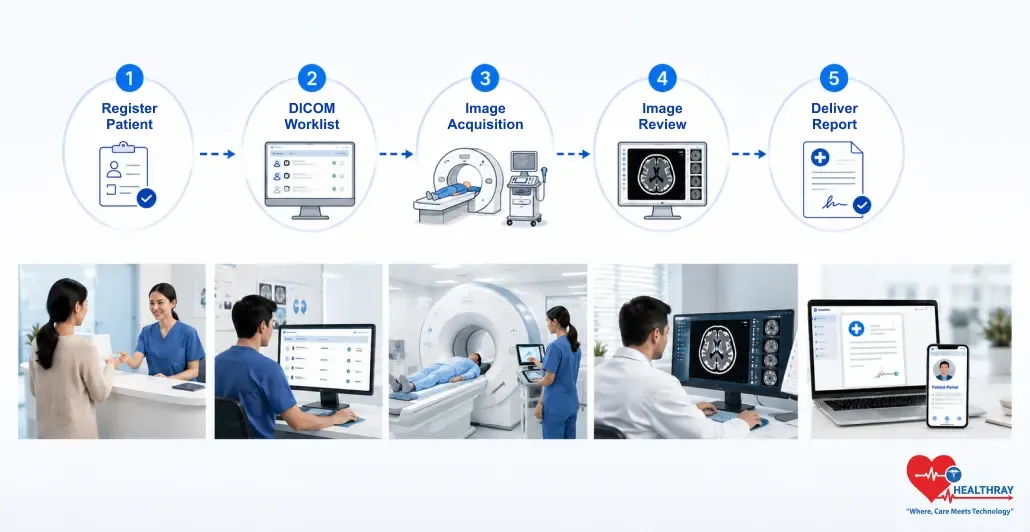
In general, most modern imaging devices, such as CT, MRI, digital X-ray, and USG systems, use the DICOM standard for image transfer. Your GE LOGIQ USG, Siemens MAGNETOM MRI, GE Revolution CT, and Philips DigitalDiagnost X-ray are all DICOM-based. That is exactly why a radiology information system can include a built-in DICOM viewer, allowing radiologists to open images directly within the platform instead of switching between multiple applications. Here is the complete workflow from patient check-in to report delivery:
Step 1: Register Patient
The patient registers once at the front desk. The radiology information software creates one case file. One patient. One record. That is it.
Step 2: DICOM Worklist
The technologist opens the RIS worklist and pulls up the patient. It does not matter whether they are in the X-ray room, USG chamber, or CT suite. The patient’s name, age, and referring physician details are already there from central registration. Nothing gets typed again at any machine.
Step 3: Image Acquisition
Once the scan is complete, DICOM images are automatically transferred from the imaging modality to Healthray’s integrated RIS-PACS archive. There is no need for manual uploads or USB transfers, and radiologists can access studies from the same platform.
Step 4: Image Review
The radiologist opens the worklist and selects the study. Regardless of whether the exam is an MRI, CT, X-ray, or USG, every study follows the same DICOM workflow within the RIS, creating a consistent radiologist workflow across all imaging modalities. The process remains the same regardless of the modality.
Step 5: Deliver Report
The radiologist digitally signs the medical report. It automatically reaches the referring physician and the patient portal at the same time.
This is confirmed by scientific literature available in the RadioGraphics journal. Research conducted in DICOM Modality Worklist indicates that automatic input of patients’ information in imaging devices prevents mistakes in manually entering data and identifying the patient. And this is more significant than it may seem at first sight because one misspelled patient’s name on the CT console means that the scan was assigned to another record.
 PRO TIP
See How A Unified DICOM Worklist Simplifies Daily Operations
If you’re currently switching between separate systems for X-ray, USG, CT, and MRI, see how a unified workflow simplifies daily operations. Explore a free 20-minute demo of how a single DICOM worklist manages everything from patient registration to report delivery on one platform.
Unified Patient Registration Across X-Ray, USG, CT, And MRI
This is an example of what happens every day in multi-modality centers. A patient arrives at 10 AM. One referral. Two tests: abdominal USG and chest X-ray. Same doctor. Same visit. The USG department of your center enters that patient into their database. The X-ray department of your center enters the same patient into its database. By the time the patient leaves, you have:
- Two patient IDs created.
- Two separate registrations.
- Two invoices for one visit.
- One referral was signed twice.
This is not a staffing issue. It is a systems issue. A radiology information system solves this by allowing the patient to register once for the entire visit. Healthray creates one case file that automatically links every modality, including USG, X-ray, CT, and MRI, while supporting accurate billing, including the cost of an MRI scan. As a result, the radiologist sees the complete imaging history, the billing team works from a single entry, and the referring doctor receives one consolidated report. For centers handling 80 to 100 patients a day across multiple modalities, fixing registration alone can give the front desk 45 to 60 minutes back every day.
 NOTE
NOTE
How Multi-Modality Billing And Doctor Commissions Work In One RIS
While patient registration is the daily grind, billing is the end-of-month problem. In most diagnostic centers in India and Africa, referral fees depend on the modality, not the visit. That creates a gap that the Multi-Referral Billing Stack (MRBS) is built to close – one system that tracks every modality, links it to the referring doctor, and calculates the commission without manual input.
The Problem With Separate Billing Systems
Imagine this situation. A doctor refers a patient to undergo a USG and a chest X-ray. There’s one entry from the USG machine and another entry from the Chest X-Ray machine. And now imagine your billing staff having to:
- Pull entries from two different systems.
- Check the referring doctor’s commission.
- Enter everything into a manual ledger.
Imagine having to do this for 30 to 50 patients every single day. This would be quite a time-consuming process. Not because it is a difficult process, but simply because these two systems weren’t designed to communicate with each other.
How Unified Billing Works Instead
Once the studies are conducted within the integrated RIS system, the invoices are generated and are associated with the correct modality and referring physician without the need for any manual intervention. Your billing department then interfaces with:
- One invoice per patient, regardless of the number of tests performed.
- Automatic commission calculation per study, without manual effort.
- Daily and monthly revenue reports categorized by modality, physician, and site.
- No need for merging of spreadsheets at the end of the day or the month.
When your RIS cannot manage multi-modality commissions out of the box, it was not built for how centers actually operate. In India, that means untracked referral splits across USG and X-ray on the same visit. In East and West Africa, where many diagnostic centers run on cash-pay models with no insurance intermediary, an untracked commission is simply revenue that disappears with no paper trail to recover it.
Learn more: If your diagnostic center also runs a laboratory, read How LIMS Saves Hospital Labs From Doctor Trust Loss to see how integrated lab workflows improve reporting accuracy and reduce operational inefficiencies.
Healthray RIS Multi-Modality Setup
Healthray brings unified registration, native DICOM viewing, a single radiologist worklist, and multi-modality billing together within a single radiology information system from the first day of go-live. The implementation team performs an MFCI assessment during go-live to identify which of the four fragmentation layers your diagnostic center should address first. Here’s what the implementation includes.
1. Machine Connection And Registration
- The DICOM files generated by your GE LOGIQ, Siemens MAGNETOM, GE Revolution, and Philips Digital Diagnost imaging devices are automatically saved to the Healthray embedded archive system once an exam is completed.
- This eliminates the need for an additional PACS system, since Healthray comes bundled with built-in PACS, along with DICOM view capability.
- The cases module handles registration: patients fill out their patient information only once, and all modalities used during the visit are linked to the same case file.
- Your radiologist, billing staff, and front desk have access to the same case file all the time.
2. Reporting And Voice Sign-Off
Native DICOM viewer displays X-ray, USG, CT, and MRI scans directly from the browser without requiring the installation of any software or additional applications. Furthermore, dictation reporting makes it possible for radiologists to dictate from anywhere they may be at the time. This proves to be highly effective when reporting emergency CT and MRI scans outside normal business hours. The report is sent to the referring physician and the patient portal through digital signing.
3. Billing And DICOM Migration
- A charge goes out with each study the instant it is complete.
- All referrals by the referring doctor end up on the same report, even though they may be created via different modalities.
- You receive one single itemized statement for each patient at the close of the day, with nothing to consolidate.
- If you are transitioning to not using PACS anymore, Healthray will migrate your DICOM archive for you. All past images will transfer to their rightful patient accounts, leaving nothing behind from your archive.
Final Verdict
Operating software for X-Ray, USG, CT, and MRI individually might initially appear easy enough. But as the number of patients and modalities rises, it soon turns into a daily headache for your organization.
A full-fledged Radiology Information System integrates registration, DICOM imaging, reporting, and billing all in one package. By having one login, one patient record, and one workflow, diagnostic centers are able to handle more patients while at the same time minimizing errors.
If you are operating individual software programs for each modality, a quick demonstration will be all that is needed to demonstrate how an integrated system can benefit your diagnostic center.