

Summary
There is an increasing pressure on hospitals worldwide to provide quicker, safer, and more personalised care, with the same resources as they had always possessed. A hospital management system takes that challenge on the head by integrating all the departments into a single source of operation. Emergency triage and medication safety to telemedicine and revenue cycle management are only a few examples of the HMS applications discussed here, but they demonstrate exactly how the modern technology can be converted to the improved patient and healthcare team outcomes.
Introduction
Consider the number of decisions made by a hospital within an hour. The results are checked by the doctors, the nurses update the charts, the nurses review prescriptions, and the billing staff process invoices at the same time. As such, patients experience it first hand when any component of that chain fails. That is exactly why how to improve patient care with technology has become the defining question for hospitals across the world.
The current generation of a hospital management system delivers all those moving parts into a single interconnected platform. Moreover, it does not merely structure information, but it renders this information practical in real time, at precisely the point when a clinician requires it. The American Hospital Association predicts that hospitalised patients in 2025 will be almost 30% more likely to survive than in 2019, and an improved information system can contribute to this change.
In this blog, we cover each hospital management system use case with a real-world scenario and a clear outcome so you can see exactly what HMS in healthcare delivers for your facility.
 NOTE
NOTE
What Is A Hospital Management System?
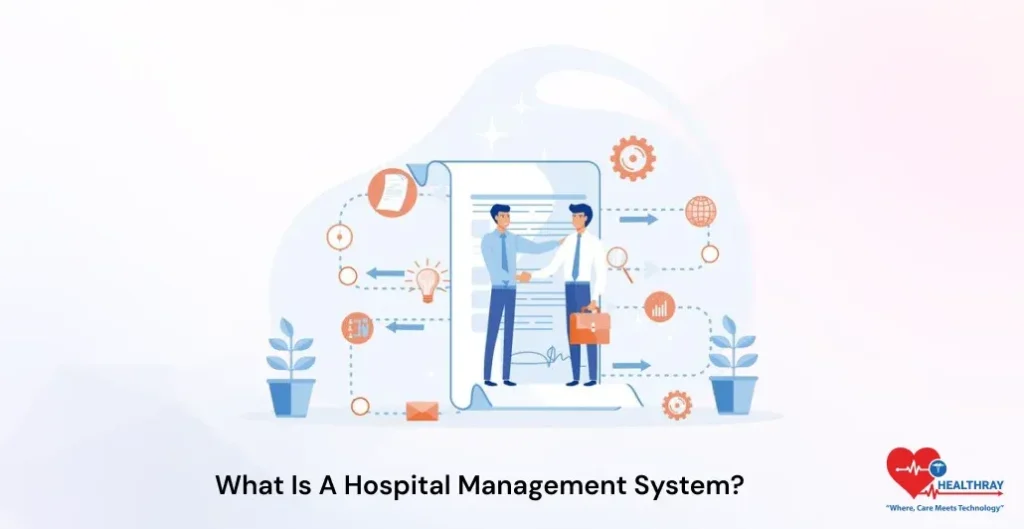
A hospital information system fundamentally is a computer-based system that handles both administrative and clinical components of a medical organization. Imagine it to be the nervous system of a hospital – patient registration, electronic health records system, appointment scheduling, pharmacy, billing and laboratory management are all housed within one system. In its absence, the various departments operate independently and hence this causes delays, loss of information, and unnecessary errors.
Additionally, an effective hospital management software is not one that merely records the data but makes the data immediate, accessible and actable as soon as a clinician requires it. A doctor asking a patient to examine him before a surgery, a pharmacist attending to a new prescription, an administrator requesting an invoice to be raised can all access the same live record at the same time. Such a degree of orchestration cannot exist with paper documents or systems that are not linked together.
Hospital Management System Use Case 1: Emergency Triage
Imagine this, a patient comes to the emergency department in a critical condition. In the absence of an HMS, employees waste crucial minutes searching, requesting other departments to find out any information about them, and identify a free bed. Subsequently, such delay can directly influence the outcome of the patient. Hospital workflow automation has been implemented and all that information is displayed on the screen the moment when the patient is registered.
The system will automatically indicate high priority cases according to triage scores and display real time bed availability in all the wards. This implies that the care team is able to make quicker and safer decisions without having the resources coordinated manually by someone. It also maintains a live perspective of all the patients in the department including the level of acuity, the wait time, and the clinician assigned to that patient so that no emergency patient is ignored during a hectic shift.
 PRO TIP
Hospital Management System Use Case 2: Centralised Patient Records
One of the most powerful hospital management system benefits is what happens when all patient data lives in one place. These days, most hospitals are faced with disjointed records whereby a GP has a set of notes, the hospital has another and a specialist has their own. That disintegration is literally damaging, especially when the physicians are coming up with decisions without the full picture before them.
Conversely, an HMS gathers all the information such as the past diagnosis, imaging, laboratory tests, allergies, and a record of current medications and treatment history into one record that all authorised clinicians can retrieve immediately. As an example, a pharmacist and a cardiologist looking at the same patient are both able to view the same live data, as well as coordinate care, without even a single phone call. In the same manner, the proper MRD management in hospital guarantees that the medical records are kept in the right way, tracked and retrieved without wasting time, which makes this level of coordination possible in the first place.
Hospital Management System Use Case 3: Medication Safety
One of the most avoidable ways of patient harm in hospitals is medication errors. A study conducted in Health Policy and Planning discovered that the lack of medication tracking is a major contributor to adverse drug events, especially in patients who handle a variety of diseases. This is tackled in an HMS by the inbuilt medication error prevention which is automatic in the prescription workflow.
As an example, in cases where a physician prescribes an additional drug to a patient who is already taking multiple medications, the system will automatically check the thereof. In case there is a conflict then it will alert the prescribing clinician before an order is relayed to the pharmacy. One automated check is enough to avoid a serious incident (or even a life-threatening event).
Patients with five or more medications are at a higher risk of adverse drug event by 35 percent than patients who have one medication. An HMS automatically compares every new prescription with the entire list of medications in the patient (check, which can take seconds to do electronically, and up to 15 minutes to do manually), and is frequently omitted in a situation of time pressure entirely.
Here is a quick overview of all six use cases, the problem each one solves, who it benefits, and the key outcome it delivers:
| USE CASE | PROBLEM SOLVED | WHO BENEFITS | KEY OUTCOME |
| Emergency Triage | Slow patient routing | ER staff, patients | Faster, life-saving decisions |
| Patient Records | Fragmented data | Doctors, specialists | Fewer diagnostic errors |
| Medication Safety | Drug interaction risk | Pharmacists, patients | Prevents adverse events |
| Telemedicine | Access barriers | Remote patients | Care from home |
| Remote Monitoring | Chronic condition gaps | Long-term patients | Fewer readmissions |
| Billing & Ops | Manual billing errors | Admin, finance teams | Faster revenue cycle |
Step towards digital era with our healthcare solution
Revamp your hospital facilities and embrace change for better healthcare management. Ease in managing and organizing large medical datasets leads to effective analysis. Seize the opportunity now!
Hospital Management System Use Case 4: Telemedicine in Hospitals
Telemedicine in hospitals has ceased to be something convenient to a must. Since the pandemic, patients expect to access care from home and facilities that cannot offer this are losing ground fast. This is achievable in an HMS that includes the telehealth capabilities and does not exist as an isolated and unconnected device isolated on the periphery of the overall patient care.
As an example, a patient who is dealing with high blood pressure should be taken into account. They are able to book an appointment with the video system via HMS, exchange their home monitoring device readings, and be provided with a new prescription in one workflow. Their cardiologist, GP and the pharmacy all have access to the updated record simultaneously. It is that type of coordination that transpires to make results better.
Hospital Management System Use Case 5: Remote Patient Monitoring
The management of a chronic condition does not occur only when a person is attending the scheduled appointments. It involves regular, constant management, and that is what an HMS can offer in terms of remote patient monitoring. Patients with diabetes, heart failure, or COPD use connected wearables and home devices that feed real-time data directly into their hospital record.
Since such patients are the ones who are at the greatest risk of deteriorating any minute, a system that monitors their vitals 24 hours a day can be a big difference. In case a reading is beyond a safe range, the HMS will send an instant notification to the concerned clinician. Precisely such warning in an early stage lets the care team have the time to intervene before the situation degenerates into a crisis. A properly developed patient information management system will guarantee that such data is correctly and safely transferred between devices, records, and care teams without any human intervention.
Hospital Management System Use Case 6: Billing and Operations
An HMS is a huge difference to the business aspect of hospital operation in addition to clinical care. Hospital billing automation is one of the clearest examples. Paper-based billing is time wasteful, subject to errors, and a constant headache to the patient and finance department. An HMS automates the entire process – capturing charges as services happen, applying the correct codes, and producing clear, itemised invoices that patients can actually understand.
In the same manner, inventory control is much more reliable using an HMS. The system monitors the stock in all of its departments and sends automatic reorder notifications when the stock levels are low. It is most crucial in the surgery and emergency case, where it is impossible to run out of a necessary component during the procedure. In the same way, revenue cycle management becomes more efficient because billing errors drop, payment cycles shorten, and the finance team spends less time chasing outstanding invoices.
Keeping Patient Data Safe With Healthcare Data Management Software
Security is not an option with so much sensitive data running through an HMS, it is a necessity. A robust platform secures patient data throughout its entire foundation, storage, transmission, and use to regulatory compliance and user access.
- End-to-end data encryption using AES standards for all stored and transmitted data
- Role-based access control so each staff member accesses only what their role requires
- Two-factor authentication adding a second layer of security beyond username and password
- HIPAA compliance software standards for USA-based hospitals and GDPR compliance for European facilities
- Automated cloud backups for disaster recovery without data loss
- Regular security audits to identify and fix vulnerabilities before they cause harm
Why Healthray Is the Leading Hospital Management Software
Healthray is one of the most complete hospital management software solutions available in India and the USA. It is designed for Indian hospitals, clinics, and healthcare networks. As a cloud based hospital management system, it gives every department live patient data at any time. The device used does not matter.
Electronic health records system management, automated billing, real-time inventory tracking, and built-in telemedicine all sit in one central platform. Furthermore, it meets healthcare data standards in both India and the USA.
A small clinic in a tier-2 city and a large multispecialty hospital can both run on the same platform. Features adjust to suit the size of each facility. Moreover, the Healthray support team is conversant with the Indian healthcare environment – therefore implementation is not daunting but manageable.
Conclusion
Every hospital management system use case in this blog leads to the same outcome. It creates a facility that is faster, has fewer errors, and gives patients a better experience. HMS supports everything from emergency triage to revenue cycle management. Facilities that invest in the right system record better clinical results, lower costs, and stronger patient satisfaction. Healthray is built for hospitals and clinics in India. Moreover, getting started takes less time than you think. Get a personalised free tour of Healthray and see how your facility can provide better care on the first day.
Learn more: The Future of Healthcare: Innovations in Hospital Management Systems