

Quick Summary: Expanded mechanization, AI integration, and cloud arrangements are integral to Healthcare Enterprise Resource Planning (ERP). Real-time information, predictive analytics, and data visualization enhance capabilities and functioning of healthcare operations. Advanced client involvement is a crucial aspect for organizations to adapt effectively to increasing patient demands & conditions.
Introduction
Healthcare operations encompass various tasks, including accounting, inventory management and human resources. Activities like managing patients, tracking inventory, managing lab activities and more with automation is crucial. These operations are now supported by expansive Enterprise Resource Planning (ERP) solutions.
In the global pandemic, healthcare medical software systems are quite popular because of their virtual controlling and consultation system. After that, it keeps evolving and integrating new functionalities that enhance healthcare delivery and decrease employee workload. Nowadays, the new software assists in resource planning, improves financial workflow, and decreases task complexity.
ERP software empowers modern businesses to decrease costs by eliminating pointless methods of resource allocation and mechanizing tedious work. Moreover, it gives staff individuals access to imperative information. This helps them make decision-making choices in healthcare more easier. It also enhances their effectiveness.
Hospital Management Software frameworks are advancing. They serve a more extensive range of assignments and business processes especially when it comes to healthcare. They incorporate unused innovation as organizations depend on them for operations. In this post, we’ll go over eight key patterns to observe in 2024 and the past that could contribute to the Healthcare industry. Lets have a look at the future of enterprise resource planning.
What is enterprise resource planning for Healthcare?
Healthcare providers utilize a software called enterprise resource planning(ERP). It helps handle various tasks like supply chain management, project management, and accounting. It also assists in procurement and risk management. Enterprise Resource Planning is an exceptional software for healthcare. It helps arrange, budget, anticipate, and detail an organization’s budget. It is also included in a complete ERP software suite.
ERP frameworks encourage the information stream between various operations and interface them together.It maintains a strategic distance from information duplication. It guarantees data astuteness with a single source of truth. It gathers an organization’s shared value-based information from several sources. Therefore, it is the best tool to enhance patient care, reduce medical errors, improve medical records, and advance medical services.
With the dynamic clinical workflow system, it is necessary to have hospital management system software in your organization. Moreover, it facilitates sophisticated healthcare facilities, assists to swiftly enter patient information, create standard medical billing, improve revenue cycle management, and easy access to patient records.
Most importantly, it reduces the conventional method of handling healthcare organization and steps towards modernization of clinical tools. Furthermore, the healthcare management software creates a master and consolidated information, generates related documents, and helps in facility management. Therefore, it is the substantial factor of enhancing patient care, effectively administering routine tasks, improving patient outcomes, and contributes to data driven decision making.
ERP software is essential for running thousands of companies of all sizes and divisions. The ERP system is as critical to business management even for the healthcare industry for their capacity to operate.These arrangements handle day-to-day operations. They cover fabricating, supply chain administration, and extended administration. Additionally, they address bookkeeping and finance tasks.
Enterprise resource systems are comprehensive, cloud-based, or on-premises, and coordinate stages that handle each generation- or distribution-based firm aspect. The future of enterprise resource planning is bright as it assists with accounting tasks. They handle operational and customer data. Additionally, they manage supply chains, inventory, improves patient outcomes, access to patient data, and human resources.
Besides, efficient medical software is needed for reducing expenses and increasing the speed of medical transactions. Improving financial information due to refining information and recording each detail. Furthermore, the hospital information management system improves healthcare delivery, increases healthcare technology, and modifies the hospital infrastructure. Therefore, the hospital management system software enhances work efficiency and lowers stress.
Top enterprise resource planning trends one must know.
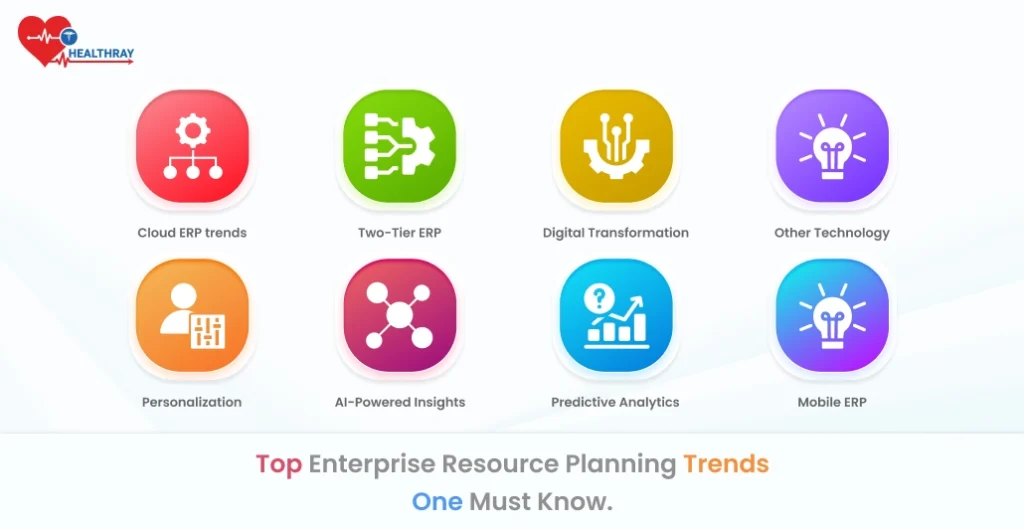
Cloud ERP Trends
Numerous healthcare organizations & companies depend on on-site ERP systems and software and are reluctant to move critical data exchange apps online. At any rate, as a rule, it is changing rapidly. Since of its more straightforward sending, lower operational costs, flexibility (i.e., capacity to utilize as required the assets at any given time), convenience, less dependence on inside IT assets, and ease of improvement for extra clients and highlights to meet commerce needs, cloud, and ERP software market is getting to be increasingly well known among businesses.
The ubiquity of cloud ERP technology has raised mindfulness of its preferences and supported the move away from on-premises computer programs, partly because cloud computing-based applications empower representatives to complete tasks from any area with a web connection—not relatively an office.
A developing number of CFOs are contributing more to cloud and ERP solutions to decrease costs in money-related precariousness, expand operational efficiency, and give back to their inaccessible workers. Twenty percent of the fund experts studied in 2020 expressed they arranged to extend their uses for cloud computing-based, ERP software frameworks.
Two-Tier ERP
Some businesses previously endeavored to actualize a single ERP system framework for their healthcare workplaces, auxiliaries, and base camps. In any case, putting that methodology into impact was costly and exceptionally troublesome as often as possible. There were very high demands for this technology to be implemented in healthcare organizations.
Because of this, one of the most significant patterns in the ERP landscape for 2023 is two-tier ERP. By utilizing the ERP approach, healthcare enterprises can take advantage of their venture in current and future ERP systems and frameworks at the level (level 1). In contrast, auxiliaries and divisions utilize a regularly cloud-based isolated ERP arrangement (level 2).
Littler healthcare units switch to frameworks that cater to their particular needs, whereas more prominent organizations seem to keep utilizing their primary ways ERP systems and framework for financials and other fundamental errands. This electronic health record has capacity to exchange information between the levels is one figure that decides how viable this methodology will be; a few level 2 cloud arrangements have coordinated corporate and ERP systems and frameworks.
This approach has some interesting aspects. It is regularly less expensive than updating the whole corporate ERP system framework to serve the whole company. A level 2 arrangement could be more straightforward to operational and customer experience data to set up and donate auxiliaries and more versatile to alter to moving to advertise conditions.
The two-tiered methodology might also be more fitting for businesses encountering quick development and business growth. Concurring to Gartner, huge enterprises ought to assess in case upgrading little, conceivably quickly extending commerce units would result in more prominent commerce benefits from a two-tier ERP technique than from a single-tier one.
Digital Transformation
In the recent landscape, digitization is the key for success and necessary for development. Enhanced patient experience, improves health outcomes, and boosts clinical experience through advanced functionalities. Furthermore, the enterprise resource planning software has been essential for proper planning of healthcare resources such as managing clinical finances, precise allocation of employees, and upgrading instrument quality. Additionally, it assists in tracking.
Managing financial resources, human resources, and healthcare assets. Detecting potential errors in resource transactions and aids to precise resource monitoring. Resource traceability can be done from any location. Provides valuable insights in the amazing format, it assists to analyze the hidden information and make prompt decisions. Additionally, It helps in tracking healthcare finance, monitoring employee performance, and avoiding stock outs situations.
Advanced change is joining computerized advances into all company assignments to make strides in day-to-day, business processes and operations. HMS Software progress client benefit and communication, customer experience, increment representative effectiveness, enhancing patient outcomes, enhance efficiency, increment income, enhance patient care, and competitiveness as often as possible.
An ERP framework may be an area to begin encouraging this change since it frequently influences most perspectives of an organization’s digital transformation. In truth, concurring to Accenture’s 2020 ERP Patterns report, cloud based ERP solutions is being utilized as a modernization device by 75% of UK organizations.
It is embedded with patient management software solutions, responsible store patient history, helps to book appointments from other locations, improve patient outcomes, and improve patient engagement rate.
This computerized change incorporates several subjects sketched out underneath digital transformation, such as the selection of AI and machine learning for progressed analytics and the association of ai powered ERP, with IoT gadgets.
Other Technology Integrated With ERP
Indeed, whereas a company’s computerized change rotates around present-day modern ERP solutions, this mechanical speculation dynamic business environment is only one viewpoint of a bigger one. Businesses combine their commerce apps with other cutting-edge advances, such as IoT, to improve critical methods of risk management, streamline operations, and careful planning while creating plans.
Retailers, for occurrence, track the development of things inside the distribution center utilizing distribution center administration frameworks that assemble data from portable scanners and clever conveyors. To upgrade online place workflows, a few businesses combine modern ERP systems and e-commerce. It permits mechanized negotiation fulfillment, stock level upgrades, and installment recording.
Also, there will be more of a connection between the SAAS ERP trend, future of enterprise resource planning, and social media within the upcoming year. Businesses may pick up a more profound understanding of their gathering of people and progress their advanced showcasing techniques and client involvement by seeing all of their customers’ and prospects’ social media actions in one area including the use of sentiment analysis tools.
Businesses can obtain more excellent experiences in complete deal handling and test modern approaches to target and offer by blending information from social media followers insights with deal arrangement history and client communication.
Personalization
ERP platforms with complex programming languages were hard to customize to each company’s specific needs in the past. Yet, cloud ERP platforms—dubbed “low-code” platforms by analysts—that require less erp configuration are now advantageous to businesses.
There is currently a growing range of various cloud ERP platform solutions available that are tailored to specific industry needs. ERP systems that have capabilities like highly configurable dashboards marketing automation are essential for firms who want to provide more relevant and personalized client experiences.
The increasing usage of artificial intelligence AI, of chatbots and other AI-powered conversational and assistive user interfaces, which can understand text or voice input from users and reply to inquiries with the help of customer and order data kept in the ERP system, is one new trend. Additionally, this is an efficient master information system that creates different accounts of each patient and maintains records with precise test reports.
AI-Powered Insights and Improvements
ERP data analysis frameworks with coordinated fake insights and machine learning capabilities help fulfill the developing requirement for personalization and improve an assortment of trade operations within the foundation of business intelligence.
In the past, businesses might include AI usefulness in their decision making, choosing the future of enterprise resource planning and data frameworks, but more producers are presently advertising ERP computer programs that currently have these features. Additionally, this automates processes of providing valuable insights, monitoring data from multiple locations, and effortlessly sharing data remotely.
Businesses can pick up an incredible bargain from AI, counting:
- More insights. Healthcare organizations depend on AI to make intelligent decision making trade choices based on the endless sums of operational, financial systems, operational and customer data, and client information they collect.
- Vast volumes of unstructured information can be filtered into actionable insights by AI advances, which can quickly recognize designs and estimate distinctive incomprehensible patterns to distinguish with manual number-crunching alone.
- Improved business processes. Various forms can be made strides and computerized with the utilization of AI. Take a producer employing a just-in-time stock approach for an occurrence to diminish the toll of carrying stock by conveying components as long as attainable. AI within the machine learning frame can make strides in labor planning and other supply chain disruptions and conveyances to boost yield and cut costs.
- According to IFS’s 2019 report, 36% of producers anticipated utilizing AI for client and customer relationship management, administration and generation planning, and 40% of producers arranged to use it for stock arranging and coordination.
Predictive Analytics
Healthcare businesses aspire for AI-powered cloud-based ERP systems. They seek artificial intelligence to filter through their operational data security and client information. This pursuit aims to discover new knowledge and boost their profit margins.
An ERP system has been used for data analysis to uncover historical events. The focus in 2023 and beyond will shift to proactive predictive analytics. This aims to identify and address potential future events. Machine learning computer programs can filter through information.
The information is collected by an upkeep company concerning hardware repairs. They figure out the probability of issues. By analyzing historical data and the future trends and optimizing upkeep plans, the company can benefit from or supplant parts recently that they have become.
Requires handy information that provides reliable data, which has no human errors and replicate information.
Additionally, it is ready to convert into desired format such as tabular, pie-chart, and bar-graphs. Therefore, medical practitioners can anticipate the future treatment outcome and their changing medical conditions of patients.
Mobile ERP
ERP companies have offered portable functionality for some time now. Their mobile devices and apps are increasingly prevalent. They’re becoming more common among users.Mobile ERP apps and frameworks are designed to provide specialists with versatile access to crucial corporate data. This empowers them to perform back-end and front-end business operations from any location. Create a modern way to execute healthcare services.
This includes areas such as airports, retail checkout counters, and warehouse floors. Also, portable modern mobile ERP solutions can advance participation among scattered workforces in different time zones.
User-friendly, versatile mobile ERP solutions and applications and apps empower clients to run errands when they’re not before a computer. Specialists can utilize their phones to achieve obligations like time following, taking a toll announcing, and call logging. They can moreover check the status of critical methods and endorsements.
Versatile mobile ERP solutions and apps expand to real-time information and data, along with bits of knowledge. They offer steady inaccessible access as well as improved efficiency. Additionally, hospital management systems enable faster and more accurate information collection and greater dexterity. Enable faster and more accurate information collection and greater dexterity.ation collection and greater dexterity.
Conclusion
Healthcare organizations are more likely to face issues in managing enterprises. Hence it’s necessary for them to have ERP software. Most ERP software vendors in healthcare are relocating to the cloud. This shift will likely be faster than before. Healthcare organizations find it less complicated to procure speed and agility in today’s advertising. Businesses that have already moved to ERP providers in the cloud. They will rummage around to amplify the cloud’s capabilities. For now the future of enterprise resource planning seems to be brighter than ever for healthcare.
The Healthcare industry will keep concentrating on making, beyond any doubt, their ERP program ready for inaccessible work within the predictable future. The future of ERP is becoming more versatile. It emphasizes secure access and supports remote collaboration. However, hospital systems also boost automation in processes, and improve hospital operations.
It is necessary to keep an eye on the presumed trends of ERP systems. They provide inventory management capabilities. This can shield the company from disturbances or unexpected shifts in the world economy.