


September 24, 2026

6 Best KareXpert Alternatives for Hospitals in India (2026)

Karexpert-alternatives-healthray-hospital-management-dashboard

When a hospital grows, small problems start piling up. A second branch means one patient file exists in two places. A new division means front-desk staff filling forms that were never made for it. More insurance patients means someone on the billing team inspecting pharmacy, consultations, and lab costs by hand, every day, because the platform is not doing it for them. Nothing feels like a crisis; it’s just extra work, department by department, until finally someone asks: Can our current software actually keep up?

That’s usually when hospitals start looking at options beyond KareXpert. Basic record-keeping and billing used to be enough. Now hospitals want a system that cuts down manual entry, keeps patient data connected across departments instead of stuck in silos, handles ABDM and ABHA properly, and makes daily hospital work a little less painful.

KareXpert is a well-known name in Indian healthcare software. But well-known and “right fit” aren’t the same thing. A 40-bed nursing home in a small town and a 300-bed hospital chain need very different things from their software. What works for one can frustrate the other.

So instead of just giving you a ranked list, this article looks closely at six real alternatives to KareXpert — how each one holds up on hospital fit, scale, compliance, billing, connecting with other systems, and everyday use, and where you should ask more questions before signing up.

How We Evaluated These KareXpert Alternatives

This comparison is based on official product documentation, publicly available information, and user reviews from Capterra, SoftwareSuggest, Techjockey, and G2. The information was collected up to August 2026. We used vendor websites and materials to understand each platform’s capabilities, but did not assume that every vendor claim was independently verified.

We looked at the areas that matter when a hospital is choosing or replacing an HMS, including clinical and administrative workflows, multi-location operations, interoperability, compliance, implementation, usability, and overall day-to-day fit. Each platform was also compared with KareXpert across these areas.

It is worth keeping in mind that a feature mentioned on a product page may not be available on every plan or fully implemented in every hospital. Where we could not confirm a capability from reliable sources, we marked it as “Not confirmed” rather than treating the vendor’s claim as a verified fact.

KareXpert Alternatives: Compare the Options at a Glance

Healthray Logo

Healthray

LOGO Ezovion

Ezovion

Mocdoc

MocDoc

Docplus Logo

DocPulse

Suvarna His Logo

Suvarna-HIS

Best for Hospitals & health systems Clinics and labs needing integrated records & billing. Hospitals, chains, labs & government facilities Hospitals, clinics & multi-speciality practices Mid-size & large hospitals & chains
Pricing Custom quote Usage-based/Custom Custom quote Custom / tailored Custom quote
Migration & Implementation Migration + configuration + training Migration + training · 2–8 weeks Implementation support Migration support Implementation support
India readiness ABDM/ABHA · PMJAY · NABH · GST ABDM/ABHA · PMJAY · ABDM/ABHA · PMJAY · NHCX · NABH India-focused · GST ABDM · NABH · NABL
Key Integrations HL7/FHIR · PACS/DICOM · Lab HL7/FHIR · native PACS · Lab FHIR R4 · NHCX · ABDM LIMS · Pharmacy · EMR · APIs HL7 · LIS · RIS/PACS · Lab
Deployment Cloud / On-premises / Hybrid Cloud/Hosted Cloud Cloud Not confirmed
Rating
OPD/IPD Management
Bed & Ward Management
Operation Theatre
Not confirmed
EMR / EHR
Pharmacy
Lab / LIMS
Billing
TPA / Insurance Claims
ABDM / ABHA
Not confirmed
PMJAY Support
Not confirmed
Not confirmed
NHCX Readiness
Not confirmed
NABH-related Tools
HL7 / FHIR
Not confirmed
PACS / DICOM
Not confirmed
Not confirmed
Lab-Instrument Integration
Typical Implementation Time
1–3 weeks
Not confirmed
Not confirmed
Not confirmed
Not confirmed
Migration & Training Support
Both
Offline-Tolerant Workflows
Not confirmed
Not confirmed
Not confirmed
Support Model / SLA
24×7
Not confirmed
Not confirmed
Not confirmed
Not confirmed
Post-Go-Live Support
MIS Dashboards
Custom Reporting
Smart / Predictive Analytics
Not confirmed
Not confirmed
AI & Automation
Not confirmed
Encryption & Data Protection
Not confirmed
Not confirmed
Access Control & Audit Trails
High Availability & Backup
Disaster Recovery
Not confirmed
Not confirmed
Not confirmed
Security Certifications / Data Residency
ISO 27001 · HIPAA · India
HIPAA-compliant
Enterprise security · Indian hosting not confirmed
DPDP · HIPAA
Not confirmed
Central Stores & Procurement
Ambulance Management
Not confirmed
Not confirmed
Not confirmed
Housekeeping Management
Not confirmed
Dietary Management
Not confirmed
Biomedical & Asset Management
Not confirmed
Not confirmed
HR/Payroll/Duty Rosters
Not confirmed
Patient Communication
Multi-Facility Support
Get A Demo

6 Best KareXpert Alternatives to Consider in 2026

1. Healthray

Healthray is designed for Indian hospital operations, with capabilities such as ABDM compliance, GST billing, TPA desk management, and high-volume OPD workflows built into the platform. This helps hospitals manage day-to-day operations through a single system. Healthray is ABDM-compliant by the National Health Authority and is used by hospitals across India.

It currently serves over 2,500 hospitals, has processed more than 5 million patient records, and supports 5,000-plus doctors across 30+ specialities. The platform supports hospital teams across multiple departments and specialities.

What Stands Out

  • ABHA ID at registration: Created on the same screen as patient registration, so compliance happens as part of the front desk’s normal routine rather than a separate task.
  • India-specific billing, built in: GST-ready billing, TPA claims, and PMJAY billing generate automatically from consultation, pharmacy, and lab data – closing the gap where revenue slips through between departments.
  • Speciality-tuned EMR: 30+ specialities including cardiology, orthopaedics, gynaecology, Ayurveda, and homoeopathy get their own documentation logic instead of one generic form.
  • AI layer: Voice-to-text documentation, automated billing audits, predictive analytics, and smart appointment scheduling – introduced in 2022 and expanded through 2025.
  • Multi-location dashboard: Real-time bed occupancy, OPD queues, revenue, and lab status across branches, with unified patient history between locations.
  • Structured interoperability: Built on HL7/FHIR, SNOMED CT, and ICD-10/11, so records stay exportable in formats regulators and insurers expect.

Best For

Multi-speciality hospitals, hospital chains, government hospitals, and growing mid-size facilities that want one unified platform across clinical, administrative, and financial workflows.

4.9/5 by G2

Pros

  • Connects OPD, IPD, ICU, LIMS, and pharmacy through a single longitudinal patient record.
  • Supports integration with hospital equipment and third-party healthcare systems.
  • Hospitals can customise workflows and forms to match their existing processes.
  • Provides predictive patient-load forecasting and revenue insight to improve hospital efficiency.
  • PMJAY, NABH, GST, and HIPAA compliance built into the core product

Aishwarya K.

The comprehensive feature set of Healthray HMIS is exceptional. From patient scheduling to billing and inventory management, everything is integrated perfectly. It’s a game-changer for improving the efficiency of hospital operations

Verified G2 Review

Cons

  • Staff may need some initial training to get familiar with the workflows.
  • Some advanced analytics views can be further optimised for smaller screens.

Rahul B.

Reflecting on Healthray HMIS, I genuinely find nothing to dislike. Its integration into our processes, user-friendly interfaces, and breadth of features have not only met but exceeded our expectations
Verified G2 Review

Considering Healthray for Your Hospital?

See how Healthray fits your hospital’s workflows, departments, and current setup.

Book a Free Demo

2. Ezovion

Ezovion Screenshot

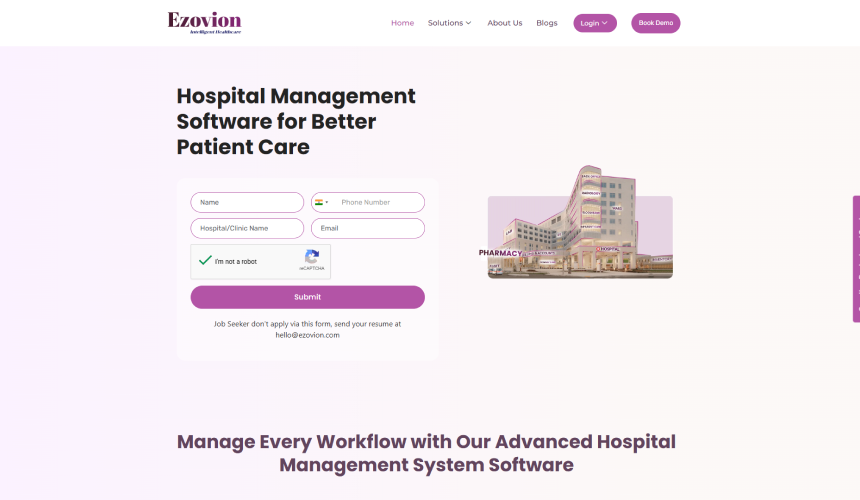
Ezovion covers almost every major hospital function, including OPD, IPD, EHR, lab, pharmacy, radiology, inventory, and teleconsultation. Its pharmacy module is a strong point, covering sales and stock management with AI-based reorder support. The platform also has a built-in radiology viewer, making it useful for hospitals with in-house imaging services.

What Stands Out

  • Native Radiology Viewer: A built-in, HIPAA-compliant radiology answer, rather than a third-party PACS viewer added on separately. Worth testing closely if your hospital does in-house imaging.
  • AI-Driven Pharmacy Reordering: The pharmacy module builds AI-based reorder logic into workflows from the start, rather than adding it on later.
  • Broad Global Reach: Deployed in India, Asia, the Middle East, Africa, Europe, and the Americas, useful for hospital groups with international operations.

Best For

Hospitals that want AI tools across OPD, IPD, lab, pharmacy, radiology, and video visits. Good if you also want smart devices connected.

5.0/5 by Capterra

Pros

  • Covers PACS, OPD, AI Pharmacy, and IPD in one connected patient record
  • Automates TPA/insurance claims and invoicing, cutting manual reconciliation work.

Nirupama

Ezovion is a seamless ecosystem that intelligently drives your healthcare operations.

Verified Capterra review

Cons

  • Limited third-party reviews make it hard to verify vendor claims
  • Connecting different vendor systems can be challenging

Based on our research, we couldn’t find clear information confirming basic hospital support modules such as ambulance, dietary, asset/biomedical, and procurement management. Hospitals that require these functions should confirm their availability with the vendor directly.

Verified Review

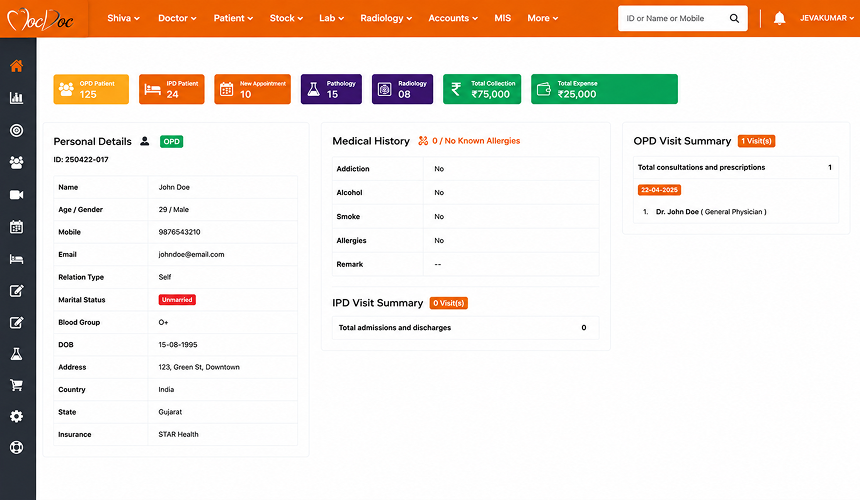
3. MocDoc

MocDoc Screenshot For Alternatives

MocDoc is a cloud-based hospital management system with over 1,500 deployments across India – hospitals, clinics, diagnostic labs, and government facilities. The platform covers OPD, IPD, EMR/EHR, LIMS, pharmacy, billing, TPA/insurance, teleconsultation, and multi-location management under one system.

MocDoc is ABDM-compliant, NHCX-ready for cashless insurance processing, and supports PMJAY workflows, which puts it among the more thoroughly verified platforms on this list from a compliance standpoint.

What Stands Out

  • Real-world deployment breadth: 1,500+ active implementations across hospital sizes and facility types-an actual track record, not just vendor claims.
  • Verified compliance depth: ABDM, NHCX integration for cashless insurance claims, PMJAY, and NABH-aligned documentation are all supported, with audit trails built in rather than run as a separate tool.
  • Strong lab module: NABL-ready workflows, barcode-tracked sample processing, analyser interfacing, multi-level result validation, and automated report delivery straight into the patient EMR.
  • OPD queue and teleconsultation tools: A live token system reduces reception crowding, and teleconsultation supports e-prescription with regional-language printing.

Best For

Mid-size and large hospitals, diagnostic chains, government healthcare facilities, and hospital chains that want proven ABDM compliance, strong lab workflows, and dependable post-go-live support.

4.9/5 by Capterra

Pros

  • NABL-ready LIMS with barcode sample tracking, machine interfacing, and automated report delivery
  • NABH and HIPAA-compliant, with data hosted on Indian cloud servers using AES-256 encryption
  • Supports teleconsultation, regional language prescriptions, and multi-location management

Mohamed S.

The system also integrates OPD, IPD, pharmacy, laboratory, and billing into a single platform, which means we no longer need to depend on multiple software solutions

Verified Capterra review

Cons

  • Some modules have limited customisation, and add-ons or security features cost extra.
  • Offline resilience isn’t documented; an internet outage stalls daily operations rather than switching to a local fallback.

Dr. Emmanuvel Thomas

Thank you for making the lives of doctors miserable. We have used a variety of medical software, and MocDoc is the worst. Very user-unfriendly and slow. Ward notes disappear frequently, and plenty of bugs. However, promoted by stupid hospital management

Verified App Review

4. DocPulse

Docplus Screenshot

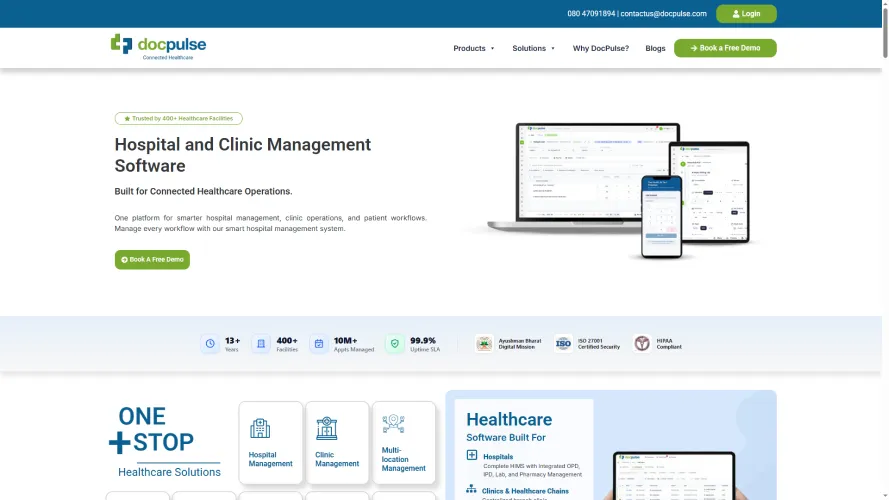
DocPulse is built specifically for the Indian market, and it shows in where the product puts its energy: outpatient workflows, billing accuracy, and TPA transparency. OPD, IPD, EMR, pharmacy, lab, billing, insurance claims, patient communication – it covers the usual ground.

The billing engine is arguably its strongest feature. It automatically pulls consultation, lab, and pharmacy data into invoices, reducing manual data entry and billing errors.

What Stands Out

  • Automated billing: Consultation, lab, and pharmacy charges land in one invoice automatically – cutting manual re-entry, missed charges, and end-of-day reconciliation headaches.
  • TPA/insurance visibility: Real-time tracking of cashless claims, pending-dues alerts, and direct TPA integration replace the need for a side spreadsheet.
  • NABH-aligned documentation: Compliance tracking, audit-ready records, and real-time monitoring are part of daily workflow rather than assembled separately for an audit.
  • Multi-branch dashboard: Consolidated visibility across locations for clinic chains and group practices running three or more sites.

Best For

Clinics, polyclinics, small to mid-size hospitals, and multi-branch outpatient networks where automated billing, TPA/insurance visibility, and NABH-aligned documentation are the top priorities.

4.4/5 by App review

Pros

  • Pharmacy module with real-time stock tracking, expiry alerts, batch management, and GST-compliant billing
  • Multi-branch corporate dashboard for consolidated chain-level visibility
  • Teleconsultation with HD video, e-prescription, and integrated online payments

Ankita Kumari

Good service. Had some issues with payment but the staff is very responsive. Keep it up!

Verified App Review

Cons

  • Managing multiple branches may require additional administrative effort and additional configuration.
  • Reporting may be less comprehensive for hospitals that need detailed enterprise-level analytics.

Ankita Singh

Neither do they answer the calls nor do they call back. Even the doctor didn’t join the online consultation. I don’t know how many times I called, but they kept disconnecting the calls. Would have appreciated it if they could have told the truth

Verified App Review

5. Suvarna-HIS

Suvarna His Screenshot

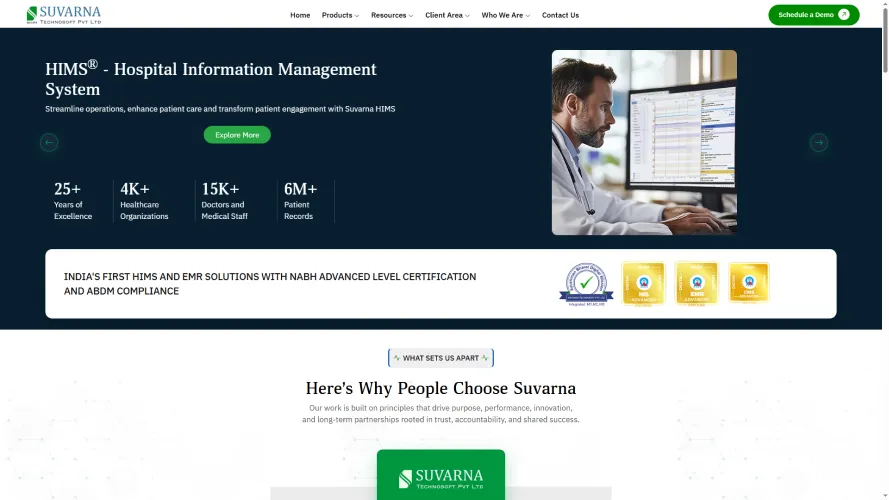
Suvarna-HIS is developed by Suvarna Technosoft, which has over 25 years of experience in hospital information systems. It covers key hospital operations, including OPD, IPD, OT, nursing, pharmacy, lab, radiology, billing, blood bank, inventory, and multi-location management.

Its long experience is reflected in specialised modules such as blood bank management, CSSD, and inpatient food and beverage costing. These are established features designed for day-to-day hospital operations.

What Stands Out

  • Dual NABH certification: Both HIS and EMR independently certified in May 2025, with certificate numbers publicly checkable on the NABH portal.
  • Mature IPD/OT workflows: Nursing documentation, inter-unit transfers, clinical charting, OT scheduling, and surgery documentation refined through decades of real hospital use – plus a real-time bed board for ward managers.
  • Multi-site enterprise management: Shared patient records across branches with centralised administration and consolidated network reporting.
  • Omni-channel patient communication: Portal, kiosk, mobile app, SMS, and email – plus queue management to cut front-desk crowding at peak OPD hours.

Best For

Hospitals of all sizes – from startups to large chains, particularly those focused on NABH accreditation, complex IPD and OT workflows, and operational areas like blood bank and CSSD that most newer platforms haven’t fully built out.

4.4/5 by Techjockey

Pros

  • Connects lab analysers directly to the EMR, reducing manual data entry.
  • Indian Market Compliance supports GST billing, TPA/insurance claims, and ABDM standards.
  • Supports on-premise deployment along with iOS and Android mobile access.

Based on available product information, Suvarna-HIS IPD and OT modules are well-built and have useful features like blood bank and CSSD management.

Verified Review

Cons

  • Higher initial costs may make it unsuitable for small clinics.
  • Implementation has taken longer than expected in large-scale hospitals.

Suvarna-HIS implementation took longer time than expected, and the interface took some time for junior staff to learn.

Verified Review

6. HaleMind

Halemind Screenshot

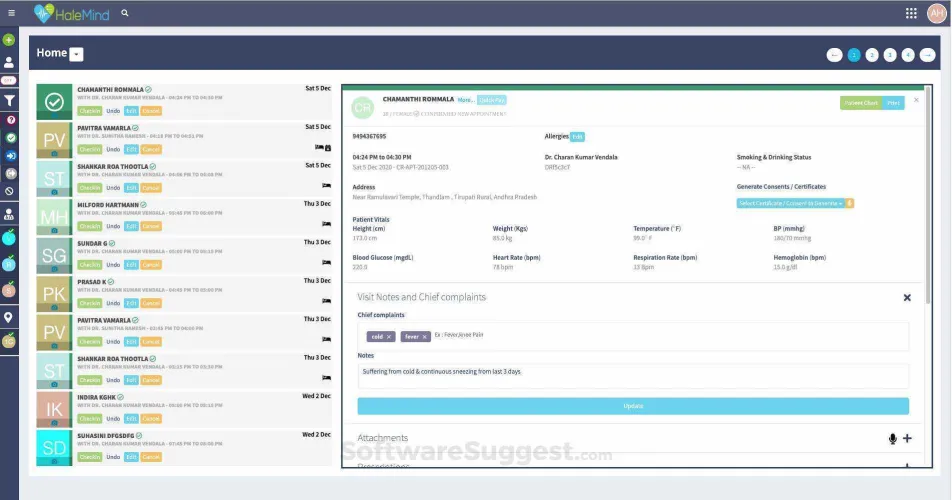
HaleMind covers essential hospital functions such as OPD, IPD, EMR, ward management, pharmacy, lab, billing, and analytics. Its key strength is ease of use, with features designed to help staff learn and adopt the system quickly.

Fast onboarding, prescription templates, and one-click billing make daily tasks easier. It also includes a patient portal and analytics dashboard for tracking revenue, appointments, and other operational data.

What Stands Out

  • Fast onboarding: New staff get up to speed without long training programmes – suited to hospitals with a small IT team and little appetite for disruption at go-live.
  • Single-click billing: Billing staff move from consultation to invoice in one step instead of multiple screens, which adds up in a high-volume OPD.
  • Visual case sheets and analytics: Clean layouts for tracking patient progress, plus a dashboard covering revenue trends, appointment patterns, and margins.

Best For

Clinics, small to mid-size hospitals, and independent practices that value ease of use, fast onboarding, and responsive 24/7 support alongside solid core HMS coverage.

4.4/5 by Techjockey

Pros

  • Patient portal for online record access and appointment booking
  • Covers core HMS modules: OPD, IPD, EMR, billing, pharmacy, lab, and analytics

Vamsi Krishna

We have been using the software for our clinic and pharmacy for the last 1 year. The software is easy to use, customisable as per your need and works well for both patient management and pharmacy

Verified Techjockey review

Cons

  • Integration capabilities may require further improvement.
  • Certain tasks involve repetitive data entry, which slows staff down in busy settings.

Deepu V

Very bad experience, don’t buy the product, wasted money on a bad product, don’t believe the sales team they will cheat you, plz don’t be a fool like me

Verified Techjockey review

How to Choose the Right KareXpert Alternative for Your Hospital

Start with what your hospital actually needs, not what looks good on a features page. A 30-bed nursing home and a 300-bed chain need very different things, whatever a vendor promises.

Bigger hospitals should focus on IPD, OT, bed management, and multi-location reporting. Smaller facilities are usually better off with something simple and easy to run day-to-day, rather than a feature-heavy system where most of it never gets used.

Don’t take “ABDM support” at face value – ask what’s actually live in production versus still on the roadmap. That distinction matters a lot for hospitals empanelled under AB-PMJAY.

Watch the billing workflow in a live demo. See whether consultation, pharmacy, and lab charges combine into one invoice on their own, or whether staff still end up re-entering the same numbers.

If NABH accreditation matters to you, ask exactly how the software supports that process: a line on a website isn’t the same as documentation that holds up in an audit.

Once you’ve shortlisted a few, get each vendor to run through one of your hospital’s own workflows- registration to billing, or admission to discharge instead of a generic demo. That’s usually where the real gaps show up.

And talk to people already using the system. Ask how long setup actually took, how hard training was, and whether support still picks up after the contract is signed. That tells you more than any table, including this one.

Final Verdict

The right KareXpert alternative depends on your hospital’s size, workflows, compliance requirements, and implementation priorities. The platforms compared in this guide differ in areas such as clinical workflows, billing, compliance, reporting, scalability, and speciality support.

Healthray may be worth evaluating for hospitals looking for broad hospital management capabilities, Indian-specific workflows, compliance support, and scalability. MocDoc, Suvarna-HIS, DocPulse, HaleMind, and Ezovion may also suit hospitals with different operational needs, facility sizes, or workflow priorities.

Before making a decision, shortlist the platforms that match your hospital’s requirements and ask each vendor to demonstrate your actual workflows, such as registration to billing or admission to discharge. This can help you assess which system fits your hospital’s day-to-day operations and plans.

See How Healthray Would Work in Your Hospital

Walk through the workflows your team uses every day and discuss your requirements around migration, integrations, implementation, and training.

Talk to an Expert

Frequently Asked Questions

What typically pushes a hospital to start looking at KareXpert alternatives?

Growth is the primary driver – adding a second branch, expanding specialities, or managing higher insurance volumes exposes gaps that a single-facility setup never had to deal with.

How important is ABDM and ABHA readiness when evaluating any HMS platform in 2026?

It is mandatory for PMJAY-empanelled hospitals- missing certification directly affects reimbursements, so always confirm whether a vendor’s ABDM support is live in production, not just listed on their website.

What should evaluation teams actually test during an HMS demo?

The billing workflow, specifically whether consultation, pharmacy, and lab charges consolidate into one invoice automatically, without any manual re-entry across departments.

How does the right HMS choice differ between a small hospital and a large chain?

Smaller facilities need simplicity and fast onboarding above everything else. Larger chains need multi-location reporting, unified patient records, and speciality-specific EMR templates that reflect how each department actually works.

What do hospitals most commonly underestimate when switching HMS platforms?

Data migration and staff retraining – patient records rarely transfer as cleanly as vendors suggest, and teams take longer than expected to build confidence with a new system.

Healthray Editorial Team

About the Author

Healthray Editorial Team

The Healthray Editorial Team creates and reviews content based on Healthray's experience working with hospitals, clinics, and healthcare technology. Our content covers hospital management software, EMR/EHR, healthcare IT, automation, and digital transformation.