

Summary
Modern Hospital Management Systems (HMS) automate the comprehensive standard of care that was so arduous for staff members. Still finding yourself depleted with manual modalities? In 2026, being dependent on manual strategies will bog down the pace of your routine responsibilities as patients prefer immediate and more digitally mediated solutions. They are not accustomed to standing in a queue and booking the appointments. Hospital workflow automation eliminates patient wait time, decreases manual task burdens, improves care quality and standards, and minimizes staff burnout. In this blog, I will discuss how automation in healthcare reduces workloads and establishes a more intelligent, low-cost, and holistic healthcare management standard procedure.
Introduction
In 2026, hospitals need to oversee the entire operation in addition to providing patient care. In traditional hospitals, 90% of operations are manual, but hospital workflow automation can streamline patient registration, appointment scheduling, billing, and record management, delays, data errors, and staff overload were common challenges. However, hospital information management systems help hospitals circumvent these types of multifaceted complexities.
The biggest positive aspect of automation is workflow enhancement. Doctors can easily look up patient history and amend lab reports in real time, thanks to hospital workflow automation that streamlines these tasks. Beyond that, HIMS is designed to make the billing procedure clearer and more unambiguous. From small clinics to multi-specialty medical facilities, automation demonstrates standard precision and efficiency at every level. HIMS makes the hospital system functional, economical, and patient-centered; this is highly vital in the contemporary healthcare landscape.
How Much Time Does Hospital Workflow Automation Software Save for Medical Professionals Weekly?
HIMS not only saves time but also makes the hospital functions more advanced and expandable.
1. Weekly Time Savings Overview
Usually, healthcare professionals devote 15.6 hours per week to manual and admin tasks, which could be significantly reduced through hospital workflow automation. By using a healthcare management solution, hospitals can save up to 15–25 hours per staff member on a weekly basis.
2. Prior Authorization Time Reduction
In traditional software, it takes 16 hours/week for prior authorizations. Further, the medical team now with HMS can save up to 12 hours. Through standard automation, it takes a minimum of 4 hours to successfully complete the process.
3. Faster Patient Intake Process
Manual patient registration takes almost 20–30 minutes, but with hospital workflow automation, the process can be completed in just 5–10 minutes. However, HMS takes 5-10 to accomplish the same process. This saves time on the front-office task workload.
4. Overall Hospital Impact
If a hospital involves 100 admin staff, then HMS can save 1,500–2,500 hours weekly. Further, HMS substantially lowers the operational overhead and raises the standard operational efficiency benchmark to a high-point level.
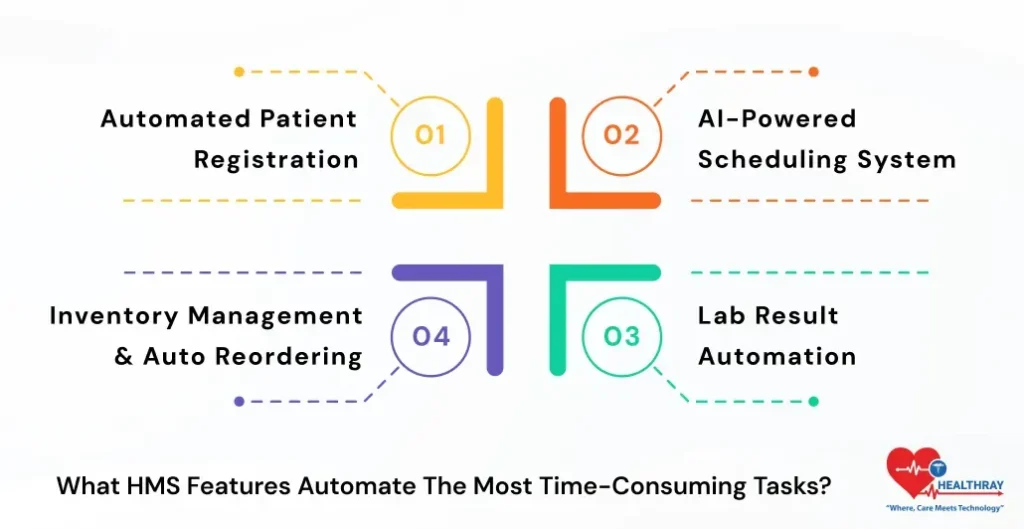
What HMS Features Automate the Most Time-Consuming Tasks?
1. Automated Patient Registration
The HMS automated registration feature, such as online portals, QR codes and pre-filled forms, captures the patient details quickly. In traditional software, it takes 8–12 minutes; however, with the HIMS platform, hospitals take 2-3 minutes to accomplish the entire procedure. Additionally, this reduces the workload of the front desk and waiting time.
2. AI-Powered Scheduling System
AI-based scheduling smartly schedules available slots and sends auto reminders, making it a key component of hospital workflow automation. Further, Clinical workflow automation software efficiently manages queues in hospitals. This reduces the manual coordination needs in medical institutions. Previously, in the conventional system, it took approximately 5-7 minutes; now it takes only 2-3 minutes to administer the scheduling responsibilities.
3. Lab Result Automation
Through HMS, lab results automatically reflect in the system, and relevant doctors are notified promptly, a key part of hospital workflow automation that saves time and reduces errors. Documentation and follow-up takes only 2-4 minutes to accomplish with hospital automation solutions.
4. Inventory Management & Auto Reordering
HMS performs real-time inventory tracking and sends low stock notifications, a feature of hospital workflow automation that prevents shortages and wastage. Further, Automated reordering reduces the need for manual checking. This expedites the inventory management process and prevents trash stocks.
What are the Main Cost Savings Beyond Time from Adopting HIMS?
1. Paper and Printing Cost Reduction
By adopting HIMS software, hospitals become fully digitized, and hospital workflow automation helps save 70-80% of costs on paper, printing, storage, and courier. Small clinics can easily save $600 to $2,400 in costs; this provides high-impact results in the long term.
2. Billing Errors and Revenue Leakage Control
In manual billings, coding mistakes and claim denials are common problems that practically every hospital faces. HMS prevents these errors by automating all the complex tasks that take humans significant amounts of time. Hospitals can easily recover 15–25% of lost revenue. Moreover, digital transformation in hospitals saves costs on legal and rework-standard expenses.
3. Staffing Cost Optimization
After applying automation in practices, medical centers no longer need additional admin staff to accomplish admin responsibilities. A single system can handle multiple workflows. Further, it enables hospitals to significantly lessen their workforce overhead.
4. Compliance and Penalty Savings
Accurate digital records and automated reporting, driven by hospital workflow automation, permit hospitals to proactively manage guidelines and compliance expectations. Moreover, hospitals can downplay the consequences of fines and sanctions arising from documentation lapses.
Step towards digital era with our healthcare solution
Revamp your hospital facilities and embrace change for better healthcare management. Ease in managing and organizing large medical datasets leads to effective analysis. Seize the opportunity now!
What Revenue Increases Come from HMS Billing Accuracy?
1. Billing Accuracy Control Revenue Leakage
HMS automated billing system captures all services accurately. Further, it cuts out the downside of manual mistakes and missed charges. Hospitals can easily recover 15–25% of revenue leakage that formerly had been uncovered.
2. Sharper Reduction in Claim Denial Rate
In a manual system, claim denials are almost 20%; however, with HMS, hospitals can lessen claim denials up to 5%. Further, accurate coding and insurance validation allow easy approval of the claim procedures.
3. Missed Charges Recovery
HMS ensures that no service or treatment charge proceeds gratuitously, whether it’s a lab test, ICU stay, or vaccines. Additionally, it helps recover hidden monetary losses and increases the overall profits.
Learn more: The Role of AI in Enhancing Hospital Management Information Systems in Healthcare
How to Implement an HIMS in a 100-500 Bed Hospital?
Implementing HMS in 100-500 bed hospitals is a phased and planned process. Let’s understand more about it:
1. Pre-Implementation Planning
Before embarking on the HIMS implementation journey, the clinic should first plan their hospital requirements. Further, hospitals should coordinate with every department and note all their needs and challenges they are facing with the current system.
2. Budgeting & Goal Setting
Implementation requires $12,000–$24,000 of budget. It depends on hospital size as well. Moreover, hospitals should clearly determine their KPIs, such as
- Reducing registration time.
- Prevents claim rejections
- Improving patient flow.
3. Phase 1: Pilot Implementation (Weeks 1–4)
Firstly, hospitals should implement core modules such as OPD, IPD and billing on a pilot basis. This phase also includes secure data migration in which existing data authentically connects to the newly constructed system.
4. Phase 2: Module Expansion (Weeks 5–8)
In the next phases, clinics should add inventory, lab, and HR modules. In his phase, hospitals should integrate HMS with existing systems by complying with the transition practices with HL7 and FHIR, rules and guidance. This ensures data flow remains consistent during the changeover process.
5. Phase 3: Full Go-Live & Training (Weeks 9–12)
In this phase, entire hospitals shift to HIMS. Further, staff gets role-based training. It is highly recommended for clinics to run a manual system in parallel for the initial few days post-HMS implementation.
6. Post-Implementation Monitoring
Monitor the performance after going live through dashboards and analytics embedded in HIMS. Further, collect staff feedback. Keep the target of 95% adoption in the next 6 months.
 PRO TIP
How to Conduct a Workflow Mapping Workshop for HMS?
1. Pre-Workshop Planning
Planning is highly critical before conducting a workshop. Also, set clear objectives. Hospitals should have proper goals for understanding workflow and identifying bottlenecks. Properly define the scope, such as patient registration, billing and bed allocation, and plan on a 2-hour focused session.
2. Workshop Start with Icebreaker
Initiate the workshop with an icebreaker for 10 mins, where everyone will share their role and their biggest challenges. Further, this creates the environment for open discussion and every team member will participate actively.
3. Define Workflow Boundaries
Hospitals should clearly decide the process starts and ends from patient arrival to discharge. Further, this makes the mapping focused and avoids unnecessary confusion in the system.
4. Current Workflow Mapping
Now, map the actual workflow with the help of sticky notes. Further, capture all steps, decision and delays.
5.Validate and Prioritize Issues
Review the entire workflow with your team and identify the areas that take significant time to complete. For example, insurance checks take more than 30 mins to complete. Then rank all the issues as per the priority. This will help business analysts accurately understand your pain points and help them construct HMS patient records system projects that are customized to your actual needs.
 NOTE
NOTE
Conclusion
Modern HMS makes manual and chaotic workflows automated and streamlined, achieving efficient hospital workflow automation that saves time and reduces staff stress. It saves considerable time of staff members and makes the medical practices fast, precise, dependable and stress-free. HMS lowers claim errors and missed charges, which inevitably increases hospital revenue. Platforms like Heathray help hospitals to build high-impact customized solutions that can efficiently raise their ROI and support their commitment to a patient-centric approach.