

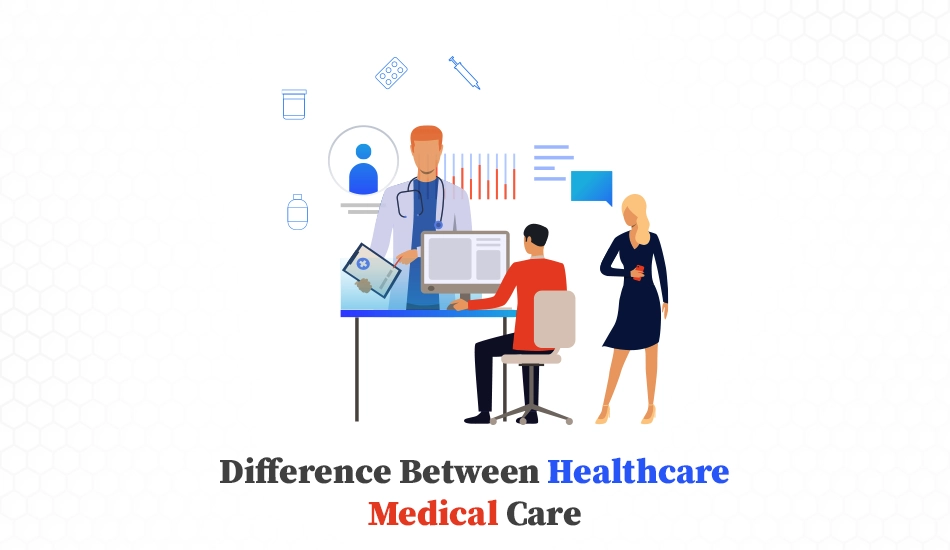
Quick Summary: A wide range of motifs are present under healthcare, with a focus on life, preventative, and general well- being. A subcategory of healthcare, medical care is devoted to the opinion, treatment, and operation of ails. Understanding the difference between healthcare and medical care is key to maintaining overall health awareness.
Introduction
The constantly evolving world of health assistance is making it necessary for everyone to understand different terms, especially the difference between healthcare and medical care. Healthcare and medical care are the two most common terms used in the medical health care industry. Healthcare professionals use these terms interchangeably. People, including healthcare and medical professionals themselves, need to be made apprehensive of the correct meaning of each term. Hence, they end up using them in each other’s place. The difference between the meanings of both names might feel minor, but it plays a significant part in icing good health.
Both of these terms have their differences along with distinctness in nature. While healthcare can be called a general term, medical care is more specific. Hence, one can rightly use these terms when they’re apprehensive of their true meaning.
However, you aren’t alone, If you need an explanation about the difference between healthcare and medical care. This text will help you understand the fundamental difference between healthcare and medical care. Please read to the bottom to have a clear idea about both of these terms and their operation.
The Hospital Management Software aids in a better healthcare eco-system from managing an appointment department to patient care department. Furthermore, it helps in accessing data instantly, record pre-visit information, provide virtual consultation, and slot booking with a one click. This software enhances satisfaction level due to secure transaction, precise records, schedules appointments immediately, and minimize the delayed billing. Create a positive impact on hospital operations and an employee work environment.
Healthcare is a broad term but medical care, a component of it. Moreover, healthcare comprises the sum of activities such as drafting a prescription, medical diagnosis, and health education. It includes all those healthcare activities that promote healthy lifestyle and increasing patient awareness about their health. Furthermore, it includes diverse parts and affects a wide population from documents to government authorities.
What Is Healthcare In Simpler Words?
Describing what healthcare is in the context of the present day is quite a difficult task. There are various parameters that add to the answer to a single question: what healthcare is. As per the current situation, healthcare has broadened to a vast aspect, from services to the devices that are used after taking care of a person. Even health care is a term that is heavily focused on by the government, politicians, third parties, and more. In a broader sense, the medical health care landscape comprises all services, goods, and mechanisms that help achieve and maintain good health.
It comprises departments like radiology, pharmacy, physician’s office, labs, and more procedures. But know that this is not all. Also, all of these entities are not compulsory in a single healthcare interaction. In simpler terms, providing healthcare means enabling organizations to provide medical services. These organizations work with the intent to improve and restore health with the help of trained and licensed medical professionals only.
Along with managing clinical and operational resources, healthcare systems must also maintain financial continuity. Organizations often collaborate with partners like AnnexMed to support accounts receivable management services and denial management services, helping reduce outstanding balances, resolve claim issues efficiently, and sustain reliable healthcare and medical care delivery.
Within healthcare, AI in Healthcare has led to more profound AI-based software developed for enhancing care facilities, Many hospitals and clinics now collaborate with an AI agent development company to build intelligent healthcare assistants that improve patient engagement, automate repetitive administrative tasks, and enhance clinical decision-making. increasing documentation efficiency, and improving financial performance. Furthermore, it helps convert your traditional healthcare system into a modern healthcare environment. It improves your hospital infrastructure, enhances treatment outcomes, optimizes diagnostic efficiency, and boosts overall financial performance.
It includes efforts to determine the factors that affect health outcomes as well as activities that improve it. Hence, medical health care focuses on improving health outcomes through diagnosis, prevention, treatment, and cure of diseases, illnesses, and injuries. This term encompasses work committed to ensuring secondary, primary, and tertiary care. After explaining “ what is healthcare in simpler words?”, let’s move into medical care.
What is Medical Care?
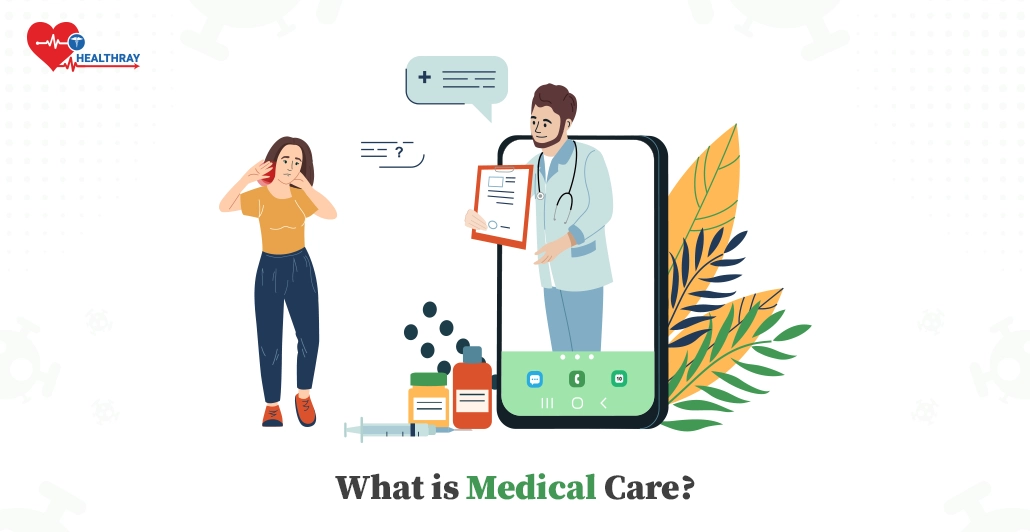
Unlike the healthcare system, medical care primarily focuses on the necessary stuff for the health and well-being of a person with the help of a doctor, nurse, or healthcare industry expert. In simpler words, taking care of sickness with the proper guidance of an expert is known as medical care or medical services. It is different from the more professional treatment plans.
Hence, it is just loose treatment that a person seeks in case of minor inconvenience. For better understanding, medical care is a part of a more extensive umbrella term, which is health care. This term encompasses prevention for healthy individuals and consultation for people with any problem. The part of disease prevention used in medical care means vaccination and health screening to detect diseases on an early basis.
A group of medical professionals who give services to the needed one, basically associated with the medical care. If it is maintained continuously, it will positively affect the patient outcomes. Enhancing patient trust is the first mission of the healthcare organization. However, it can be accomplished by everyone.
The services are not limited to physician consultation and maintaining relationships. Moreover, it includes monitoring blood pressure, regular check up, performing radiology operation, checking sugar, and administer prescriptions.
There are certain cases where symptoms motivate people to seek medical care. These symptoms are difficulty breathing, coughing, fever, blurry vision, and more. Your certain daily activities may compel you to seek medical care. Diagnosis is one of the most crucial components of imparting medical emergency service. But this process is undoubtedly complex and involves considering the patient and symptoms and then continuing treatment.
Additionally, it is a challenging task to detect problems with mental health. The treatment in imparting medical care will involve prescribing drugs, medications, psychotherapy, and surgeries. Although medical care is an essential aspect of healthcare, ensuring prevention can be a better idea. It is a component of healthcare. A person must undertake regular screening even in the absence of symptoms. Hence, self-vigilance can be a crucial part of maintaining health at a certain level.
Medical care has been performed by licensed healthcare practitioners, nurses, and dentists. Comprises four care such as primary, secondary, tertiary, and quaternary. Furthermore, it includes the associated medical activities such as health screenings for detecting chronic conditions. Therefore, it indirectly improves clinical revenue and healthcare productivity.
Difference Between Healthcare and Medical Care: Basic Differences
As mentioned before, within medical health care, healthcare is a process that involves prevention, diagnosis, and restoration of health. This process comprises ensuring a better and hygienic environment and health outcomes for a fit lifestyle. It is an entire system that helps maintain people’s health and comprises services such as public health campaigns, health insurance coverage, education, and more.
The healthcare system involves the hospital facilities, related to the surrounding environment, and patient diagnosis. Whereas the medical term, which is related with the rendering of healthcare services by the healthcare professionals, nurses, pharmacists, and laboratories. It does not confine to the boundary like a healthcare system. It reaches to every healthcare system and includes all types of medical services.
Any medical service rendered to individuals by medical experts is pertained to as medical care. This covers services including medical procedure provision, pharmaceutical tradition, and disease opinion and treatment. Medical care can include:
- Effects like starting or terminating a tradition.
- Keeping an eye on blood pressure or sugar situations.
- Doing MRIs and X-rays.
Therefore, medical care is a subset of healthcare. Conditions and diseases are treated in medical treatment. Healthcare encompasses not only medical treatment but also all the coffers, including installations, knowledge, and surroundings — demanded to maintain a healthy way of life. Healthcare is a nonstop, ongoing process that occurs when a person is well, yet medical attention is generally only sought after when a person becomes terrible.
Who can provide healthcare and medical care?
Many different segments of the public, including individuals, local volunteer organizations, government agencies, pharmaceutical companies, and doctors, can offer healthcare. It is not necessary to have any medical specialty to provide healthcare.
Everyone has a part to play in promoting population health as a whole. In a similar vein, you can receive first aid from any nonspecialist. The environment can be kept clean by everyone, even a layperson.
On the other hand, medical care involves both disease diagnosis and treatment. Therefore, in order to deliver these treatments, trained and licensed professionals and medical experts with specialized training are needed.
This category of healthcare professions includes physicians, nurses, dentists, optometrists, pharmacists, psychologists, therapists, and others.
The foundation of medical care is mutual trust between the patient and the doctor. Read more about the best healthcare app development company for better understanding.
Who is responsible for healthcare vs. medical care?
In the medical health care framework, healthcare refers to giving people access to food, clean water, and aseptic atmosphere, and medical installations similar to HMS Systems and specialty care centers. It also entails raising mindfulness of dangerous habits, including medicine dependence, drunkenness, and smoking. These are essential mortal rights. Thus, the state government is in charge of furnishing these amenities. A portion of the duty for health care is attributed to its existence. It’s each person’s responsibility to take the best possible care of their health.
Again, medical care is what you get when you go to the physician or doctor in response to any symptoms or medical necessity. Examples of medical care include blood glucose monitoring, bypass surgery for cancer, and the identification and treatment of the illness. Therefore, medical care is more personalized for each case than it is for the state. An excellent medical labor force must thus handle medical treatment.
However, healthcare and medical care goes hand in hand. If you are focusing on one factor, it creates imbalances on the other. However, it is required to be careful while administering healthcare and medical care. Adopting the right healthcare software technology to improve clinical efficiency and upgrade the quality of healthcare services.
Objective difference between healthcare and medical care
There has been finer medical care in recorded history. Ultramodern medical practices and rising health technologies have greatly accelerated the speed and frugality of medical care. Imaging technologies revolutionize X-rays and MRIs.
In the operating room, robotic technologies have shown to be significantly more resourceful. Nonetheless, sweats are ongoing to facilitate the best care styles, strategies, and technology in order to give quicker opinions and further effective treatment. Go through an excellent article to Medical Office Software Program Features to know technology at its best.
In the past 50 years, doctors say there has been a 75% reduction in the death rate following a heart attack. Maintaining current practices while making improvements is the aim of medical care.
In relation to healthcare, it currently has certain drawbacks. Half of the world’s population lacks access to essential healthcare services, according to the WHO. Only some segments of society receive the same level of access to healthcare systems and facilities. There are fewer healthcare facilities and options available to residents of rural places, and these resources are primarily focused on urban areas.
Compared to other high-income nations, the United States has a lower life expectancy and death rate. Despite spending about doubly as much on healthcare as other nations, the United States continues to have worse health outcomes and results. Contemporizing healthcare systems and making these coffers accessible to remote communities are the current precedents.
Top 4 differences between health care and medical care
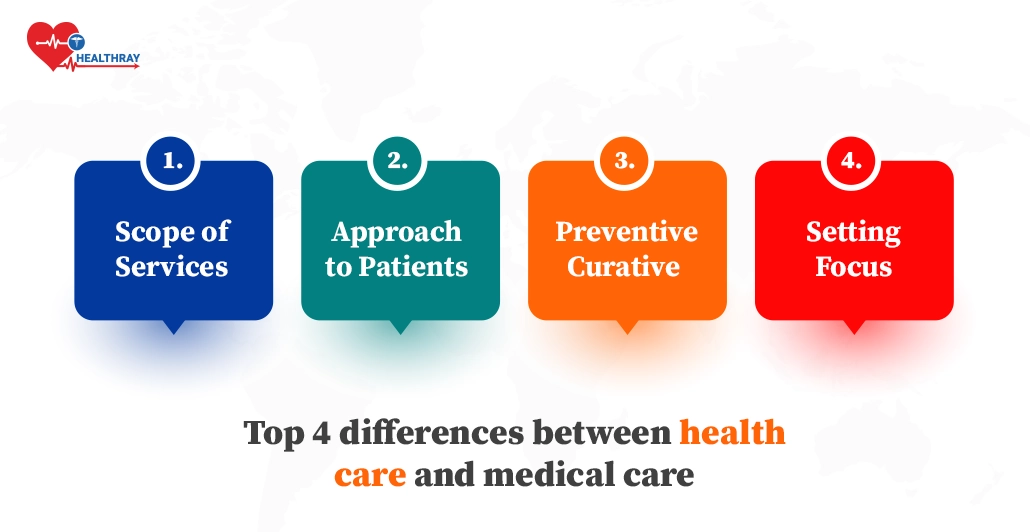
Scope of Services
Health Care: Encompasses a broader spectrum of services, focusing not only on treating illnesses but also on preventive measures, health education, and overall well-being support. It includes lifestyle management, nutrition, and activities promoting a healthy lifestyle.
Medical Care: Focuses substantially on managing, treating, and diagnosing ails or medical diseases. It entails the use of remedial treatments, medicines, and surgeries, among other medical interventions.
Approach to Patients
Health Care: Emphasize a holistic approach that takes into account a person’s social, internal, and physical characteristics. To address a person’s entire health requirements, the hospital and numerous healthcare providers constantly work together in a cooperative effort.
Medical Care: Tends to concentrate more hard on particular ails or affections. It involves specialist medical interpreters whose primary focus is on treating the medical enterprises that have been diagnosed. These professionals may work alone or together.
Preventive vs. Curative Measures
Health Care: Emphasize the significance and benefits of preventative care, including routine examinations, networks, immunizations, and life changes to reduce the chance of illness. It seeks to save good health in order to stop health issues from developing.
Medical Care: Focuses on precluding illness treating after they’ve formally started, taking action when necessary. In order to see cases restore health and reduce symptoms, medical care entails the opinion, treatment, and operation of affections.
Setting and Focus
Health Care: Constantly offered in a variety of locales, this includes services similar as educational institutions, heartiness enterprise, and community health installations. Promoting a healthy life and other healthy habits and preventing health problems before they start are the main pretensions.
Medical Care: Mainly handled in clinical or sanitorium surroundings, with a focus on illness opinion and treatment. The thing is to use medical procedures to manage current health issues.
Conclusion
In summary, understanding the difference between healthcare and medical care is crucial for grasping the full spectrum of public health systems and services. Indeed, though the expressions are constantly synonymous, they relate to different angles of the larger generality of well- being. recognizing health is a complex conception; healthcare takes a holistic approach that includes precautionary measures, health education, and general wholesomeness.
Again, medical care focuses on the identification, handling, and treatment of particular ails and is an essential part of the country and overall healthcare system. Understanding these distinctions highlights the reciprocal nature of the two and highlights the significance of both targeted interventions and preventative measures. Through negotiating the complications of health systems, people and communities are better able to make opinions about their health and well- being. Hence it encourages a visionary and all round approach that covers all aspects of health, from keeping oneself healthy to managing medical issues.