


Healthcare is changing at a rate that no one could foresee and adding complexity to go along with almost all the noble ambitions. Hospitals are no longer the places that provide medical staff the isolation to work on. They have evolved into large, sophisticated infrastructures that can include departments and personnel, technology, and patients, all of which need to work in harmony. It’s a give-and-take and every error made can really impact patient care, safety, and the general efficiency of the hospital.
This is when hospital administration software plays a role. These telecommunication gadgets are helping hospitals to leave behind direct record keeping, uncontrolled scheduling, and piecemeal communication. Through a hospital administration software type programme, anything, be it patients’ data to billing and staff administration, can be finely tuned for maximum efficiency leaving no information behind.
patient care. Hospital management software, through automation of routine activities and through achievement of compliance with legal requirements, minimizes many of the daily pressures of operation.
In this article, we’ll dig into how this Hospital Information Management System is reshaping hospitals, improving everything from patient management to financial workflows. Whether you’re a Resident Medical Officer (RMO), a Chief Operating Officer (COO), or a Chief Technology Officer (CTO), this technology is making your work smoother and more effective.
What is Hospital Administration Software?
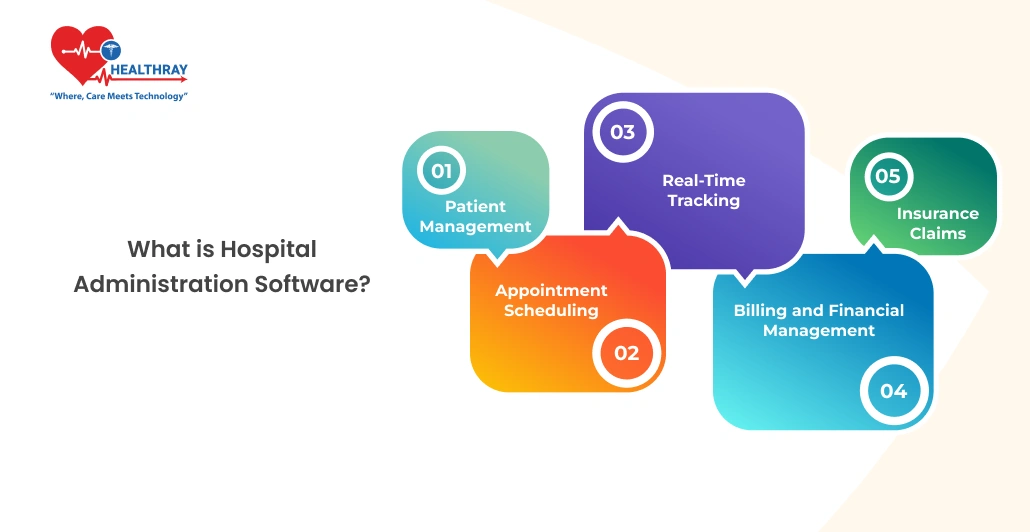
Hospital administration software is an information technology that has been established to administer the huge and complicated operations of a health care institution. It brings together a multitude of activities at the hospital for access on one platform, and thus, it achieves greater synergies between departments, fewer manual errors, and consequently, better patient care.
Patient Management
Electronic Health Records (EHR): This captures and holds patient medical records, diagnoses, treatment regimens and laboratory data all in one place without paper files.
Appointment Scheduling
Hospitals can accommodate the patients’ appointment scheduling, doctor assignment, and avoid over booking or scheduling conflicts. Platforms like Emitrr can complement these systems by automating appointment reminders, patient notifications, and two-way texting, helping hospitals keep patients informed and reduce missed appointments
Real-Time Tracking
It may be used in tracking the patient movement between different areas (outpatient, surgery, recovery) so that continuous safe and discreet movement of patients would be possible as well as prevent patients from getting confused and staff to get distressed.
Billing and Financial Management
Accurate Invoicing: Billing errors can no longer plague. Hospital Management System Software automates it, and hence, all services rendered are billed appropriately without revenue losses.
Insurance Claims
Automatization of the insurance claim process reduces time delays, document mistakes, and repetitive tasks by hospital personnel.
Advantages of Having a HMS Software
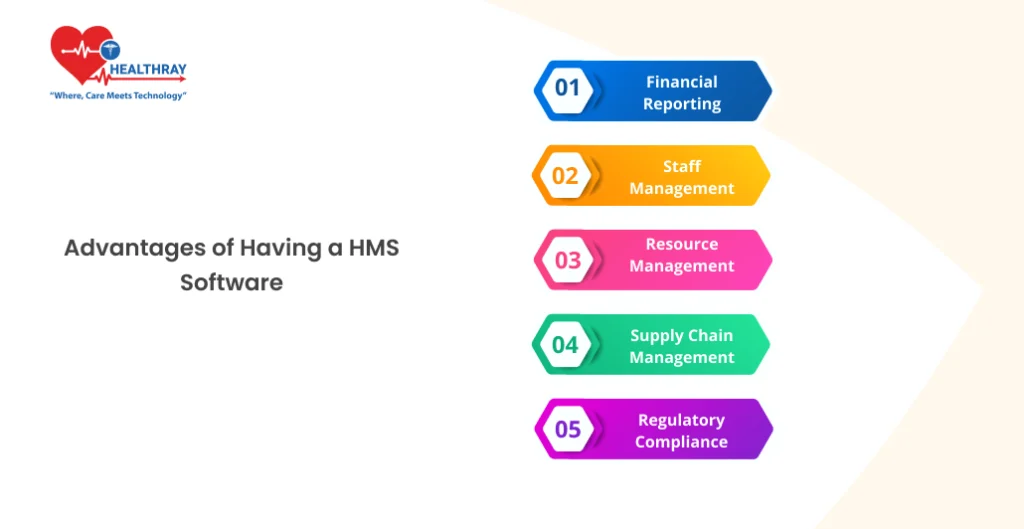
Financial Reporting
By monitoring/recording revenues, expenditures, and unpaid items, hospitals can present a comprehensive overview of the financial position in relation to the hospital’s financial health.
Staff Management
Scheduling and Rostering: Work scheduling (shifts, overtime, and availability of hospital personnel) is much easier to orchestrate, etc. It ensures that there is sufficient staff at the necessary time, without over-staffing or burn-out.
Performance Tracking: This hospital management can also keep track of staff performance indices, ensuring proper assessment, training, and recognition.
Resource Management
Equipment Tracking: Availability of hospital equipment is most often the problematic area. As a result, by and through this software, administrators can track all equipment usage with a view toward enhancing the resource’s maintenance and distribution.
Supply Chain Management
The software has the capability to record inventory (use of medications, medical supplies and consumables), that critical supplies are never depleted and waste is removed.
Regulatory Compliance
Data Privacy and Security: Confidentiality and compliance of health care law (e.g., HIPAA) are unconditionally guaranteed by the software, by which patient data is preserved and kept confidential.
Why Hospital Administration Software Matters?
Hospitals are intensive high-density, high-stress, high-risk of error environment in which a small error/information can be disastrous and missed if only a fraction of that information is obtained Without proper coordination, delays, miscommunication, and human errors are common—and these mistakes can have serious consequences for both patients and the hospital’s reputation.
Hospital management packages tackle these problems by automating, organizing and controlling daily operations. What was previously a laborious and time consuming task, which could take hours, can now be completed in minutes with the push of a button, freeing up time for hospital personnel to concentrate on other important activities.
Technological tools also assure that departments in a health care facility talk better, which in turn results in faster decisions and better patients’ experience. In the end it enables hospitals to work like factories, where every piece of equipment in the system is working at full capacity.
Why These Challenges Matter?
patient care. This loss is not only in time, time and money, reputation, and in the rare case also in patient safety. Hospitals depending only on manual work perform on obsolete technology in a quickly developing field.
Losses are still being experienced at health care institutions and demand on health care institutions only is increasing and there is no centralized administration system hospitals are not only prone to this, but also inefficient.
The good news? Hospital administration software directly addresses these concerns, allowing hospitals to stay current with the continuously growing needs of contemporary medicine.
How Hospital Administration Software is Transforming Specific Roles?
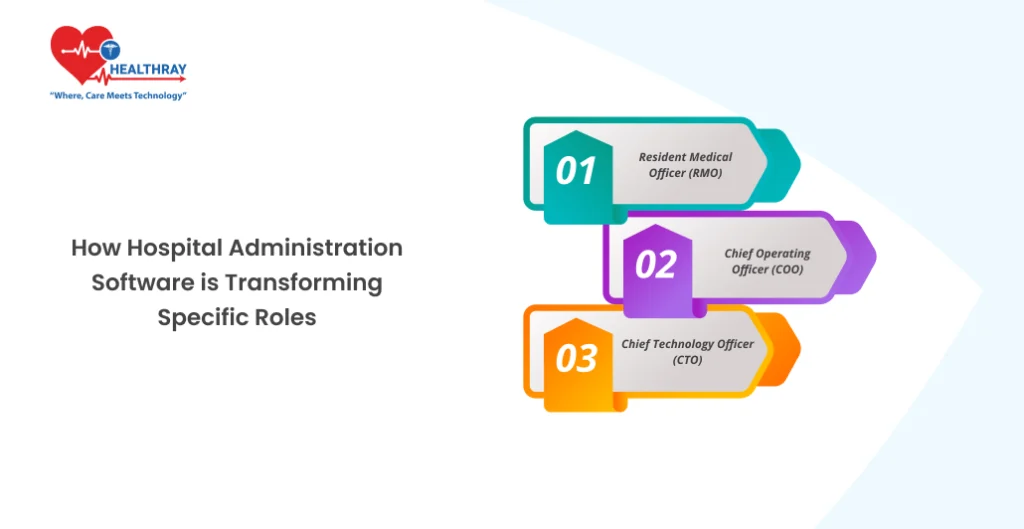
But hospital administration software is not just about changing how hospitals as a whole work, it is about changing the on-the-job responsibilities of individuals at the heart of the network. These are the game breakers for Resident Medical Officers (RMOs), Chief Operating Officers (COOs) and Chief Technology Officers (CTOs), as they can enhance productivity and create effects in their daily jobs.
Resident Medical Officer (RMO)
Real-Time Access to Patient Data: RMOs can access the patient notes immediately and therefore can always be furnished with all the information needed at any time. This enables them to make more precise decisions rapidly, especially in emergency situations.
Automated Updates: In contrast to manual updates that are done by isolated departments, the software guarantees live update of patient data. RMOs no longer need to chase down lab results or imaging reports—they’re automatically available.
Task Scheduling and Reminders: It is a useful application for RMOs to manage their time effectively by organizing patient rounds and setting up reminders for key activities. This minimizes the risk of missing important patient follow-ups.
Chief Operating Officer (COO)
The job of a COO in a hospital is to ensure that things keep working smoothly and reasonably. Hospital administration software provides the COO with better control and visibility over the hospital’s daily operations, allowing them to make informed decisions with less guesswork.
Streamlined Resource Management: The software is available to COOs to track hospital resources, from medical hardware to personnel. With current state-of-the-art data, COOs can be guarantee that there is when and where there is a need for it, there are no roadblocks from shortages.
Performance Monitoring: Hospital management software allows the measurement of performance metrics (e.g., patient displacement, staff productivity, subunit productivity). Using this information the COO can pinpoint areas of inefficiencies and work on improving it.
Cost Control: COOs are also responsible for managing the hospital’s budget. The software’s financial management features help monitor outlays in real time, mitigate frivolous expenditures, and enhance financial management.
Chief Technology Officer (CTO)
Due to digital health product development, the title has been changed to CTO. Its role has also expanded to include the responsibility of the hospital’s technology infrastructure, data security and IT staff accountability and system proper functioning. HMS software plays a pivotal role in this:
Data Security and Compliance: CTOs have the responsibility to safeguard patient information from data breaches or unauthorised access. Hospital management applications come with embedded, built- in security, such as encryption and controls, to ensure confidentiality of such sensitive information.
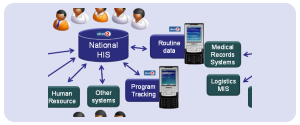
System Integration: CTOs oversee the integration of hospital administration software with other healthcare technologies, such as electronic health record systems and diagnostic tools. Seamless connectivity guarantees seamless communication within all systems, resulting in better coordination of hospital operations.
Innovation and Scalability: With increasing size of hospitals and new technologies in practice, CTOs are required to ensure that software is scalable with the needs of the hospital. Hospital administration software provides the potential to use its own tools and technologies to enable best practice tomorrow without any compromise.
The Collective Impact
That is, until these positions intermix and the outputs result from software, the profound change will take place. As, in presenting such a note, tools such as RMOs have easy access to patient records, COOs have the ability to monitor operational efficiency, and CTOs provide a secure, scalable technology infrastructure, the hospital as a whole functions as a cohesive unit. Each role is supported by the ability of the software to auto- and process, provide real-time data, and facilitate better interdepartmental communications.
In short, hospital administration software empowers key personnel to focus on their core responsibilities while leaving the administrative burden to technology. As a result, all lead to better patient results, better management of hospitals, and a future-oriented health care structure.
Real-World Examples of Success

The effects of hospital administration software are not just in theory, but are already being experienced in real hospitals all over the world. Each of the systems outlined in this grant is achieving demonstrable positive outcomes, spanning from reducing . Let’s consider a hypothetical multispeciality hospital and the main changes created by management software for hospitals.
Example 1: A Multispeciality Hospital Streamlining Patient Care
Challenge: A multispeciality hospital with a high volume of patients suffered from inefficient patient care workflows. In patients, service delays were occurring because of ineffective interdepartmental communication and medical professionals were sometimes unable to access the latest information about the patient. This led to dissatisfaction among patients and staff, as well as a loss in hospital efficiency.
Solution: The hospital implemented hospital administration software that integrated all departments—emergency, inpatient, outpatient, radiology, and billing—onto a single platform. That opportunity enabled real-time data on patient management, and immediate access to the patient data, regardless of the department.
Results:
Reduced Wait Times: With seamless communication between departments, patients were seen more quickly, significantly reducing wait times. Software optimized scheduling and patient flow, so that no one was oversatured into an unneeded delay.
Improved Patient Outcomes: Physicians had direct access to patient history, lab, and imaging, which allowed faster development of diagnoses and sooner implementation of better treatment plans.
Enhanced Staff Productivity: Nursing and administrative staff no longer required to manually key data or move between departments to access reports. With this release they have the opportunity to devote more time, to their patients.
Example 2: Optimizing Financial Operations in a Hospital
Challenge: The financial department of a hospital suffered from recurring problems in billing and revenue cycle management. There were frequent errors in patient invoices, leading to disputes, delays in payments, and overall confusion. Claims for insurance were being denied due to inaccurate paper processing.
Solution: The hospital implemented hospital administration software to automate billing, manage insurance claims, and track expenses. Software also made it so that every service offered to patients existed in properly documented and billable format and automated the submission of insurance claims submission.
Results:
Billing Accuracy
Automating billing guaranteed the invoices included all the correct information, leading to fewer billing disputes, better cash flow, and more timely payment. Patients received accurate bills, reducing confusion and delays in payment.
Faster Insurance Processing
Through automated claims submission, the hospital experienced a decrease in denials, and quicker reimbursements from the insurance companies.
Clear Financial Reports
The software generated detailed financial reports that allowed hospital management to track revenue, expenses, and profitability in real time. This gave them more insight into how money is being spent and what else they could optimise it for.