


Summary
The current nature of running hospitals in India is an entirely different thing than it was several years ago. The expectations of patients have grown, the amount of data has gone up and the compliance requirements are in tandem with the global standards that are followed in the USA. In such a case, the issue of the appropriate hospital management software in India is crucial. This blog takes you through the systems of modernity, the important features and the top 10 platforms in 2026 and therefore, you will be able to choose the best HMS to use in your facility.
Introduction
Healthcare in INDIA is evolving rapidly and digital adoption no longer seems to be a choice. Consequently, hospitals have come to demand the same level of efficiency practiced in the USA particularly in the areas of automation, analytics, and patient experience. This is causing decision-makers to seek out the best hospital management software in India that will help grow without unnecessary complications.
First of all, a hospital management system is a central platform. It integrates clinical, administrative and financial processes into a single digital ecosystem. That is, it substitutes disparate tools with a single coordinated tool.
Most hospitals at this stage continue to use a disjointed array of tools, and this increases the number of errors and reduces the speed of service delivery. This is where modern hospital software systems play a crucial role. It streamlines manual work and enhances the flow of patients as well as securing sensitive information.
In case your hospital cannot handle the billing on time or long OPD queues, patient satisfaction will be directly influenced by your HMS decision.
From small clinics in INDIA to large healthcare networks in the USA, digital systems now shape operational success. Thus, it is possible to make the right decision based on the understanding of how hospital software functions.
What is Hospital Management Software?
Hospital Management Software (HMS) is a digital platform, which is integrated to manage clinical, administrative, and financial activities of a hospital.
It typically includes:
- Patient records (EMR/EHR)
- Billing & insurance
- Appointment scheduling
- Pharmacy & lab integration
In simple terms: it replaces multiple disconnected tools with one unified system.
Importance of Hospital Management Software
Healthcare providers in India now face:
- Higher patient expectations
- Strict compliance requirements (NABH, ABDM)
- Increased data volume
Without HMS:
- Billing errors increase
- OPD queues grow
- Patient satisfaction drops
A modern HMS ensures efficiency, accuracy, and better patient outcomes.
Key Features of Modern Hospital Management System (2026)
INDIA healthcare facilities are now looking forward to the same technological maturity across the hospitals in the USA. As a result, hospital management software in India has developed beyond simple record keeping and billing.
AI & Advanced Analytics
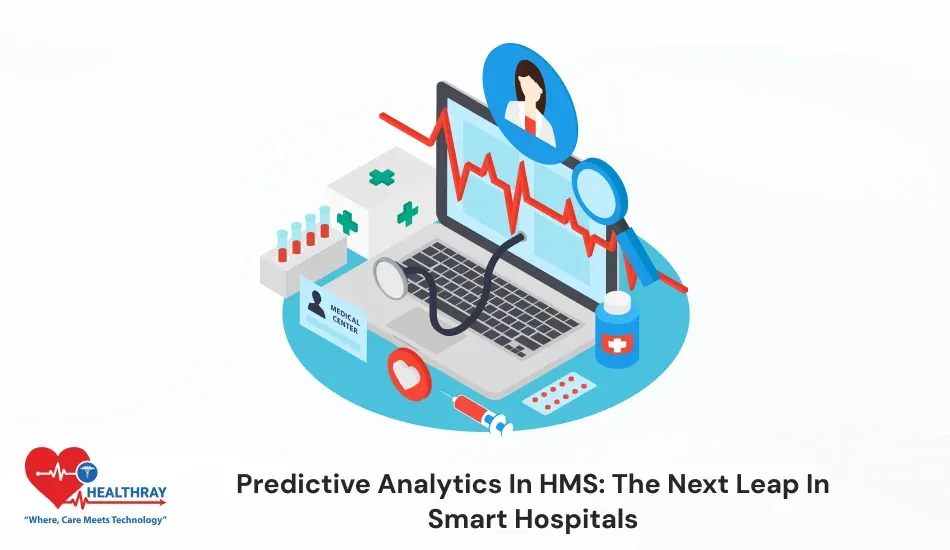
AI will become practical but not futuristic in the year 2026. Patient statistics are examined, admission patterns forecasted and doctors aided through clinical insights. In addition, voice-to-prescription systems help save time on documentation and this is a precious consideration among physicians.
Cloud-Native Platform & Security
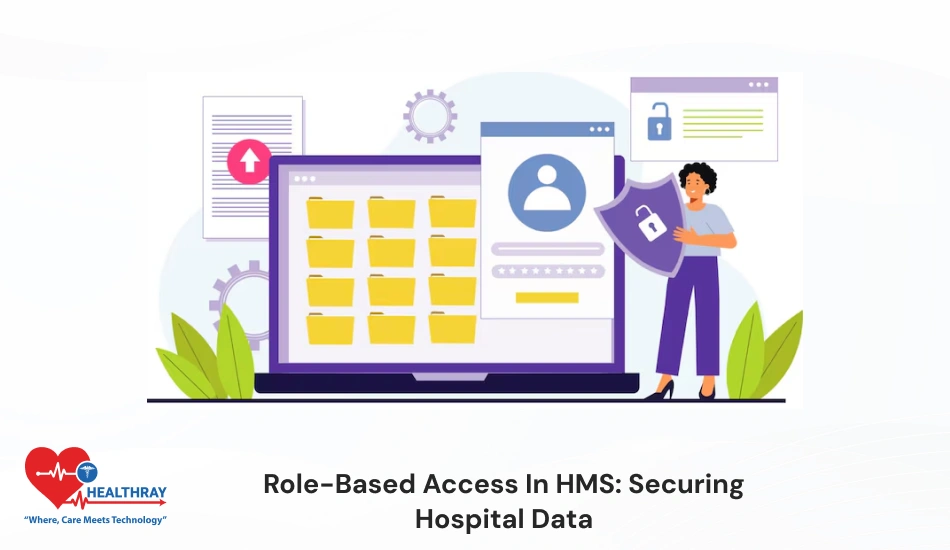
The use of cloud in INDIA is on the rise with the hospitals competing with cloud-first technology adopted in the USA. HMS software based on clouds provides encryption of data, automatic backups and quicker recovery in case of disasters. Concurrently, the adherence to the national healthcare guidelines is inadmissible.
Interoperability & EHR/EMR
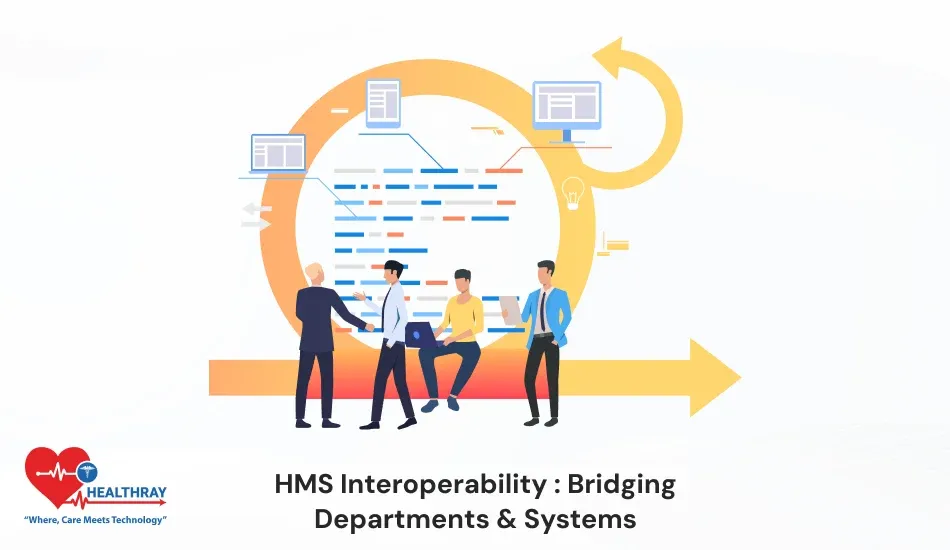
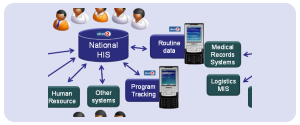
A state of the art hospital information management system is one that is able to pull together lab systems, radiology, pharmacy and EMR in a seamless manner. It is possible to note that such interoperability will avoid data silos and facilitate easier coordination of care.
Automated Workflow Management
Repetitive tasks are eliminated in OPD registration to discharge summaries by automation. As such, employees are more patient-centered rather than being paperwork-oriented. This productivity is of equal concern in INDIA and the USA.
Telemedicine & Mobile Access
Remote consultations have become a regular model of services. The ability to conduct integrated mobile access enables doctors and patients to engage safely, and this enhances the engagement and continuity of care.
Revenue Cycle & Inventory Management
Billing errors directly affect cash flows of hospitals. Therefore, the current HMIS software automates the claims, inventory levels, and stock shortages.
IoT & Remote Monitoring
The IoT devices supply real-time information into the system to allow proactive monitoring of the patients. This creates a reduction in readmissions and outcomes in the long run.
 NOTE
NOTE
Top 10 Hospital Management Software in India (2026)
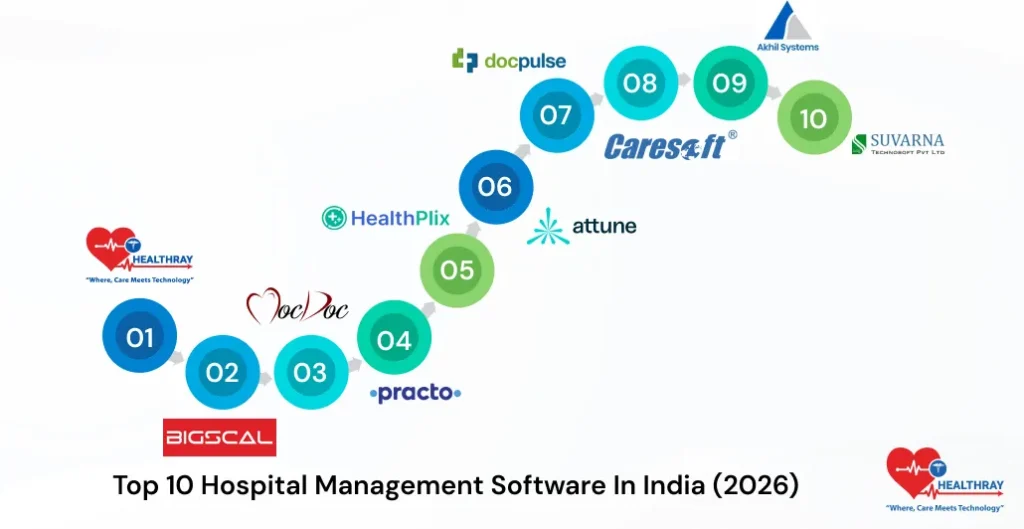
Hospitals in India increasingly benchmark themselves against global healthcare organizations in the USA. As a result, the following platforms stand out in 2026.
1. Healthray
Overview
Healthray is an integrated hospital management system that integrates clinical, administrative and financial operations on a single platform.
The system is very compatible with the actual hospital-important functions hence making the staff less resistant to adoption.
Core Features
- From booking to discharge and billing End-to-end patient journey management.
- EMRs including the labs, pharmacy, radiology, and clinical notes.
- Minimization of revenue leakages by automated billing, insurance records and claim tracking.
What Makes It Stand Out
- User-friendly interface that reduces the time of onboarding of hospital teams.
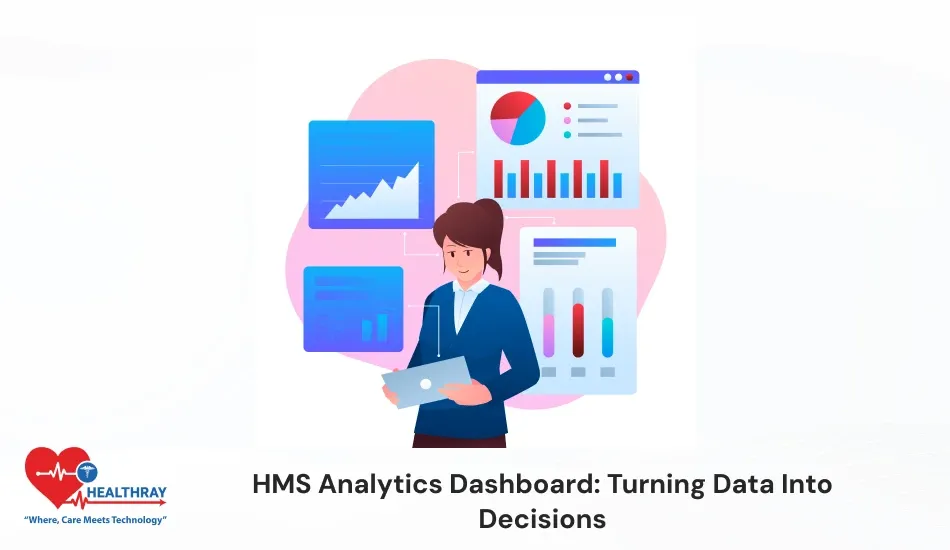
- Complex analytics patient flow monitoring, departmental performance and revenue trend monitoring.
- Grows well within the small hospitals to large multi-specialty setups.
Deployment & Security
- Both on-premise and Cloud models.
- Good data encryption, automated backup, and architecture congruent with regulations that are applied in India and the USA.
It still requires you to match its modules to your workflows with the selection of Healthray. A custom demo should be requested at all times to ensure a fit.
2. Bigscal
Overview
Bigscal is an infrastructure built to meet the needs of hospitals in the process of growth and expansion, requiring a flexible digital infrastructure.
Core Features
- Patient records in a centralized repository which is deployed as a cloud.
- Intra-departmental workflow management of OPD, IPD and diagnostics.
- Pharmacy and billing systems integration.
Best For
Growing hospitals looking for adaptable healthcare management software without heavy upfront IT investments.
3. MocDoc
Overview
MocDoc is an IT hospital management solution with a cloud first approach targeted at mid-size hospitals.
Core Features
- Digital patient records on the management of OPD and IPD.
- One ecosystem pharmacy, lab and billing modules.
- Live access to Departmental level hospital data.
Best For
Hospitals that want to minimize the operational delays and manual coordination.
4. Practo
Overview
Practo is used by both large healthcare enterprises and clinics.
Core Features
- Scheduling of appointments and management of queues online.
- Electronic prescriptions and electronic communication tools with the patient.
- Elementary analytics of practice performance tracking.
Best For
Quickly established clinics and networks that focus on convenience facing the patient.
5. HealthPlix
Overview
HealthPlix is more devoted to AI-powered EMR software.
Core Features
- Doctor structured clinical documentation.
- Artificial intelligence support and templates.
- Consultation-specific workflows.
Best For
Certain doctors and specialty clinics which are focused on clinical efficiency.
6. Attune
Overview
Attune favors intricate hospital functions and management across locations.
Core Features
- Powerful lab and diagnostic mergers.
- The department-wise customization achieved through modular architecture.
- Complex reporting and performance monitoring.
Best For
Hospital chains and institutions trading in various locations in India and in the USA.
7. DocPulse
Overview
DocPulse integrates internal hospital processes and patient interaction solutions.
Core Features
- Video consultation and telemedicine.
- E-prescription and messaging between patients.
- Doctor and patient accessibility on the mobile.
Best For
Hospitals specializing in online consultations and remote care.
8. Caresoft
Overview
Caresoft is a configurable hospital information management system for multi-specialty hospitals.
Core Features
- OPD, IPD, billing, and surgical planning modules.
- Laboratory and pharmacy system integration.
- In-house workflows developed according to the needs of the hospital.
Best For
Hospitals require custom workflow without internal process modification.
9. Akhil Systems
Overview
The Akhil Systems is aimed at big hospitals and governmental healthcare facilities.
Core Features
- Profound personalization and company-level reporting.
- Ready for audit compliance and patient analytics.
- Infrastructure support in the long run.
Best For
Huge hospital chains that would like to have standardized reports like those of hospitals in the USA.
10. Suvarna HIS
Overview
Suvarna HIS is an all-inclusive healthcare management software.
Core Features
- Combination of EHR/EMR and administrative and financial.
- Safe data storage and multi user.
- Asset and pharmacy management characteristics.
Best For
Hospitals with a middle rank and desire to balance between usability and depth of the system.
Comparative Table of Top HMS Providers
Here’s a detailed comparison that makes choosing easier:
| Software Name | Best For | Key Strengths | Deployment |
| Healthray | Large & multi-specialty hospitals | End-To-End Workflows, Advanced Analytics, AI-Driven EMR | Cloud / On-premise |
| Bigscal | Growing hospitals | Flexible Architecture, Strong Integrations | Cloud |
| MocDoc | Mid-sized facilities | High Configurability | Cloud |
| Practo | Clinics & Enterprises | Familiar Interface, Patient-Centric Tool | Cloud |
| HealthPlix | Individual doctors | EMR for Clinical Efficiency | Cloud |
| Attune | Labs & chains | Modular & Reporting | Cloud / On-premise |
| DocPulse | Telemedicine | Patient Engagement | Cloud |
| Caresoft | Custom workflows | High Configurability | Cloud |
| Akhil Systems | Government/large | Deep Analytics | Cloud / On-premise |
| Suvarna HIS | Mid-sized hospitals | Balance of Features | Cloud / On-premise |
How to Choose the Best Hospital Management Software for Your Hospital
The wide variety of options available when selecting hospital software systems is too much to handle, particularly when comparing features, deployment options and long-term sustainability.
Understand Your Hospital Scale
Provided that you operate a small clinic, list simple requirements, like booking appointments, billing, and simple inventory. Multi-specialty hospitals, on the contrary, have to pay attention to advanced interoperability and reporting.
Budget Considerations
The issue of cost is present, but it may not be the most valuable one. Go beyond start-up expenses to sustain, modify, and educate. Other systems have predictable annual pricing and this fits into the requirement in both INDIA and the USA.
Support and Training Availability
A highly supported system eliminates downtime. INDIANA hospital employees require straightforward onboarding, quality customer care, and learning capabilities. Failure to conduct this assessment in hospitals tends to cause delays in adoption.
 PRO TIP
Why Healthray is the Best Choice in 2026
Healthray is one of the best hospital management software in India, which is a future-ready and well-balanced one in 2026. It provides a full ecosystem facilitating patient life cycle, including booking appointments, billing, and discharge, which assists hospitals in getting rid of disjointed systems and enhances the overall efficiency.
Healthray can be integrated more quickly and make more informed decisions due to its user-friendly interface, sophisticated analytics, and artificial intelligence-based insights. Scalability, elastic deployment (cloud and on-premise) and the attention to data security and compliance make it a good option both in the small clinics and in large multi-specialty hospitals.
Conclusion
Due to the dynamism in healthcare taking place in India, the selection of the best hospital management software in India is a strategic choice and not a technical one. To enhance efficiency, reduce operational expenses, and increase care to patients, your HMS needs to be in balance with internal objectives and long-term expansion strategies.
The systems outlined below are the most suitable hospital management software systems to have in 2026 that will support single clinics to large multi-specialty hospitals. You should always test your workflows, make end-users participate in the demos, and organize stage-by-stage rollouts to select the best HMS. By using this strategy, a transformation of the hospital to a digital workflow will become more effective and easier.