

Quick Summary
In India, the Healthcare ecosystem is the booming sector according to the research data. There are continuously emerging trends in this sector, and implementing EMR systems in healthcare is one of them. Moreover, this platform facilitates third-party integration, improves patient data management, and alleviates healthcare provider tasks.
Introduction
The shift from conventional to modern healthcare systems is possible with the embracing of EMR systems. Moreover, the EMR system in healthcare changes the lifestyle of the individual and creates a healthier environment. Consequently, it enhances the overall Indian economy.
Electronic medical record systems have some unique properties that attract massive healthcare organizations, and the adoption rate of EMR systems is continuously increasing in India. Therefore, it improves the patient’s medical process and reduces hospital costs.
Exchange medical files with a single tap and anyone can edit documents after getting approval with the senior authorities. The EMR software allows providers to share accessibility, connects with multiple healthcare providers, and can set alerts based on the requirement. Remote Patient Monitoring (RPM)Creates smart analytical dashboards for swift decisions, decreases administrative burden through autonomous tasks, and improves connectivity with providers.
It is observed that hospitals boost their revenue after implementing Healthray’s EHR systems due to numerous functionalities such as advanced billing systems, inventory management, ICD-10 code support, laboratory management systems, virtual diagnosis tools and mobile prescription.
What are the Best Features of Electronic Health Records?
EHR systems are the top-tier qualitative innovation in the medical industry. Timely monitoring of disease can reduce and quickly identify the risks of non-communicable diseases (NCDs). Moreover, Healthray’s EHR software has other valuable features, such as:
Cloud Computing System
It is an advanced feature of EHR systems. In this system, the entire hospital database is stored on the hosted servers, which helps find medical information from any location. Therefore, patients and healthcare providers can monitor health data from home. Versatile benefits of cloud computing systems are :
- Secure the medical transaction
- Enhancing healthcare data availability
- Track patient data from geo-location
- Customize the function as per hospital requirement
- Supports remote collaboration with the healthcare team.
Digital Medical Charting
The main feature of electronic medical record systems is that they facilitate digital versions of medical records. Furthermore, all hospital departments use the same software for conducting their tasks, and managers can operate remotely and track the activities and performance of junior staff. Several benefits derived from digital medical charting include:
- Optimization of healthcare workflow
- Reduces the medical costs incurred on paper, stamps, and printing
- Accuracy in healthcare documentation
- Ease of storing and finding the required medical data
- Minimizes the cost of maintaining paper records.
Remote Patient Monitoring (RPM)
- This helps to motor the patient’s data from anywhere. Furthermore, it benefits major stakeholders such as patients, medical professionals and medical researchers.
- Healthcare providers can identify major diseases on time through accurate medical data, and continuous monitoring of medical records.
- EMR systems in healthcare support patients to take prompt medical action. Consequently, there are higher chances of fast patient recovery.
- Patients can send their medical reports to other specialists within the same platform and get remote medical counseling at low costs.
- Enhances healthcare delivery, improves satisfaction level, and adheres protocols to enhance patient safety.
Administering Clinical data
- Clinical data includes a patient’s health history with demographic details, allergy information, symptoms, consultation notes, treatment notes, appointment history, surgical prescription records and progressive notes.
- EMR System in Healthcare records administering clinical data in arranged format. Therefore, it makes the data reliable and improves its quality. Additionally, it enhances patient safety.
- Properly managing clinical data shields against various types of risks such as cyber risks, administrative risks, and legal risks. Therefore, it advances medical practice.
- Healthray’s EMR system synthesizes with AI features to manage the clinical data faster and decreases the work burden on medical staff.
The Key Benefits of EMR Systems in Healthcare
EMR Systems in healthcare have a positive impact on patients, medical staff and healthcare specialists. Additionally, it is too supportive of software for government institutions, as it records all patient information digitally and maintains accuracy in records. Therefore, it reduces government expenses on collecting disease data and helps inform the public about the current spread of disease. Other benefits of EMR Systems in healthcare are:
Accurate Invoicing
Everyone knows that a cash-based system is time-consuming and strenuous. To make it simpler, implement Healthray’s EHR system. Furthermore, this is the best medical billing software. Accurate invoicing has numerous benefits, such as:
- Enhances patients’ faith in healthcare organizations
- Lowers penalty risks
- Maintains cash stability
- Supports making prompt financial decisions
- Increases patient retention rate
Streamlining Administrative Tasks
As per research, more than 70% of medical staff are exhausted with operational work. Subsequently, they can’t save time to improve patient engagement. Administrative tasks are part of routine hospital activities. Moreover, the EMR software solution administers this in the right way.
Automated administrative tasks save a significant amount of time and maintain work-life balance. Therefore, it signifies an improvement in healthcare facilities. The electronic health records system handles multiple person tasks and an efficient software in case of front-desk healthcare activities.
Additionally, the EMR system aids to record swiftly, secure efficiently, and share from any digital device. Streamline to administer the claim process, manage inventory levels, and administer healthcare resources.
Creating a Modern Healthcare systems
Conventional medical practices make the healthcare infrastructure dull and slow. On the other hand, modern healthcare technology like Healthray’s EMR system changes the entire medical framework in the healthcare landscape.
This EMR solution helps to set up a digital healthcare system with AI-based functionalities. Furthermore, it helps to improve healthcare practices, enhance clinical outcomes, support medication discovery and improve public health.
Seamless Communication with Healthcare providers
Electronic health records have seamless connectivity to medical departments for operating patient’s medical processes from a unified platform. Moreover, it provides the facility to communicate with healthcare professionals and other specialists through video calls and messaging. Integrity in EMR systems has numerous advantages, including:
- Convenient software for patients.
- Improving the patient’s medical condition faster
- Reduces transportation expenses
- Expanding healthcare services
- Consult with many online providers or specialists in less time.
Step towards digital era with our healthcare solution
Revamp your hospital facilities and embrace change for better healthcare management. Ease in managing and organizing large medical datasets leads to effective analysis. Seize the opportunity now!
Steps for Implementing Electronic Medical Records for Advancing the Hospital Ecosystem
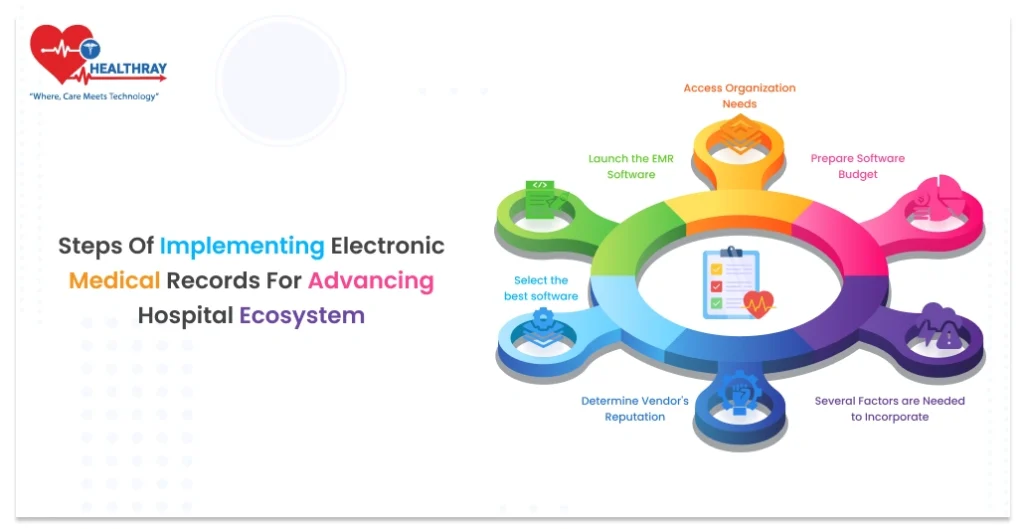
The Electronic Medical Record (EMR) is designed to alleviate the hospital working system and advance the healthcare ecosystem. Different healthcare stakeholders derive benefits from EMR systems, including patients, healthcare professionals, researchers and government institutions. Therefore, it is predominant to install EMR systems in each healthcare organization.
Access Organization Needs
Every hospital has its own challenges. First, find out those hurdles that impede the hospital’s objectives.
After that, meet with departmental managers and prepare a proper list of the healthcare departments.
Prepare Software Budget
After analyzing the requirements, draft the proper allocated budget for creating modern healthcare infrastructure.
This is a considerable factor in selecting the best EMR systems in healthcare. Moreover, it helps to reduce the upcoming financial consequences.
Several Factors are Needed to Incorporate
Before making the final selection of EMR systems, it is crucial to consider several factors in healthcare, such as adherence to medical guidelines, following all security measures, scalability, the easiest interface, and interoperability.
These are some common factors that are compulsory to have in EMR systems. Moreover, these factors support increasing patient care, reducing training costs and improving patient safety.
Determine the Vendor’s Reputation
There are lots of vendors on the market that sell duplicate software with the same logo and company name. Be aware of them while choosing the top 10 best electronic medical record solutions.
Don’t be rushed while taking the EMR software decision because it is a one-time investment and affects the overall healthcare organizations.
Select the best software
Draft a list of the leading EMR software in a particular country. Furthermore, consider at least ten software programs and choose the one that is best suited for your healthcare organization.
Moreover, select the software that helps fulfill your healthcare goals faster, like Healthray, and determine whether the crucial factors are incorporated or not.
Launch the EMR Software
After carefully selecting the best software, take a free trial of the EMR system and request to add some functionalities that are required for advancing healthcare ecosystems.
Then, test the EMR software. At last, launch the software in the hospital and train the medical staff according to the hospital hierarchical organization chart.
Conclusion
EMR in healthcare is the single piece of software that can change the hospital ecosystem. The adoption rate of this software is increasing rapidly due to its features. Furthermore, the features are cloud-computing systems, digital medical charting, remote patient monitoring, and administering clinical data. Be mindful while you implement EMR systems in healthcare. Moreover, it is crucial to adhere to several steps, including accessing hospital needs, considering several functions, and selecting and launching the best software.