

The Overview
Choose electronic medical records (EMRs) for promoting data interchange, generating efficiency, and enhancing a patient’s engagement in medical research. EMRs reduce expenses, cut down on errors, and enable the healthcare provider to deliver exceptional patient care.
Introduction
You must first understand what an EMR is in order to respond to your physician and ask why EMR is important. It is the medical history of your patient that EMRs put in electronic storage. It stipulates that they keep record of the patient’s old medical records. Why Don’t EMRs/EHR Solutions Work Well? They make sure that your interaction with the patients is for the betterment.
Another reason EMRs are important for healthcare professionals is to treat patients, run tests, preserve medical data, and generate an income. EMR software allows for the particular investigation of the past of medical records. Hence it gives you a great view of that practice and all medical records kept there. With that being said, the EMR does another good job by offering powerful features that manage to enhance practice and clinic going work.
This impacts all aspects of financial feasibility at practices as well as the faster and more proficient delivery of services by you doctors and nurses for their patients. Even further, EMRs increase patient satisfaction with the healthcare experience. Thus, any practice employing EMRs is progressing in a great way by enhancing patients’ and healthcare providers’ lives.
Importance of EMRs to the Healthcare System
EMRs are a huge benefit for the healthcare system. The reason for this is that EMRs will put you ahead of the game from where you are. Medical records continually put things right in front of you. Sorting the medical charts is probably not in most patients’, physicians’, or clinic owners’ lists of favorite duties. Luckily, you do not have to worry about that; the EMRs take care of everything by giving the person around you electronic access to all the digital health information you require.
The information presented here therefore; how EMR systems work? What goes for EMR application in the healthcare industry? In this world, where everybody seems to be in a rush, it is simply necessity to have the things you want are on your palms. Organization and sharing of medical records and charts should take little time from you-the patient, or worse-the specialist. Their moment of profitability is; EMRs. They give you digital duplicates of all your health data.
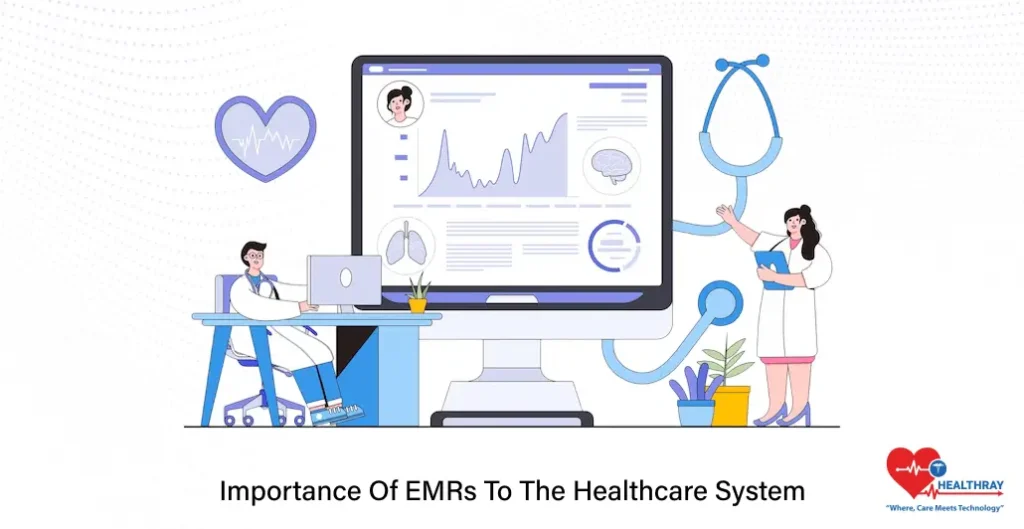
An electronic medical record (EMR) presents information in a way that is more physician-patient-friendly than difficult-to-copy medical records. For example, information on different diseases is shown in an EMR as pie charts and charts.
EMRs help most times less than the otherwise needed paper records tracking across multiple clinics, opening up floor space for local workflow issues while being energy efficient and cost-saving while promoting communication with laboratories and external agencies.
EMRs help patients as well because they, too, give the patients access to medical information that can be followed over some time with great accuracy. EMRs also give the patients power to make better choices on the basis of their medical information while enhancing their confidentiality and privacy with respect to their health records.
Reason to Use Electronic Medical Records
Fewer Errors
Fewer mistakes are the most significant advantage of using EMRs in tracking the patient’s wellbeing. Using electronic record keeping, health professionals are lowering the chances of mistakes associated with manual medical record keeping.
EMRs assure the accurate and very careful patient information recording with standardized formats and programmed prompts. It minimizes the chance of wrong interpretation, illegible handwriting, and missing documents ,all these major issues handwritten frameworks.
Furthermore, EMRs facilitate interprofessional communication among multiple healthcare providers involved in a patient’s care. Time-sensitive decisions made with up-to-date medical information are a hallmark of improved quality and efficiency in health delivery.
Furthermore, Electronic Medical Records allow decision support tools, such as alerts for drug intelligence or reminders for preventive check-up, to be integrated to further strengthen patient safety and outcomes. Conversion of paper records into electronic medical records advances the provision of patient-centered care and enhances physician satisfaction with requests by reducing unnecessary administrative processes and significantly minimizing error chances.
Education
Patient instruction depends on electronic medical records or EMRs, which are potentially critical interventions for managing proactive health care and informed decision-making. Patients’ involvement in the process of health management is active when they have electronic access to their medical records, such as test results, treatment plans, and pharmaceutical histories.
EMRs provide that access, presenting patients with detailed information that guides them in understanding their infections, available medications, and preventive measures. It becomes easy for patients, physicians, and healthcare professionals to communicate. Accurate descriptions of diagnosis, medicines, and aftercare instructions all receive enhanced communication.
Patients comprehend better medical information and remember it. They have access to these records whenever it is convenient for them, as there is no need to obtain a court order for patient education because electronic medical records (EMRs) should feature external links and materials as frequently as possible and include reliable health websites.
The adoption of electronic medical records software promotes patient empowerment and involvement, fosters a team approach to healthcare, and eventually improves the health outcome of the patients.
Security
Electronic medical records (EMRs) have unparalleled security features making them the best conventional medical record alternative in monitoring the health status of a patient and diseases. Paper-based medical records, which are lost, burnt, or penetrated by unauthorized persons, need to be replaced because they have strong encryption methods and access controls to safeguard private patient information.
The best EMR software come with stringent internal security measures for compliance with security laws and generally applicable federal laws like HIPAA (Health Insurance Portability and Accountability Act). Authorized healthcare masters are given access to electronic records. Audit trails ensure that all patient data access is traceable as to who did it and when.
Moreover, EMRs make disaster recovery and backup possible. They safeguard against unexpected calamities, such as cyberattacks or natural calamities since loss of data usually takes place due to these events. The continuation of benefits is notwithstanding the patient’s secrecy and judgment. They do this by keeping patient information in secure advanced settings.
Patients are, in general, more trusting adult patients and confident because generally, they are older. The advancement in security provided by EMRs gives them peace of mind and assures them that their medical records are safe from intrusions or breaches.
Data Interchange
An electronic medical record system has numerous advantages. These involve the monitoring of patients’ states of health and having access to real-time data through the EMR for effective communication among healthcare providers and other practitioners. This way, one can also link practitioners to call upon one another via fields and regions.
It guarantees that all parties concerned have easy access to real-time data that is current. This includes the patient’s medical history, test results, medications, and much better care delivery. Above that, secure sharing is easily possible with the EMR software, which helps with the care process while setting up transition cases like referrals or hospital admissions.
With electronic medical records comes a good view for authorized healthcare professionals on adult patients and vital information. This leads toward more appropriate diagnoses, better decisions, and fewer medical errors. Patient engagement in EMRs can also be provided by allowing them unique access to their health records.
Patients can quickly navigate through
- Medical history,
- Lab results,
- Prescriptions,
- Treatment plans.
Thus, practically speaking, patients may make some healthcare choices based on the correct information. Interoperability hence becomes an excellent case for the use of EMR systems to monitor patients’ welfare.
Greater efficiency and cost savings
When regarding greater efficiency and cost savings, EMR kicks in. It’s a unique benefit that makes it a worthy asset for following the assistance of patients and their health care providers.
First, EMRs were introduced to online, automated processes of different administrative tasks, for example, appointment scheduling and billing and medication administration. This relieves administrative loads on staff members, who instead would spend more time in patient care.
Also, EMRs eliminate the usage of paper records, saving on space taken up by hard copies and physical storage, reducing costs on maintenance and printing. While on the contrary, Electronic medical record files are easily accessed from various locations, thereby reducing the amount of time spent on menial tasks exchanging paper files.
Furthermore, EMRs provide data analysis and reporting that lets healthcare providers and organizations study trends, monitor outcomes, and enhance the quality of care. Through data analytics and reporting, healthcare providers can optimize resource allocation, prevent unnecessary lab tests and procedures, and save costs alongside improving patient outcomes.
Among every other system EMRs are best because they guarantee higher productivity and costs savings. With that, it is an excellent tool for tracking a patient’s wellness.
Healthray’s EMR\EHR Solutions are the best!
Are you anxious to begin your journey in healthcare with utmost excellence? Healthray is always there to help you. Being the world’s leading EMR and EHR represented as leaders in all around-the-world technology, fine standards for innovations, and reliability.
One of the EMRs\EHRs out there, ours, is not software alone; it is very much a culmination of research, developments, and experts’ feedback. State-of-the-art features help Healthray streamline workflows with outstanding efficiency while improving patient outcomes.
What sets Healthray apart from other electronic medical record providers is our commitment to delivering the best solutions to the overall industry. We are aware of the issues that face healthcare today, which the platforms we have aptly solve while providing excellent care.
Elevated performance in healthcare management systems would be: Healthray electronic medical records. Join the impressive list of prosperous practitioners who have turned to Healthray to help get your practice soaring higher than it has ever been. Discover all the opportunities at Healthray for your practice.
Conclusion
If you’re thinking about deciding on using electronic medical records for tracking a patient’s health, you’re doing just right. This is actually revolutionizing the way in which better patient outcomes are delivered. There is a very wide range of benefits to be gained from EMRs, such as sharing information among providers, cost-effectiveness and reliability of patient data. Thus, patient engagement through convenience could be one powerful reason for using EMR.
Also, EMRs would introduce streamlined administration tasks, reduce operational costs, and help for better and informed decision-making through good data analysis. Using EMRs, healthcare could improve care, coordinate, and dehumanize the occurrence of erroneous delivery of medical treatment with time, hence improving quality.
It is the necessity and importance for the today’s world which has been transformed into rapidly changing health care for the whole world to embrace the use of electronic medical records. Besides their requirement, EMRs can also be a great factor for maintaining a competitive record and providing the most appropriate and effective diagnosis and treatment. Health experts may also use EMRs to revamp patient care and influence medical progressions.