

Quick Summary
Electronic health record systems are the modern innovation in healthcare that has digitized medical tasks. It is the best healthcare management software because it manages hospital activities and minimizes the stress of senior managers. Moreover, EHR systems for hospitals have several advantages, such as electronic test results, imaging diagnosis, online prescribing, effective clinical decision-making, decreased medical expenses, healthcare data management and saving potential time.
Introduction
Electronic health records systems are an advanced medical technology that increases healthcare efficiency. Moreover, this technology creates a marvelous effect on healthcare facilities and helps in spending more time on patient care.
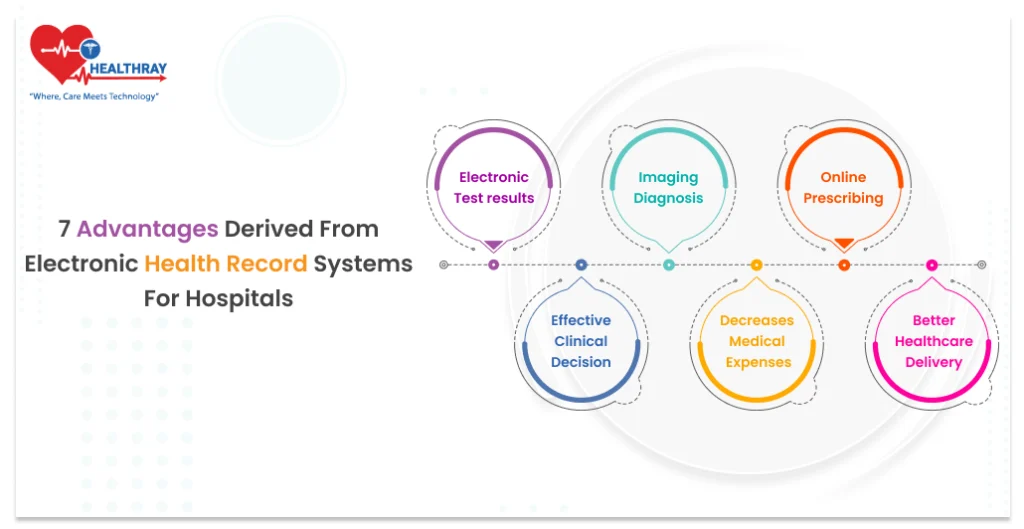
Moreover, the seven advantages of EHR systems for hospitals are: online prescribing, imaging diagnosis, electronic test results, effective clinical decision-making, decreased medical expenses, healthcare data management and saving potential time.
EHR systems for hospitals maintained comprehensive patient records, such as patients’ medical histories, appointment details, medication records and lab test reports. Furthermore, it can include more patients’ records, as it mainly depends on the medical case.
Not limited to patient records, EHR software administers entire hospital records along with adherence to security regulations. Additionally, it mitigates the conflicting situation among healthcare staff, and this software is more effective in urgent care.
What is The Meaning of EHR Systems?
Electronic health record (EHR) systems maintain medical information and help rapidly conduct healthcare tasks. Moreover, this software is accepted by each type of healthcare organization, whether it is large-scale or small-scale.
This solution has enormous capacity to administer large sets of healthcare and patient data. Therefore, it improves patient facilities. Furthermore, Healthray’s electronic medical records have the comprehensive features to do the hospital work faster and the tasks simpler.
Some EHR systems for hospitals have AI-enabled functionalities, like Healthray. Furthermore, this platform has incompatible features such as a cloud-based system, ICD-10 code support, an interactive interface, integration with medical systems, imaging integration and having EDD/EGA formulae.
Key Importance of EHR Systems in Healthcare
Electronic health record systems in healthcare provide that high level of contentment to healthcare providers and patients that is difficult to get with other medical facilities. Moreover, EHR systems for hospitals help to expand medical facilities and reach those areas where it is difficult to receive the best healthcare treatment. Review the key importance of EHR systems in healthcare:
Administers medical data
Smart systems ease the process of collecting and organizing a large amount of data. Furthermore, this data includes patient records along with medical history, treatment notes, vendor information, test results, prescription records and medical personnel information.
Maintaining medical data is crucial because this information is moved from one department to another department. Furthermore, it makes the payer’s tasks easier as all records are well-maintained and simpler to share with third parties, whether they are government agencies or insurance companies.
Consolidated healthcare data has several advantages, such as quicker claim processing, simplifying finding the needed medical information, and efficiently conducting day-to-day healthcare activities. Additionally, it improves the medical record-keeping system and saves ample storage space.
Improve healthcare systems
Healthcare systems are almost revamped in many healthcare organizations. Furthermore, they select the latest medical technologies to transform the medical scenario, like Healthray. EHR systems for hospitals provide healthcare services to those locations where medical accessibility is impossible. Also, Improving healthcare systems has other advantages, such as:
- Simplify to follow medical guidelines
- Enhances independent medical practices
- Properly administers healthcare finances
- Decreased the cyber attacking risks
- Improving medical workflow
Facilitates ambulatory services
- Ambulatory care refers to the process of consulting patients Virtually. Consequently, it eradicates the need to visit the healthcare organization.
- EHR systems facilitate a great opportunity for healthcare providers to increase their monthly income without any additional investment.
- This software has several reasons to provide ambulatory services, including online patient scheduling, digital registration of patients, collecting medical records and video consultation.
- Study shows that more than 80% of patients are likely to use remote consultation platforms to book medical appointments, and entire hospitals can benefit from electronic medical record software.
Precise medical billing
Want to simplify the administration of a financial transaction? Implement Healthray, the top EHR software for individual medical specialists. It helps to reduce mistakes while billing and supports in following the standardized billing format. Precise medical billing has numerous benefits, including :
- Speed up the reimbursement process
- Adherence to billing guidelines
- Reduces discording situations with payers
- Fast work on the claim denial process
- Compiling the billing transaction for creating a medical budget.
Step towards digital era with our healthcare solution
Revamp your hospital facilities and embrace change for better healthcare management. Ease in managing and organizing large medical datasets leads to effective analysis. Seize the opportunity now!
7 Advantages Derived from Electronic Health Record Systems For Hospitals
EHR adoption provides relief to healthcare professionals in many tasks. Moreover, it has several features, such as electronic medical documentation, population health management, patient record management and revenue cycle management. Electronic health systems for hospitals have numerous advantages, such as:
E-test reports
A short medical work can consume a lot of time and expenses. Moreover, approximately 3–4 rounds are generally taken by patients for small tests. Therefore, it is required to adopt EHR solutions to expedite the lab process, reduce patients’ costs, and reduce their loss in business while spending their time on medical treatment. Digital test reports offer unique advantages, such as:
- Improve healthcare data
- Eliminates the waiting line for receiving test reports
- Simplify to embed with the healthcare system
- Send reports to other healthcare providers
- A time-efficient platform for hospitals
Digital Imaging diagnosis
Online Imaging diagnosis removes the complicated procedure of making radiology films. Therefore, it simplifies the process and saves an extensive amount of medical expenses.
Mainly, the healthcare costs, including chemical procurement and radiology instruments, requires space for placing radiology reports, manpower expenses, and the disposal of the radiology reports in the desired manner.
On the other hand, digital imaging diagnosis follows some easy steps to produce radiology images. Firstly, taking images of particular areas that have some medical issues through some equipment.
After that, it enhances image clarity through an equipped instrument. Then, they used electronic sensors to record the radiology images and finally, reports were prepared in digital format. Also, it helps in reducing medical errors.
Tele-prescription
- With Healthray’s electronic health records software, it is easy to get medical assistance from your home and consult with a digital provider anytime through messaging or video calling.
- It works in any situation, whether it is an emergency or mild cold or minor injury. Moreover, this cloud based ehr system has profound functionalities that mitigate patient and medical costs.
- EHR makes the treatment faster and simpler. Moreover, it solves many healthcare challenges that can’t be done through with other medical facilities.
Effective clinical decision
Clinical decisions need some soft and technical skill-set that requires a great platform, where numerous healthcare providers can communicate without any obstacle. We found Healthray, the leading EHR platform, that is an all-in-one weapon for hospital challenges.
Electronic health records for patients assimilate data in a systematic way and prepare comprehensive reports in a single dashboard. Therefore, support in making clinical decisions.
Decreases medical costs
Electronic health records is the encompassing solution to mitigate healthcare and patient expenses. Moreover, improving patient flow and reducing administrative costs is the essential one to mitigate overall hospital costs. The several ways to decreases medical costs are :
- Properly managed administrative department
- Timely filing income-tax return
- Effectively assigning medical tasks
- Improving revenue cycle management
- Proper hospital accountancy.
On the other hand, patients can save their medical expenses by eliminating duplicate tests and decreasing in-person visit costs. Therefore, implementing EMR systems is the leading option for hospitals to reduce costs.
Better healthcare delivery
Better healthcare delivery requires properly managed healthcare components such as patients, healthcare resources, healthcare provider, data healthcare management and medical supplies. Moreover, explore ways to get better healthcare delivery :
- Integrate patient portal for enhancing their satisfaction
- Efficiently manages clinical data
- Ambulatory care settings
- Improves healthcare employee contentment. Therefore, it reduces turnover rate.
- Enhances patient outcomes by providing accurate treatment.
Time-efficient platform
EHR systems for hospitals have profound capability to save medical employees and patient’s time. Furthermore, it includes various features that help increase the speed of medical tasks. Demonstrating some ways of EHR systems that save medical time :
- Speed up the reimbursement procedure
- Automate daily medical tasks
- Optimizes clinical workflow
- Improves medical documentation process
- Persistently follows medical guidelines.
Conclusion
EHR systems for hospitals manage healthcare tasks in a more advanced way. Furthermore, this software platform has seven major advantages such as electronic test reports, digital imaging diagnosis, effective clinical decision, decreased medical costs, better healthcare delivery and time-efficient platform. Consequently, it mitigates overall healthcare costs, reduces the patient’s health risks and quickly solves complicated medical cases.