



Summary
Clinics deal with patient crowds and lengthy lines on a daily basis. Patients are kept waiting for hours, and staff members are panicked, which adds to doctors’ workloads and stress. This daily confusion impacts care quality and clinic growth. Doctor queue management systems efficiently resolve all the problems of clinics. It organizes the patient flow, manages doctor availability and provides real-time updates on the same screen. Clinics that use doctor queue management software have shorter wait times and happier employees, and doctors are more focused on patient care. Long waiting times are not just an inconvenience; they directly impact patient satisfaction and hospital reputation. Keep reading!!!
Introduction
The biggest challenge for hospitals and clinics is long waiting times. To see their specialist, patients arrive early, pick up tokens, and stand in line for hours. Sometimes, emergency cases arise, doctors are late, and the entire OPD system becomes sluggish. Result? Patients get annoyed, staff works under pressure, and doctors feel stress. This daily chaos not only impacts patient experience but also hampers clinic growth. What happens if lengthy wait times are shortened and patient flow becomes seamless?
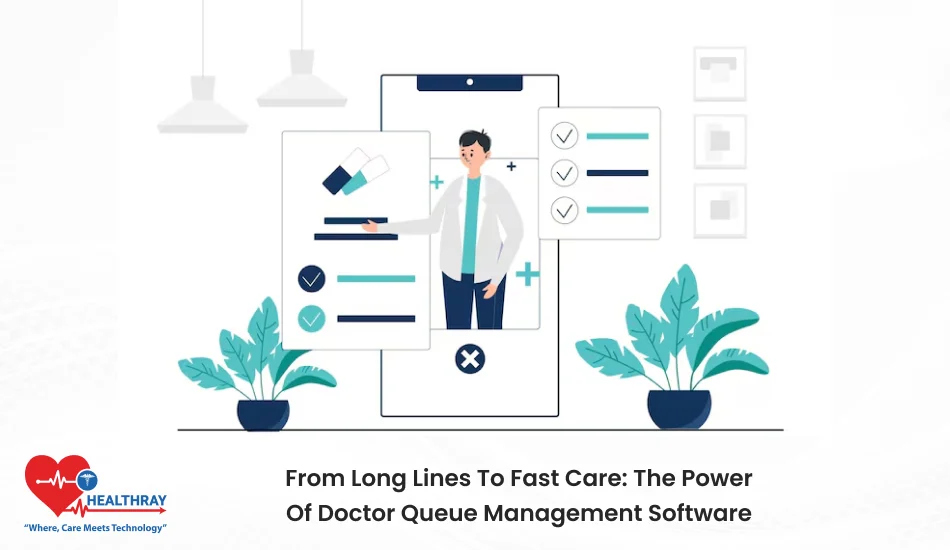
This is possible with doctor queue management software. Doctor appointment system manages patients in proper sequence, sets the queue as per doctor availability and provides real-time updates. This not only reduces waiting time but also minimizes unnecessary work pressure on staff. Clinics can move from guessing to planning mode with the aid of doctor queue management software. Clinics can clearly determine patient arrival, next patints and delay status. Also, patients get transparency, helping clinics establish strong relations of confidence with them. Keep reading this blog to understand how doctor queue management software turns long lines into fast care. Also, we will discuss how clinic software makes the OPD operations smooth, organised and stress-free.
The Problem: Long Queues and Lost Efficiency
Long wait times are not just an inconvenience. Furthermore, it directly impacts patient satisfaction and hospital reputation. According to a study, 60% of patients find lengthy wait times can be a frustrating aspect of their medical visit. Along with frustration, these queues create administration chaos as well. Common Queue-Related Issues:
Crowded Waiting Areas
Overlapping appointments or walk-in patients cause hindrance in waiting areas. Furthermore, it makes the entire system slow and creates bottlenecks. Moreover, it enhances the workloads at the front desk and it becomes difficult for admin departments to pay attention to every patient.
Poor Communication
Patients are unaware of their turn. Further, staff have to constantly handle call-outs and queries, thus wasting considerable time. Moreover, lack of communication makes the workflows unclear and ambiguous and creates confusion and chaos.
Doctor Time Mismanagement
Doctor time mismanagement disrupts the opd workflows. Further, sometimes clinics face unnecessary gaps; sometimes overbooked slots put the doctors in rush mode, consultation quality get drops and overall efficacy of clinics slows down. Additionally, Opd appointment management system can easily fix this imbalance.
Patient Dropout
Due to long wait times, the majority of patients leave clinics before consultation. They anticipate that their turn will arrive later. Further, this wastes the appointment slots and hampers the clinic’s image in the market. Also, it impacts revenue cycles, as patients are the crucial asset of the hospital’s revenue system. A disgruntled patient will lower productivity and, eventually, revenue.
The Hidden Impact on Healthcare Providers

In this environment, clinics face
- Revenue loss
- Patient dissatisfaction and certainty
- High stress level.
Crowd control has become more crucial since the COVID-19 pandemic. This enhances the need for doctor appointment booking software for clinics.
Enter the Doctor Queue Management Software
Doctor queue management software is a digital-first system that can efficiently handle patient queues in clinics, hospitals, and diagnostic centers. Further, it replaces manual registration or paper-token systems and provides fully automated queue flow. It centralizes all the daily operations of clinic appointment scheduling, digital check-ins, notifications, and doctor availability tracking and helps staff access the clinic’s operation instantly.
How Digital Queues Replace Physical Lines
Doctor queue management software eliminates the need to stand in a long queue. Further, patients are added to the digital queue. Furthermore, this helps staff or patients easily access their consultation time through display screens, mobile apps, or SMS updates. Also, healthcare appointment software can easily integrate with EHR or HMS to keep the records or coordination in alignment with the workflow and ensure that everything runs smoothly.
Experiences That Completely Transform
- Patient Experience: Patient experience becomes completely faster, smoother, and transparent. Furthermore, patients receive clear conversations regarding their turns.
- Staff Experience: Clinic software reduces and makes the daily procedures more organized.
- Doctor Experience: With healthcare appointment software, doctors get time-efficient and predictable schedules. This makes the consultation fast, efficient and higher quality.
How Queue Management Software Transforms Patient Experience
The waiting area is where a patient forms their initial opinion of your clinic. Further, when waiting time whether it’s actual or perceived gets minimized, patient satisfaction naturally gets a boost. How does digital queue management software improve patients’ experience? Let’s figure out:
Faster Service Delivery
Doctor queue management software accurately structures the patient flow. Furthermore, it helps hospitals serve more patients in a single day without creating anarchy at the front desk. Front desk team, rather han indulging in managing crowds, responds to patients calmly.
Step towards digital era with our healthcare solution
Revamp your hospital facilities and embrace change for better healthcare management. Ease in managing and organizing large medical datasets leads to effective analysis. Seize the opportunity now!
Reduced Anxiety and Frustration
Real-time updates grant trust and reassurance to patients. Additionally, it removes the need to repeatedly inquire about “how much more time I need to wait.” Moreover, the system is fair and transparent and clearly displays the exact time of doctor consultation. Thus, it minimizes wait times and disturbances at the front desks.
Contactless and Safe Interaction
In this post-pandemic world, it is crucial for clinics to combat overcrowded situations. Furthermore, queue management software provides remote check-in, mobile-based tokens, and contactless processes. Moreover, it creates a secure environment, as every step into medical practices is transparent and adheres to compliance. Thus, it expedites the treatment procedures and enables clinics to thoroughly analyze the patient symptoms.
Personalized Communication
Queue management software provides a personal touch and updates to the patient. Further, patients get turn alerts, reminders, and follow-up messages automatically on their devices. Plus, clinicians’ software helps patients remain aware and also minimize confusion in their healthcare journey. Overall, it provides a smooth and connected experience to patients.
Healthcare Administration and ROI Impact
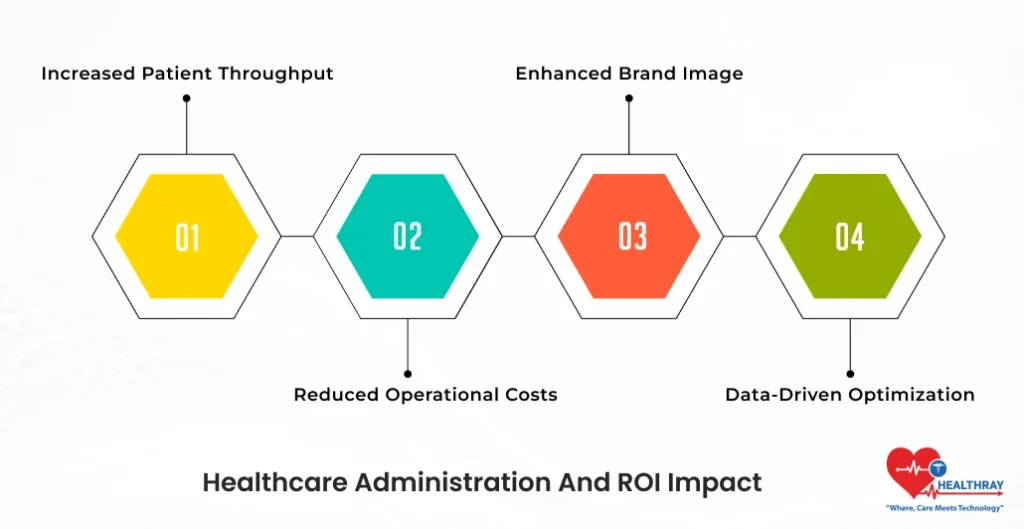
Beyond just convenience, queue management software directly influences financial or administrative matters. If it’s implemented correctly, then it will greatly raise overall efficiency, revenue, and patient service quality.
Increased Patient Throughput
Digital queues streamline delivery. Further, it helps clinics serve more patients in a day. If clinics become capable of serving an extra 10%, then they can contribute considerable growth in monthly revenues without paying for extra staff and infrastructure.
Reduced Operational Costs
Automation reduces the load of manual coordination. Furthermore, it helps staff minimize time wastage on token handling, calling, and crowd control. Moreover, it naturally reduces administrative overhead and frees up more productive time for the team.
Enhanced Brand Image
These days fast and organized care is highly imperative for a patient’s healthcare journey. Further, clinics that are adept at minimizing their waiting time get higher-quality reviews and get trustworthy credibility. Also, it makes the clinic’s local visibility strong without the need of investing in a heavy marketing budget.
Data-Driven Optimization
Analytics provides clear insights to clinics on hidden patterns. In the traditional system, doctors are incapable of determining the patient volume. Further, doctor queue management software helps clinics determine which clinics have the longest queues and which doctors get overbooked.
 PRO TIP
Integration with Digital Health Ecosystems
These days, doctor queue systems do not work in isolated environments. Further, it is a part of a big digital queue system, where all team members work on the same page.
- EHR & HMS platforms: All patient information, including appointments and medical history, is encrypted when EHR and HMS merge into a single platform.
- Telemedicine modules: The system creates a virtual queue for online consultation. Patients can sit anywhere and receive the precise time of their doctor’s consultation.
- Billing & EMR systems: The System synchronises appointment, billing, reports, and patient records. This minimizes the stress of manual errors in the work processes.
- AI-powered analytics: This system predicts the future just like a smart assistant. It can easily determine high patient volume scenarios, doctors’ availability, and which slots occupy more load. This helps clinics make tangible decisions based on the insights.
The Role of AI and Automation in Queue Management.
These days next-gen queue management systems use AI and predictive analytics and proactively handle the medical operations. Further, AI works like an intelligent assistant and resolves the problems without delay. Many hospitals are now integrating an AI voice agent in healthcare to improve patient communication, automate updates, and streamline appointment coordination.
- Predictive queue length forecasting: The system can easily calculate the waiting time depending on patient traffic and doctor efficiency.
- Automated load balancing: The system automatically predicts the workloads on doctors and based on that, AI agents automatically shift the patients to assigned doctors and departments.
- Dynamic token generation: The system prioritizes emergency or critical patients and automatically raises their token.
- Voice-enabled updates: Voice assistants or digital screens provide real-time updates. Further, this expedites the communication flow and makes it more clear and transparent.
AI makes it possible for hospitals to move from a reactive to a more proactive mode, where the clinic’s attention is diverted from managing lines to strategically planning patient flow.
 NOTE
NOTE
Conclusion
The shift from long lines to smooth, hassle-free care is not just a tech upgrade. It transforms the approaches of medical practices. Doctor queue management software is a perfect combination of efficiency, empathy and innovation.
By adopting this system, healthcare providers get faster patient turnover, more patient satisfaction, better staff productivity, and a safe clinical environment. For patients, it means less waiting and more healing. In the modern age of healthcare, time isn’t just money it’s comfort, safety, and trust.